
The Cabinet’s approval to restart the Kiwul Oya Reservoir Project has brought renewed attention to unresolved questions of land, development, and governance in Sri Lanka’s Northern and Eastern Provinces.
Initially launched in 2011 to address water shortages in Vavuniya and Mullaitivu, the project was suspended in late 2023 amid economic pressures. It is now expected to resume between 2026 and 2031, funded through domestic resources, with projected costs rising sharply from Rs. 4,170 million to Rs. 23,456 million.
While officially presented as a necessary intervention to improve water security, the project has generated strong opposition among local communities, particularly Tamils in the North and East, who view it as politically consequential rather than technically neutral.
Central to these concerns is the perception that the reservoir project will reinforce the Weli Oya settlement scheme, an area historically known to Tamils as Manalaaru.
For affected communities, the project is not an isolated infrastructure initiative but part of a broader historical pattern in which development has facilitated demographic change and territorial consolidation.
This history shapes contemporary responses: opposition is driven less by resistance to development itself than by fear of further land alienation and the erosion of long-standing community presence.
In this context, development is understood as an instrument of power, capable of reshaping space, identity, and political authority. The vulnerability of ancestral lands and traditional habitats remains one of the most pressing concerns for Tamil and Muslim communities in Sri Lanka’s Northern and Eastern Provinces.
Land is inseparable from livelihood, cultural continuity, and political recognition, particularly in post-war contexts where displacement and dispossession remain recent memories. The continued marginalisation of land rights has intensified anxieties around loss of identity, environmental degradation, and the long-term sustainability of community life.
Without addressing these structural issues, development interventions risk deepening grievances rather than resolving them. Protecting Sri Lanka’s fragile border regions therefore requires more than sector-specific infrastructure projects.
It demands a coordinated development approach that prioritises local well-being, ecological protection, community-led land management, and long-term sustainability. Secure land rights and locally accountable governance are essential to achieving stability. Yet provincial governance structures have struggled to fulfil this role.
Although provincial councils were established to decentralise authority and protect regional interests, their capacity to meaningfully intervene in land governance and development planning has been limited. As a result, settlement expansion, land acquisition, and environmental intrusion have continued with insufficient oversight, particularly in border areas of the Northern Province.
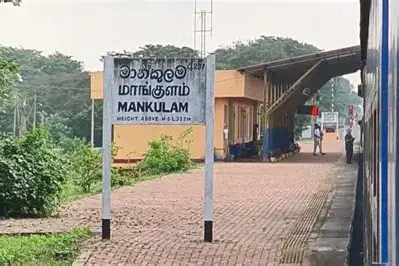
It is within this broader context that Mankulam assumes critical strategic importance. Situated in the Oddusuddan Divisional Secretariat of Mullaitivu District, Mankulam occupies a central position within the Northern Province. Historically, it functioned as a key node in the Wanni’s forest economy, facilitating trade, movement, and livelihoods across a wide geographical area. Today, it remains a vital point of connectivity between the Northern and Eastern Provinces and a strategic junction linking Jaffna, Kilinochchi, Mullaitivu, and Vavuniya.
Mankulam’s significance is reinforced by its infrastructure. The A9 highway and the North-South railway line pass directly through the town, connecting the northernmost regions of the country to the south. The A34 highway links Mankulam to the eastern coastal areas, further consolidating its role as a transport and logistical hub. These routes have long made Mankulam a focal point for movement, administration, and control.
Its geographic position has translated into political and strategic influence, including during the civil war, when it held military importance for both the Sri Lankan Army and the LTTE. Control over Mankulam has historically enabled influence over the wider Wanni region and access to the Jaffna Peninsula, showcasing its enduring relevance.
Despite this, Mankulam is often framed as a peripheral town rather than a central strategic asset. This framing obscures its function as a gateway linking all five districts of the Northern Province and as a critical connector for geographically isolated and disadvantaged areas (GIDA). Many of these areas face growing vulnerability, including intrusion into water infrastructure, internal depopulation, and the gradual dispossession of land. Without a coherent administrative and political framework centred on Mankulam, these pressures are likely to intensify. Recognition of Mankulam’s importance is not new.
In July 2008, the Cabinet approved relocating the Northern Provincial Council to Mankulam, a decision later reinforced by its designation under the Urban Development Authority and subsequent approvals by the Northern Provincial Council. A long-term development plan was prepared to establish a modern administrative city capable of balancing economic growth with social needs. The strategy envisages strengthening provincial administration, attracting diverse industries through a large-scale industrial park, providing housing across income groups, and allocating space for education, research, tourism, and recreation.
Crucially, the plan also emphasizes environmental protection, with more than half of the proposed development area designated as forest. The role of UDA must be complementary, supporting the Northern province’s aspirations and needs, primarily by empowering local governments to develop their physical infrastructure.
The development strategy is guided by principles intended to avoid the pitfalls of uneven urban expansion. These include adopting a polycentric urban model, integrating existing communities rather than displacing them, conserving agricultural land, and implementing development in phases to ensure long-term sustainability. Initial survey work has already been completed, and international financing has been considered to support early stages of implementation.
The stated objective is to create a balanced and sustainable urban centre capable of supporting the administrative and developmental needs of the Northern Province.
Notably, even during the war, Mankulam was identified as a development hub. The LTTE’s development wing initiated projects aimed at protecting ecological resources, including forest expansion initiatives such as the development of the Vadamunai Forest. This history illustrates that Mankulam’s environmental and strategic value has long been recognised, irrespective of the governing authority.
Development in this area has never been incidental; it has always been politically and territorially significant. Looking ahead, the challenge lies not in justifying development in Mankulam, but in defining its purpose and governance. While Jaffna’s cultural significance remains undisputed, the concentration of administrative and economic activity there has contributed to the neglect of other districts within the Northern Province.
Addressing this imbalance requires an innovative and inclusive development approach that strengthens regional governance rather than centralising power further.
Recent emphasis by the Governor of the Northern Province on improving transport infrastructure in Mankulam represents a positive step. Improved connectivity can enhance economic opportunity and service delivery. However, infrastructure alone is insufficient. Without a clear political and administrative vision, development risks reinforcing existing inequalities and vulnerabilities. What is required is a coherent strategy that positions Mankulam as an empowered administrative centre, potentially as the provincial capital, capable of coordinating development, safeguarding land rights, and directing state attention toward fragile border regions.
If post-war development in the Northern Province is to contribute to long-term stability rather than renewed contestation, it must be grounded in territorial sensitivity, community protection, and accountable governance.
Mankulam represents a critical test case. Its future development will signal whether reconstruction efforts can move beyond technocratic infrastructure provision toward a genuinely inclusive and protective model of governance that secures land, livelihoods, and identity for marginalised communities.