
Despite the ongoing war in the Middle East and the resulting global economic crisis, the Tamil Nadu Legislative Assembly election remains a notable focal point for Sri Lankan Tamils.
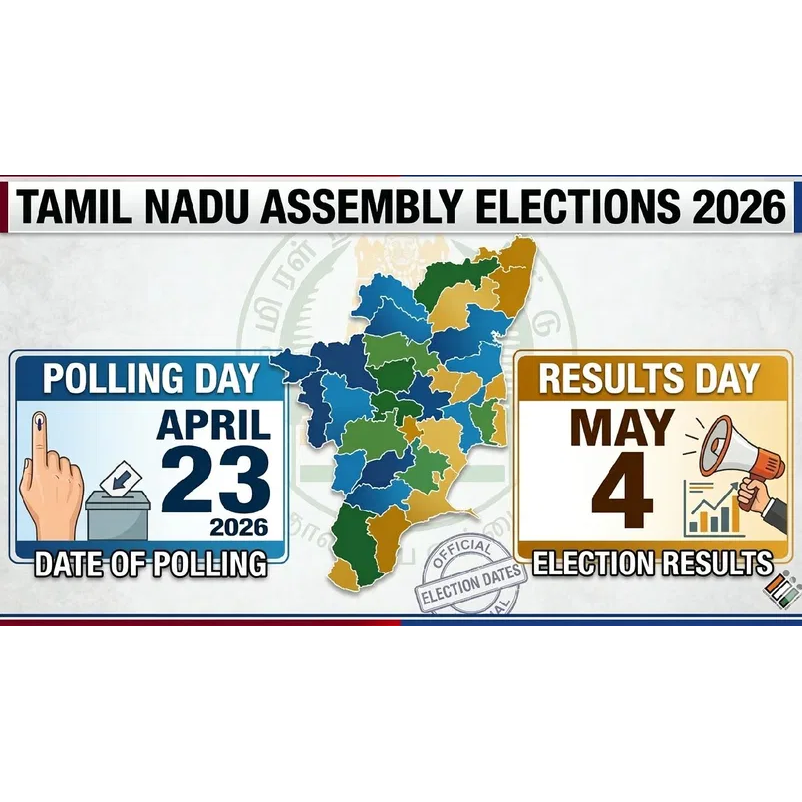
The Election Commission of India has announced that polling will take place on April 23, with the counting of votes scheduled for May 4. This election is particularly being observed for three primary reasons.
In its entire history, the ruling Dravida Munnetra Kazhagam (DMK) has never won back-to-back elections to form a government in the state. This election will determine whether the son, M.K. Stalin, can achieve what his father, Kalaignar Karunaididhi, could not. Notably, the DMK is contesting this time, leading an unprecedented coalition of 24 parties.
The All India Anna Dravida Munnetra Kazhagam (AIADMK), which ruled Tamil Nadu several times under the charismatic leadership of M.G. Ramachandran (MGR) and J. Jayalalithaa, icons who shone in both cinema and politics, faces a critical test.
The second question is how long the party can remain an influential political force in the absence of such magnetic leaders. The AIADMK’s electoral performance, while in alliance with the Bharatiya Janata Party (BJP), is expected to provide the answer.
The third question concerns the entry of actor Joseph Vijay’s party, Tamizhaga Vettri Kazhagam (TVK), and the shift it will cause in Tamil Nadu’s political landscape.
Recent history in Tamil Nadu offers many examples, showing that not every actor who jumps into politics relying on ‘fan power’ can become another MGR. Great acting talent does not guarantee a successful political career, as evidenced by Sivaji Ganesan and Kamal Haasan. Conversely, it cannot be said that actors who succeeded in politics were always the finest performers in cinema.
However, it is no longer possible to dismiss the massive crowds gathering to see Vijay, the latest entry from cinema, as people who won’t translate into votes. The interest shown by major parties like the AIADMK and BJP in forming an alliance with his party is a testament to this.
Unlike MGR, who proved his popular support in a by-election before challenging the ruling party in a general assembly election, Vijay is testing his strength directly in the assembly elections without any prior electoral track record.
Be that as it may, most Indian media outlets predict that this Tamil Nadu Assembly election will be a three-way contest. In a political arena where coalition politics has been the tradition for nearly six decades, the ultimate question remains: Which of the two main Dravidian camps—the DMK-led or AIADMK-led alliances—will benefit from Vijay’s decision to contest alone?