
As Anura Kumara Dissanayake completed two years in office on September 23, 2026 as the ninth executive president of Sri Lanka, extensive discussions and analyses are underway regarding the domestic performance of his NPP government. At the same time, the approach it adopts in foreign affairs has not received sufficient attention.
Given that the JVP, the party that launched two armed insurrections to seize state power in Sri Lankan and maintained a harsh stance against American and Western ‘imperialism’, came to power in a new avatar as the National People’s Power, it is a fascinating topic for political observers to see how it has discarded its former radical doctrines and adopted tactical changes in international relations.
In an environment where domestic policies and foreign affairs are inextricably intertwined, it is essential to examine the government’s performance across both arenas in an integrated manner.
International assistance and cooperation are indispensable for Sri Lanka’s economic recovery. In the country’s current context, domestic economic stability depends heavily on relations with the International Monetary Fund (IMF), the World Bank, and bilateral creditors such as China, India, and Japan.
The government faces severe challenges in balancing the economic relief promises given to the people domestically with the reforms agreed upon with international financial institutions. A suitable foreign policy must be pursued to seamlessly advance debt restructuring agreements and retain the confidence of international investors.
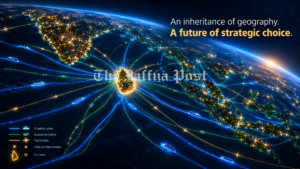
Sri Lanka’s location in the Indian Ocean region has turned the country into a key arena amid competition between superpowers. It is important to evaluate how the government handles the policy of “friendship with all, hostility toward none” and how it navigates the pressures of regional superpowers.
.
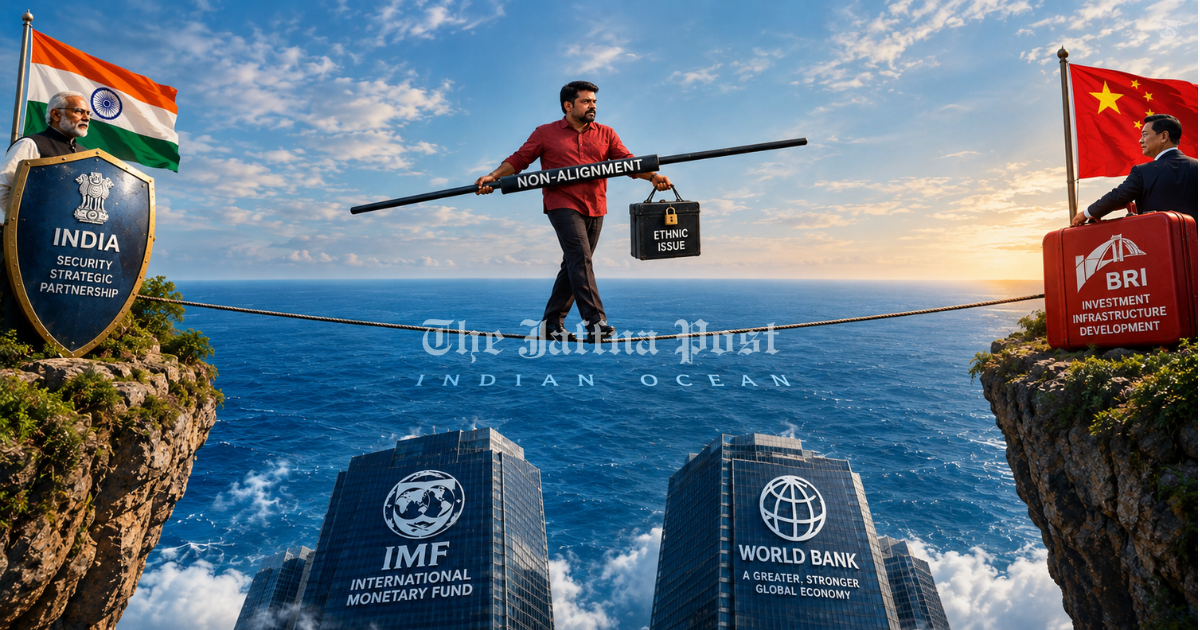
President Dissanayake has repeatedly emphasized that Sri Lanka will pursue a non-aligned policy of maintaining friendly relations with all nations without getting trapped in power struggles among superpowers like the United States, China, and India. He has also stated that his government will follow an independent and neutral foreign policy that protects Sri Lanka’s sovereignty and stability without yielding to the dominance of any foreign country. In addition, he has also stated that Sri Lanka will under no circumstances compromise its neutrality during international conflicts and regional disputes.
While maintaining political closeness with China, the JVP historically held a stance against India, our immediate neighbor, calling New Delhi’s strategies in the region ‘Indian expansionism’. However, the transformation displayed by the NPP government which has the same JVP as its main constituent party in abandoning its fierce anti-Indian stance and fostering close relations in its foreign policy demonstrates its adaptation to pragmatic ‘geopolitical realism’.
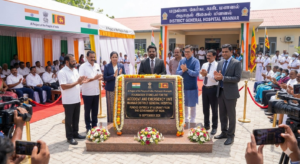
Before being elected to the presidency, Dissanayake visited New Delhi along with key party figures upon an official invitation from the Indian government, and following his assumption of office, he chose India for his first official foreign visit. The NPP government has provided a clear assurance that Sri Lankan soil will never pose a threat to India’s regional security interests.
In line with New Delhi’s ‘Neighborhood First’ policy, economic, security, and energy sector cooperation between the two nations continues seamlessly, more than ever before. Some anticipated that this closeness between India and Sri Lanka might help foster a flexible approach on the part of the NPP regarding the national ethnic issue. However, despite maintaining close diplomatic ties with New Delhi, the NPP government shows no willingness to relax its rigid stance when it comes to the political solution to the ethnic problem and devolution of power.
The government operates in a manner that satisfies the Sinhalese voter base of southern Sri Lanka and the traditional unitarian ideology of the JVP. The government maintains silence regarding India’s persistent demands to swiftly conduct the long-delayed Provincial Council elections and fully implement the 13th Amendment to the Constitution.
President Dissanayake’s government is employing a strategy to avoid New Delhi’s intervention in the ethnic issue by appeasing India’s regional security concerns. It appears New Delhi also understands that Colombo no longer wishes to link the Tamil issue with bilateral affairs between the two countries, and is acting accordingly.
New Delhi, which had long called for the full implementation of the 13th Amendment to fulfill the political aspirations of the Tamil people, has now avoided explicitly naming the ‘13th Amendment’ as a tactical approach, asking instead for the ‘full implementation of the Constitution’. This demonstrates that the Indian government is currently unwilling to adopt an approach that would cause discomfort to President Dissanayake and his administration on the ethnic issue.
At the same time, the NPP government is managing its relations with the United States and Western European nations through an approach centered on the country’s economic and security interests, aligned with present-day geopolitical dynamics.
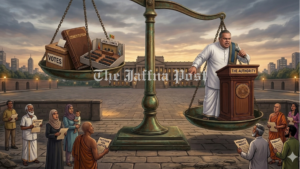
Historically, the Sri Lankan left has maintained a hostility toward the World Bank and the International Monetary Fund (IMF), widely known as the ‘Bretton Woods Twins’. While in the opposition, the NPP revived this hostility by highlighting the hardships experienced by the people as a result of the agreement with the IMF. However, upon assuming power, realizing the practical reality of a country trapped in a severe economic crisis, the NPP chose a path of compromise with international financial institutions and the West.
The Dissanayake administration continues to move forward with the $3 billion Extended Fund Facility (EFF) agreement reached with the IMF by the previous government. At the same time, the government is showing keen interest in renewing trade and investment ties with the United States and European Union countries.
While strengthening relations with India and the United States, the government also maintains its ties with Sri Lanka’s traditional partner, China, smoothly and without any hindrance. Following his visit to India, President Dissanayake paid an official visit to Beijing early last year, ensuring Chinese investments and the uninterrupted progress of debt restructuring efforts. Furthermore, through visits to Asian and Middle Eastern nations such as the United Arab Emirates and Vietnam, he expanded Sri Lanka’s diplomatic opportunities in the Asia-Pacific region.
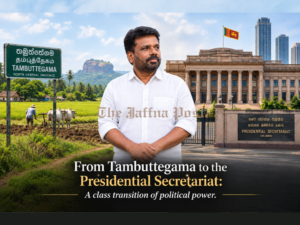
Meanwhile, a major transformation brought about by the NPP government is shattering the long-held class-dominant perception in Sri Lanka that the Ministry of Foreign Affairs could only be handled successfully by the elite class possessing English fluency, Western education, and a traditional bureaucratic background.
By appointing Vijitha Herath, a man of simple demeanor who comes from an ordinary rural background, was educated in the local language, and worked at the grassroots level, as the Minister of Foreign Affairs, the NPP government has demonstrated in practice that the power to shape foreign policy, which was once confined to the Colombo elite, can be taken into the hands of ordinary people’s representatives to guide the country without damaging Sri Lanka’s dignity on the international stage.
It has proven that diplomatic fundamentals rely on dedicated commitment to the nation’s interests and clear dialogue, rather than extravagant English speeches. The foreign policy of Sri Lanka under President Dissanayake’s administration can be briefly defined as ‘a shift away from ideological radicalism toward a pragmatic geopolitical balance’.
It can be said that the government maintains a three-dimensional balance that allays India’s security concerns, secures economic support from the West, and safeguards Chinese investments. However, criticisms are noteworthy in highlighting that creating a neutral path between India and China in geopolitical affairs is no easy task, and attempting to maintain friendly relations simultaneously with India, China, the US, and Western nations will inevitably create many practical contradictions over time.
While the diplomatic balance that the NPP government attempts to maintain currently serves Sri Lanka externally, the primary and legitimate criticism remaining against the government is that this balance is not being utilized to provide a fair political solution to minority communities, particularly the Tamil people, regarding the internal national ethnic problem.