
A warning to Hindu temples and the Tamil diaspora
Hindu temple festivals have always occupied an important place in Tamil religious and cultural life. Across Jaffna, Kilinochchi and other parts of Sri Lanka, as well as in diaspora centres such as Paris and Germany, annual festivals bring families and communities together in prayer.
However, an uncomfortable question must now be asked: Are some of our temple festivals moving away from spirituality and becoming extravagant displays of wealth, status and personal ego?
This year, several celebrations appear to have gone far beyond customary religious observance. Enormous sums are reportedly being spent on fireworks, high-intensity lighting, amplified music, competitive drumming, elaborate decorations and repeated processions. Diaspora sponsors sometimes appear to compete with one another to show who can finance the largest or most spectacular event.
There is nothing wrong with supporting a temple or celebrating a religious tradition. The concern arises when devotion is measured by noise, spectacle and spending, while suffering people remain invisible only a few meters away.
Pandatharippu Was a Serious Warning
This issue is not merely about taste or criticism of extravagance. It has become a matter of public safety.
During a Murugan temple festival in the Pandatharippu area on 20 August 2026, more than 500 people reportedly required treatment after exposure to high-intensity lighting and fireworks. Approximately 400 were treated at Jaffna Teaching Hospital, including 114 children aged between two and twelve. Medical specialists warned that the lighting equipment may have emitted extremely intense light and ultraviolet radiation.
Following the incident, Northern Province Governor N. Vethanayahan and Fisheries Minister R. Chandrasekhar held a high-level meeting on 25 August. Officials agreed to develop local-government by-laws regulating high-intensity lighting, fireworks and other potentially dangerous festival activities. They also acknowledged that existing laws controlling excessive loudspeaker noise are not being properly enforced.
The Pandatharippu incident must not be dismissed as an isolated accident. It demonstrates what can happen when technology, competition and extravagance overtake responsibility.
Festivals Outside – But Emptiness Afterwards

Another contradiction deserves serious reflection. During major festivals, certain temples overflow with crowds. Processions fill the roads and social media is flooded with photographs and videos. Yet, once the festival has ended, some of these same temples receive relatively few worshippers.
This raises an important question: are people attending for spiritual reflection or merely for entertainment, social recognition and public display?
True worship should not exist only during a heavily promoted annual spectacle. A temple must remain a centre of spirituality, service, ethical guidance and community welfare throughout the year.
The contrast is particularly painful around Nallur. While thousands gather for worship, vulnerable people including persons injured during the war and those living with disabilities can sometimes be seen seeking assistance on nearby streets. Many pass them without a second glance.What does it say about our religious priorities if we spend millions on fireworks that disappear within minutes but overlook a disabled person sitting outside the temple?
The Vanni Is Facing a Different Reality
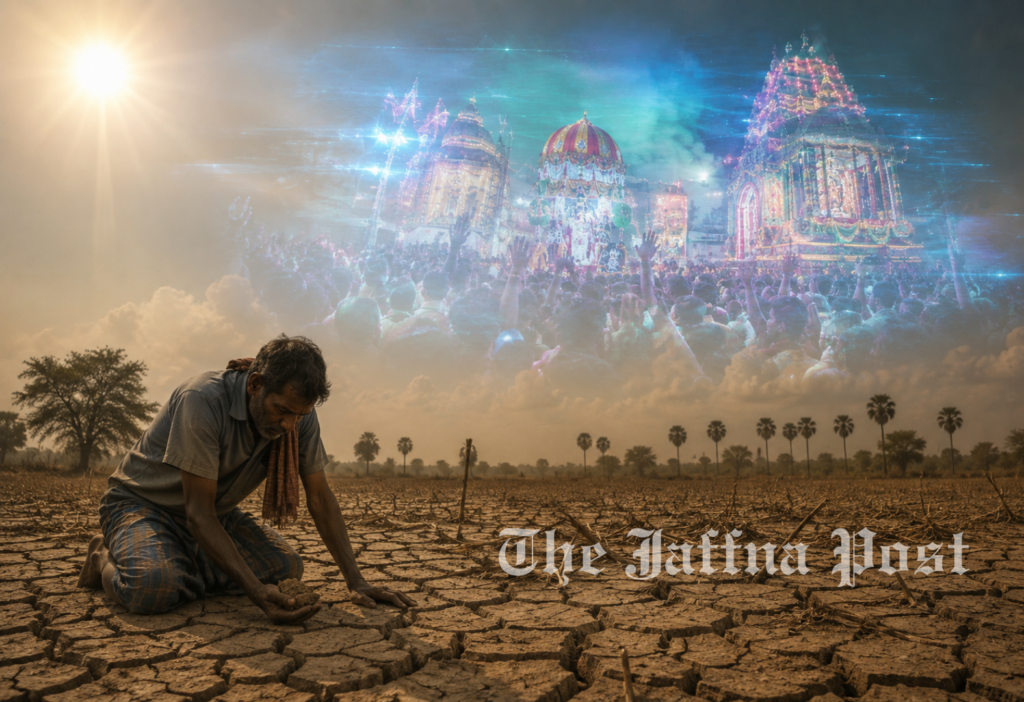
Communities in the Vanni are dealing with intense heat, water shortages and increasing pressure on agriculture. In late August, the Department of Meteorology issued a warm-weather advisory covering Jaffna, Kilinochchi and Mullaitivu. Across Sri Lanka, declining reservoir levels and drought conditions are placing communities and farmers under growing pressure.
Many families in the North are already struggling with the high cost of food, farming inputs, electricity, transportation and education. Farmers fear losing crops and livestock because of inadequate water. War-affected families, widows and persons with disabilities continue to live without stable incomes or adequate housing.
Against this background, spending millions of rupees on temporary decorations, deafening sound systems and fireworks cannot be presented as unquestionable religious service. Imagine if even 25 per cent of every large festival budget were allocated to:
- Drinking-water facilities and agricultural wells
- Support for war widows and persons with disabilities
- School meals, scholarships and educational materials
- Medical treatment and mobility equipment
- Livelihood assistance for farmers and fishing families
- Solar power and permanent community facilities
Such assistance would not diminish the festival. It would give the festival a deeper spiritual purpose.
Paravai Kavadi and Dangerous Forms of Devotion
The increasing frequency of Paravai Kavadi and other extreme bodily practices also requires careful examination. Kavadi has a longstanding place in Murugan worship, and sincere personal vows should be treated respectfully. But respect for tradition does not mean that every modern variation must escape scrutiny.
Practices involving suspension, extensive piercing or other serious physical risks should be subject to medical, safety and age-related controls. They should not become competitive spectacles organised on every street corner or promoted through social media.
God does not require devotees to endanger their lives to prove either faith or wealth. Religious freedom cannot remove the duty of temple administrators and public authorities to protect children, participants and spectators.
Regulation Must Begin Immediately
The Governor’s decision to pursue by-laws is welcome, but announcements alone are insufficient. The Northern Provincial administration, local councils, police, health authorities, Hindu councils and civil-society organisations should jointly introduce enforceable festival regulations including:
Mandatory approval of festival budgets and safety plans for large public events.
Licensing and technical inspection of fireworks and high-intensity lighting.
Enforced limits on loudspeakers, operating hours and noise levels.
Medical supervision for dangerous kavadi and body-suspension practices.
Prohibition of children participating in hazardous rituals.
Transparent publication of festival income, overseas donations and expenditure.
A compulsory percentage of major festival donations allocated to community welfare.
Public liability insurance and emergency arrangements for large gatherings.
Restrictions on excessive decorations and environmentally harmful materials.
Personal accountability for temple trustees and sponsors who disregard safety rules.
Similar ethical responsibility must be encouraged among diaspora temples and festival organisers in France, Germany and elsewhere. Diaspora success should be reflected through compassion and constructive investment, not through competition over who can finance the loudest or most lavish procession.
Hinduism Is a Way of Life
This is not an argument against Hindu festivals. It is an appeal to protect their dignity. Hinduism teaches discipline, humility, compassion, self-control and service. A temple festival should unite the community, assist the vulnerable and strengthen moral responsibility. It should never become an arena for ego, commercial promotion or reckless competition.
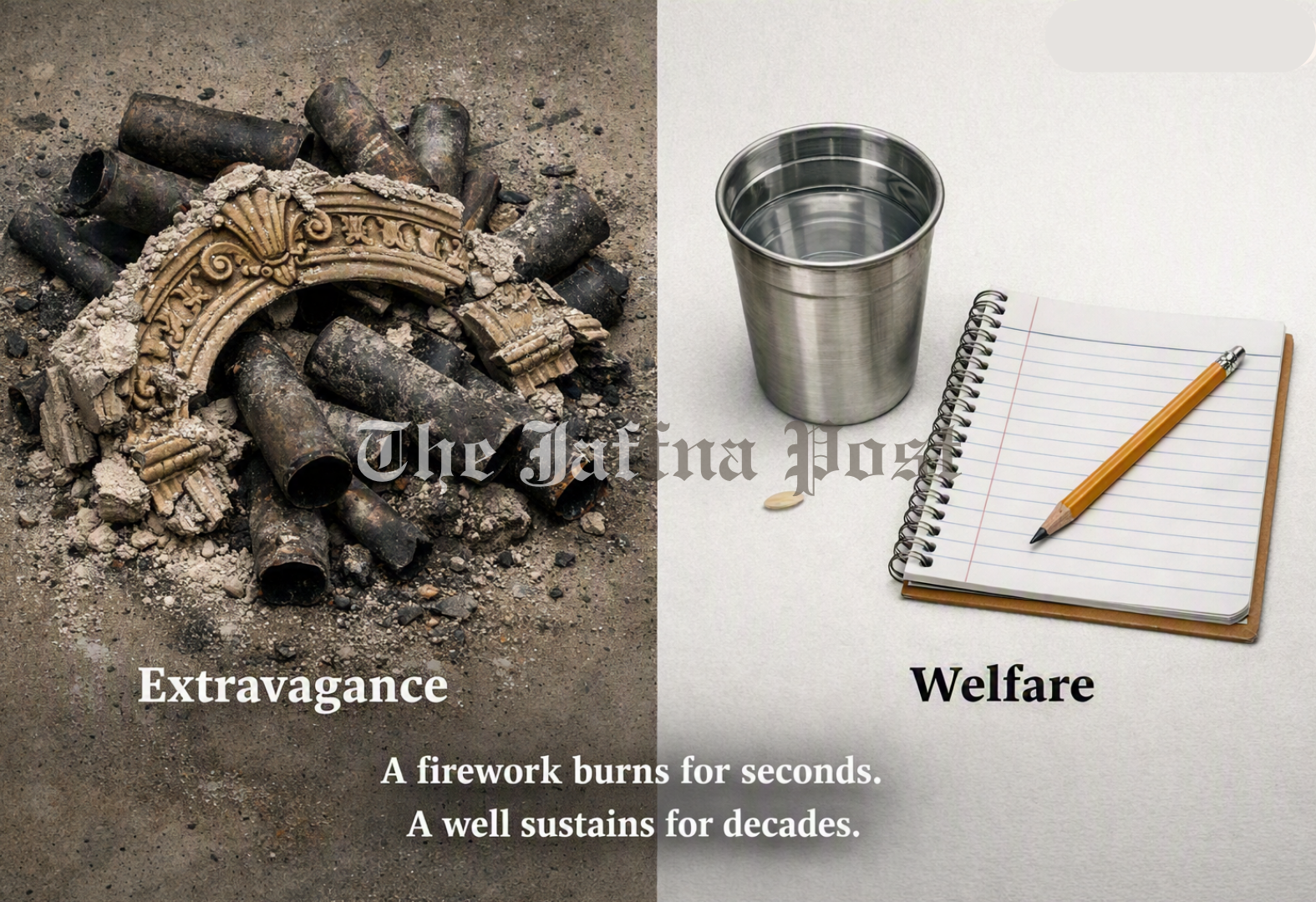
Our community must move from a ‘spend for display’ culture towards a ‘serve through faith’ culture. A firework burns for a few seconds whereas a water well may sustain a village for decades. A decorative arch disappears after the festival while a scholarship can change a child’s entire future.
The Governor, Hindu councils, civil-society organisations and temple trustees must act now. More importantly, diaspora sponsors must examine their own consciences. The question is not how much we spend in God’s name. The real question is: how much suffering are we prepared to relieve in God’s name?