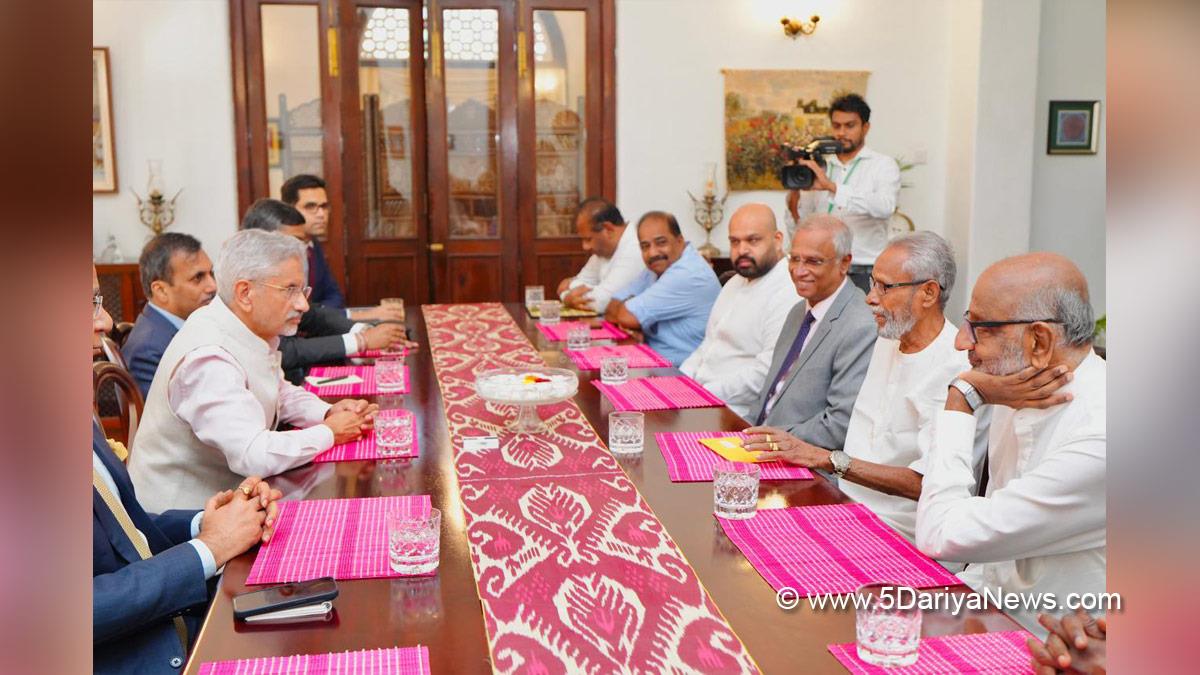

Once again, Sri Lankan Tamil political parties met Indian External Affairs Minister Subramaniam Jaishankar last week at India House in Colombo and requested him to exert pressure on the Sri Lankan government to hold elections to the provincial councils and fully implement the 13th Amendment to the Constitution.
Jaishankar arrived in Colombo on the evening of December 22 on a day-long visit as Prime Minister Narendra Modi’s special envoy to announce India’s assistance for Sri Lanka’s recovery from the devastation caused by Cyclone Ditwah last month.
Leaders of the Ilankai Thamizharasu Katchi (ITAK), the Democratic Tamil National Alliance (DTNA) and the Tamil National People’s Front (TNPF) had a joint meeting with Jaishankar on Tuesday 23.
It was a different approach this time. Despite their differences, Tamil politicians now seem to think that they need to have at least some understanding among themselves when talking to foreign leaders and diplomats about the problems of the Tamils. They consulted each other before the meeting with Jaishankar.
The leaders discussed relief and reconstruction work to be carried out for the people affected by the natural disaster in the North and East. They also pointed out to him that it would have been much easier to provide relief and carry out reconstruction activities for the cyclone-affected people if the provincial councils were in place now.
The TNPF leader Gajendra Kumar Ponnambalam, who has traditionally shown no interest in the provincial council system, also told Jaishankar that provincial council elections need to be held. He cut short his meetings with leaders of Tamil Nadu political parties in Chennai and hurried back to Colombo for the meeting with Jaishankar.
While stressing the need to have the provincial council elections, Gajendra Kumar sought to differentiate himself from other politicians by pointing out that devolution within a unitary state was not possible in Sri Lanka, and that only a federal system could solve the ethnic problem.
Not to be outdone, ITAK president C.V.K. Sivagnanam promptly stated that they too were of the firm view that federalism was the only viable political solution to the problem and that they were concerned not with the label of federalism, but with the content of the powers to be shared.
Gajendra Kumar told journalists that he did not know about the contents of the letter to Prime Minister Modi, handed over to Jaishankar by ITAK and DTNA leaders jointly. It is reliably learnt that the letter included a request to prevail upon the Sri Lankan government to hold provincial council elections at the earliest but made no mention of a federal solution.
It is important to note that Sri Lankan Tamil parties’ insistence on provincial council elections or their stance on federalism is not new to Jaishankar. He has had several talks with them not only as the Minister of External Affairs, but also during his earlier stint as Foreign Secretary.
When Eelam People’s Revolutionary Liberation Front (EPRLF) leader Suresh K. Premachandran brought up the issue of the merger of the Northern and Eastern Provinces at a meeting in Colombo when he was the Foreign Secretary several years back, Jaishankar retorted that much water has flown under bridge since the 1986 July Indo-Sri Lanka Peace Accord, and that India was not in a position to talk to Colombo about the merger of the two provinces again.
In a meeting with leaders of Tamil parties including Late Rajavarothayan Sampanthan in Colombo after becoming the Minister of External Affairs, Jaishankar questioned how one could make a federal claim to Sri Lankan governments that have not implemented even the 13th Amendment for more than three decades.
Jaishankar did not say anything about federalism at last week’s meeting. It is understood that the Indian minister did not give a direct answer to Tamil readers’ request that India urge Colombo to hold the provincial council elections at the earliest. Instead, he is understood to have asked questions aimed at eliciting the views of Tamil leaders on how the provincial council elections could be conducted in the current situation. Only then they brought to his notice the importance of provincial councils for the relief and reconstruction works.
A leader who attended the meeting said Jaishankar was not responding to requests from them to impress upon Tilvin Silva, powerful general secretary of the JVP, the flagship party of NPP, on the imperative to protect the provincial councils system and hold early provincial council elections. Silva is set to visit New Delhi.
In the 38 years since the signing of the Peace Accord, India has not been able to bring Sri Lanka on track to fully implement the 13th Amendment. The Modi government cannot be expected to exert any pressure on President Anura Kumara Dissanayake’s government on the ethnic issue in the context of a vastly changed geopolitical situation.
However, it can only be expected that India will continue to insist on the full implementation of the Constitution of Sri Lanka (purposely avoiding mentioning the 13th Amendment), along with the conduct of provincial council elections. It cannot be expected that New Delhi will ask a government that is seriously focused on rebuilding the country from the ravages of natural disaster, to hold elections anytime soon.
Meanwhile, ITAK General Secretary M.A. Sumanthiran said before the cyclone that a political movement will be launched from January to demand the government to hold provincial council elections. Interestingly, the NPP government, which is not keen on holding provincial council elections, has found a convenient excuse in the devastation caused by the cyclone.
The Tamil parties have no option but to appeal to India. The Tamil National Council (TNC ) led by Gajendra Kumar, has sought the help of political parties in Tamil Nadu to press the Indian central government to encourage President Dissanayake’s government to introduce a federal solution through a new constitution.
Some observers see this as an attempt to bring the Sri Lankan Tamil issue back into focus in the campaign for the State Assembly elections in Tamil Nadu, which are still four months away.
On the whole, the strategy of the Tamil parties is to seek India’s favour to win the Tamils’ demands, from holding provincial council elections to finding a political solution based on federalism.
The former Tamil leaders who put forward the demand for federalism did not have a road map to achieve it. Similarly, today’s leaders are also merely talking about a solution based in a federal system and have no plan to realise it.
It is necessary for the Tamil parties to have a clear understanding of the major mistake committed by the Tamil side in dealing with India in the post-Peace Accord period and the major forces responsible for it.
There is no gainsaying that the Tamil side is also no less responsible for today’s deterioration of the provincial council system. The Sri Lankan Tamil community is paying a heavy price for having condoned the horrendous mistakes of the past without forethought of the consequences.
Image credit: 5dariyanews.com