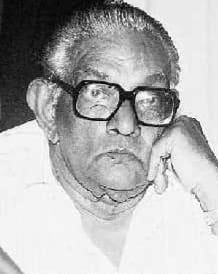
Murugesu Sivasithamparam, whose 102nd birth anniversary is commemorated today (July 20), was one of the illustrious leaders spearheading the struggle for the political rights of Sri Lankan Tamils in the second half of the last century.
Remembering Sivasithamparam, a towering personality with a stentorian voice, means not only honouring one of the pivotal figures in the struggle for the political rights of the Tamils for nearly a half century, but also celebrating achievements and sacrifices of a remarkable son of our hometown, Karaveddy in Vadamarachchi, where he was born.
Affectionately called ‘Siva’, he stood out for his integrity and dignity in both personal and political life, a stark contrast to many politicians today. He could have enjoyed a comfortable life with the wealth inherited from his feudal ancestors while pursuing a lucrative legal profession, but Siva chose politics, and in the process, sacrificed his wealth.
A victim of the 1983 Black July devastation, his house on Norris Canal Road in Colombo, was burned down and looted. He questioned whether the policies and strategies he advocated had caused great distress for the Tamil people. This was evident in his speeches in the latter part of his life.
Like many other leaders of the Tamil United Liberation Front (TULF), Siva was compelled to seek refuge in Tamil Nadu with his family and live off the goodwill of the state government. During Chandrika Bandaranaike Kumaratunga’s regime, as Minister of Rehabilitation and Reconstruction, Sri Lanka Muslim Congress leader M.H.M. Ashroff, offered several lakhs of rupees as compensation to Siva for Black July losses. But Siva rejected the offer outright, stating he would not take even a cent as compensation, while the Tamil people were losing life and property due to the brutal war. Until the end, his family remained true to his stance, never receiving or accepting any compensation from the Sri Lankan government.
No wonder then, that even those who differed with Siva in politics, held him in high esteem. I witnessed the respect Sirimavo Bandaranaike, the world’s first woman prime minister, had for Siva and for the TULF secretary general A. Amirthalingam, during my days as a Parliamentary Correspondent for the Virakesari newspaper.
As Leader of the Opposition, she made an impassioned speech in the House, on the condolence motion on the death of Amirthalingam, who was killed in Colombo in July 1989. She expressed deep gratitude to both Amirthalingam and Sivasithamparam for their historic speeches against the motion brought by the J.R. Jayewardene government on October 16, 1980, to deprive her of her civil rights.
She said she was comforted that a Sinhalese did not kill Amirthalingam, clearly showing the esteem she held for the two Tamil leaders that went beyond policy differences.
My days as lobby correspondent saw not just the decline in the quality of debates in Parliament but also the debasing of statesmanship. Often, members would be seen descending into the well of the House, and scuffles were an all too common occurrence.
The Speaker and senior MPs would often be heard advising ‘Honourable Members’ to lead by example, behaving with dignity and give respect to the august assembly. Siva’s name would be mentioned when the names of Tamil leaders who had contributed immensely to the quality of Parliamentary debates were recalled.
Among the Tamil leaders of the day, Siva commanded high respect from the icons of Sri Lanka’s leftist movement, Dr. N. M. Perera and Dr. Colvin R. de Silva. Many former parliamentary correspondents still speak highly of how Siva presided over the House as Deputy Speaker between 1968 and 1970.
Siva became fascinated with Marxist theories while an undergraduate at Colombo University College in the early 1940s, and involved himself in the activities of the Ceylon Communist Party (CCP). The late Communist leader, Comrade Nagalingam Shanmugathasan (Shan), with whom I associated closely for many years, shared with me his experiences with Siva in the CCP, some of which he included in his autobiography titled ‘Political Memoirs of an Unrepentant Communist’, released in July 1989, during the tumultuous days of the second uprising of the JVP.
Comrade Shan also recalled campaigning with Siva in the Point Pedro electorate in support of Ponnambalam Kandiah, one of the founder leaders of the CCP, who went on to become the first (and arguably the last) Communist Member of Parliament from the Tamil region.
Later, in an unexpected turn of events, Siva distanced himself from the CCP and ran as an independent candidate against his political mentor Kandiah in the Point Pedro electorate during the 1956 general election, but was unsuccessful.
He turned things around in the March 1960 general elections, when he contested the newly formed Udupiddy electorate as a candidate of the All Ceylon Tamil Congress (ACTC) led by G. G. Ponnambalam. Running against Kandiah, he successfully entered Parliament for the first time at the age of 37. Point Pedro had by then been divided into the constituencies of Point Pedro and Udupiddy in the delimitation process.
Parliament was short-lived due to a political crisis, and general elections were held four months later in July 1960. Kandiah did not contest due to ill health. Siva, once again the ACTC candidate for Udupiddy, entered Parliament, defeated the Ilankai Tamil Arasu Kadchi (ITAK) Federal Party candidate Kandappu Jeyakody.
He repeated the feat in the 1965 general elections, but saw the tables turned unexpectedly by Jeyakody in the May 1970 elections, the same elections in which Amirthalingam of the ITAK lost his Vaddukkoddai seat.
When Amirthalingam and Siva were out of Parliament, the United Front Government led by Prime Minister Sirimavo Bandaranaike introduced the 1972 Republican Constitution compelling the ITAK and the ACTC to form an Alliance aligning with several other Tamil parties to fight for the political rights of the Tamil people. Thus the Tamil United Liberation Front (TULF) was born.
This period marked a turning point in the political lives of both Siva and Amirthalingam. The political developments that followed are now part of Sri Lanka’s tumultuous recent history of ethnic politics that preceded the emergence of armed Tamil militant movements that would later shape the trajectory of Tamil politics.
Amirthalingam and Siva were a powerful duo in Tamil politics before the emergence of armed militants contouring a different course. Their moderate leadership remains unmatched in Tamil politics to this day.
Siva’s political approach emphasised Tamil unity over party politics. Whether during the 1961 ‘Satyagraha’ of the ITAK, or the formation of the TULF in the 1970s, Siva never aspired for positions but prioritised Tamil unity in the struggle for political rights.
Siva was the first TULF leader to compromise in the interest of Tamil unity. In the July 1977 general elections, the TULF won Tamil dominated constituencies in the North and East, becoming the main opposition in Parliament. Although some suggested Siva for Leader of the Opposition, he fully supported Amirthalingam for the post.
Siva gave up his Udupiddy seat to contest from Nallur for the sake of minority Tamil community representation, despite his hometown’s disapproval. T. Rajalingam, as the TULF candidate secured highest number of votes in Udupiddy, while Siva won Nallur by a record margin.
Siva was firm in his belief that a viable political solution to the ethnic problem required unity not only among Tamils, but all Tamil speaking people. Disturbed by the expulsion of Muslims from the North, he declared at a Sri Lanka Muslim Congress convention in Kalmunai in the Eastern province, that he would not return to the North until Muslims were resettled.
Tragically, it was Siva’s lifeless body that was taken to Jaffna after he died in Colombo on June 5, 2002.
-Veeragathy Thanabalasingham-