
Investor Obstacles: Bureaucracy, Policy Inconsistency, and Foreign Direct Investment (FDI)
When shopping for something as simple as a cabbage, most people compare several vendors before deciding where to buy. The cheapest option is not always the best; rather, we look for value for money. Once we find a vendor who consistently offers quality produce, fair prices, and reliable service, we tend to return rather than search elsewhere. As customers, we rarely try to persuade a vendor to improve—we simply take our business elsewhere.
International investors behave in much the same way. They seldom complain publicly about the obstacles they encounter in a particular country. Instead, they quietly redirect their investments to locations that offer a more attractive business environment.
This is the challenge Sri Lanka faces today. Despite its strategic location, educated workforce, and considerable natural advantages, the country continues to attract relatively low levels of foreign direct investment (FDI).
This article examines the reasons for this underperformance and outlines the reforms needed to make Sri Lanka a more competitive destination for international investment.
Why Sri Lanka Needs FDI
Promoting FDI is essential for placing the economy on a sustainable growth path beyond the immediate recovery from the crisis. It is not merely helpful—it is a long‑term necessity for a genuine and durable economic revival.
Sri Lanka’s economic recovery following the 2022 crisis, cannot be sustained through domestic demand alone. Domestic economic activity is vital for creating employment and improving living standards, but it cannot generate the foreign currency required to service external debt and finance essential imports.
Sri Lanka therefore has two principal avenues for earning foreign exchange:
Expanding exports, historically the most reliable source of foreign currency
Attracting foreign direct investment, which strengthens export competitiveness and integrates the country into global value chains
The country continues to carry a substantial external debt burden, around US$ 50 billion even after restructuring, and requires a steady flow of foreign exchange to maintain macroeconomic stability. Experience from Sri Lanka and high‑performing East Asian economies demonstrates that export growth is closely linked to foreign direct investment.
Export‑oriented FDI brings capital, technology, management expertise, international marketing networks, and access to global value chains. Unlocking Sri Lanka’s considerable, but largely untapped potential, to attract export‑oriented FDI should therefore become a national economic priority.
Sri Lanka’s Recent FDI Performance
Sri Lanka’s annual FDI inflows have historically grown moderately, peaking at around US$ 2 billion in 2018. After a pandemic‑era dip to US$ 434 million in 2020, inflows rebounded. In 2025, FDI rose to only US$ 1.04 billion, led predominantly by infrastructure and tourism.
Regional Comparison of FDI Inflows
| Country | 2005–2010 Average | 2011–2020 Average | 2024 Baseline | 2025 Latest |
| Singapore | ~ US$ 35–50 B | ~ US$ 65–140 B | US$ 143.35 B | US$ 154.30 B |
| Vietnam | ~ US$ 6–8 B | ~ US$ 12–16 B | ~ US$ 25 B | US$ 27.62 B |
| Bangladesh | ~ US$ 0.8 B | ~ US$ 1.5–2.5 B | US$ 1.27 B | US$ 1.77 B |
| Sri Lanka | ~ US$ 0.4–0.6 B | ~ US$ 0.8–1.2 B | US$ 0.71 B | US$ 1.04 B |
This comparison clearly illustrates where Sri Lanka stands today and how far it must go to reach the standards achieved by its successful regional competitors.
It is also important to note that, according to the Central Bank Annual Economic Review, the bulk of foreign direct investment reported over the past two years consisted of borrowings from third parties (presumably commercial banks) and reinvested earnings. These components do not represent fresh foreign exchange inflows into the country.
Actual new equity investment in 2025 amounted to just US$85 million, highlighting the continuing weakness of genuine foreign direct investment.
Post‑Crisis Vulnerabilities
Sri Lanka experienced its worst economic crisis since independence, culminating in the sovereign debt default of 2022. The crisis stemmed from unsustainable debt, severe foreign exchange shortages, policy failures, and external shocks. Following the Aragalaya movement, successive governments initiated difficult reforms, including IMF‑supported debt restructuring.
Although the economy has stabilised, Sri Lanka remains vulnerable. The recovery has been driven largely by domestic market-oriented production, while export-oriented production continues to play a secondary role. Central Bank data show that Sri Lanka has not yet reversed the long‑term decline in FDI inflowsthat contributed to the crisis.
To achieve sustainable growth, Sri Lanka must significantly increase its foreign exchange earnings. Attracting international investment and expanding exports are essential for building a strong foreign exchange buffer and strengthening the economy against future shocks.
Sri Lanka’s Untapped Potential
Sri Lanka possesses many natural advantages that Singapore does not: abundant land, natural resources, agricultural potential, and a strategic location in the Indian Ocean. Yet these advantages cannot be fully realised without institutions that investors trust.
Sri Lanka’s untapped potential includes:
- Expanding exports of goods and services—tourism, IT, manufacturing, logistics, agriculture, and value‑added industries
- Developing a workforce aligned with modern labour market needs
- Leveraging its strategic location through a balanced foreign policy
- Building institutions that provide predictability, professionalism, and credibility
Singapore succeeded not because it possessed abundant natural resources, but because it built trustworthy institutions. Sri Lanka already possesses many natural advantages that Singapore lacks, but without institutional reliability, these advantages remain underutilised.
How Investor Confidence Was Damaged
Investor confidence suffered major setbacks due to several policy decisions that created uncertainty and fear among existing and prospective investors alike.
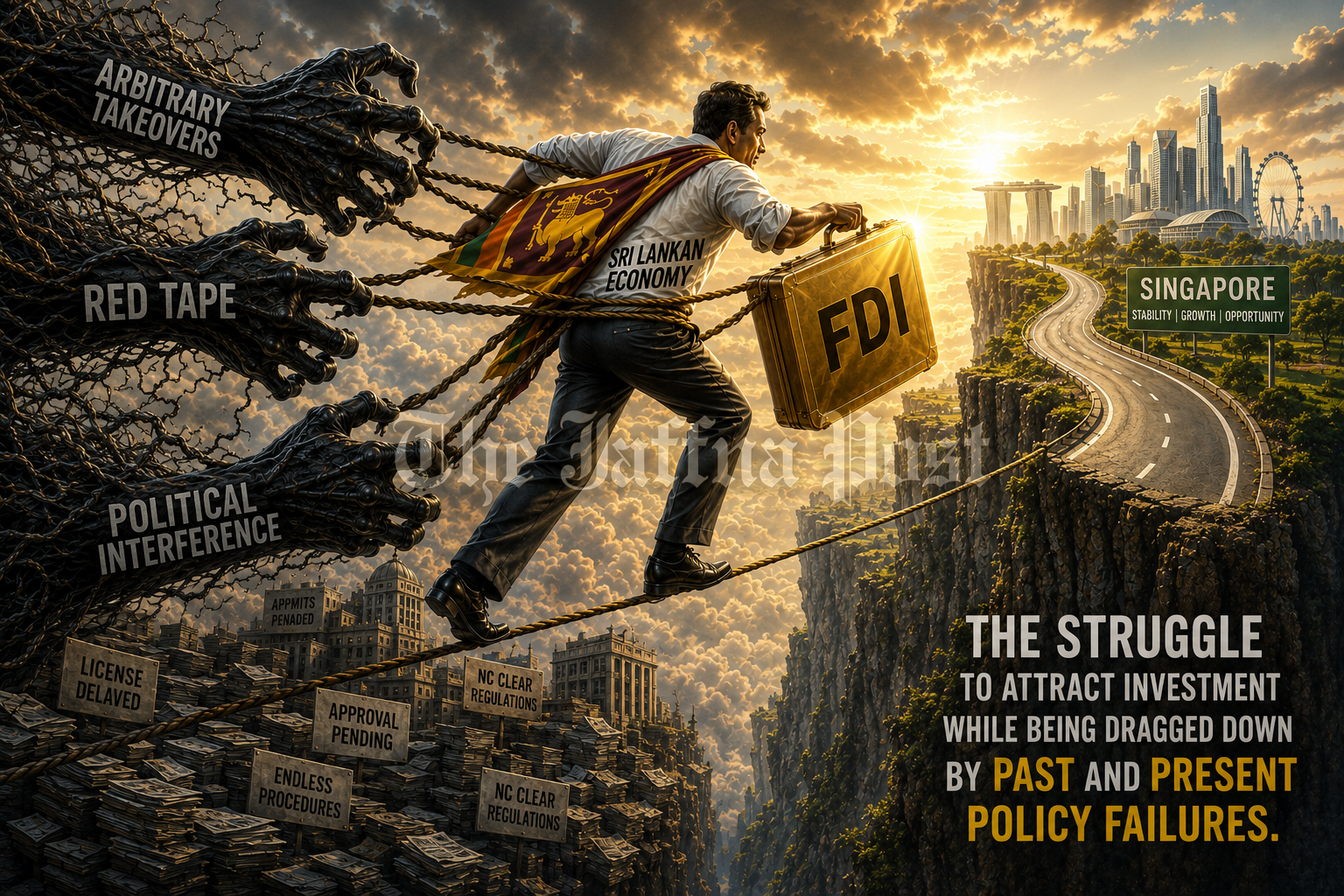
In 2011, Parliament passed the Revival of Underperforming Enterprises and Underutilised Assets Act, allowing the government to acquire 37 private enterprises. Together with the Strategic Development Projects (SDP) Act of 2008, these laws granted the minister responsible for the BOI broad discretionary powers, undermining the institution’s credibility.

These Acts created what investors described as the ‘MR 10%’ and ‘Two BOIs’ regime characterised by political discretion, arbitrary decision‑making, and inconsistent application of rules.
According to investors and economists in Japan and South Korea, these Acts along with arbitrary takeovers such as the Hilton Hotel, shattered investor confidence. Many foreign firms exited Sri Lanka during the Rajapakse administration, and others halted planned investments. Repealing these Acts is essential for meaningful FDI reform.
Numerous investment opportunities in the marine industries, manufacturing, tourism, logistics, and renewable energy have reportedly failed due to excessive red tape, shifting government priorities, or political interference. Such experiences damage Sri Lanka’s international reputation far beyond the individual projects concerned.
Investors commit capital where agreements are honoured, laws are applied fairly, approvals are predictable, institutions function professionally, and policies remain stable across governments. Without these strengths, promotional roadshows alone cannot generate sustainable investment.
FDI promotion must be managed by competent professionals selected on merit rather than political affiliation. Officials must be appointed based on knowledge, experience, integrity, and judgement—and protected from arbitrary political interference.
Lessons from Singapore
MIT Professor Edward Schein, in Strategic Pragmatism: The Culture of Singapore’s Economic Development Board’, identified six reasons multinational executives prefer Singapore:
- A one‑stop service for resolving issues
- Political stability and absence of corruption
- Clear rules and a government that keeps its promises
- Timely problem‑solving supported by efficient communication
- A pro‑business attitude and highly professional EDB officers
- A high‑quality labour pool with strong technical aptitude and discipline
Sri Lanka must internalise these lessons. Investment procedures should be standardised, transparent, digitised, and subject to legally enforceable timelines.Removing unnecessary political discretion would reduce corruption and increase investor confidence.
The BOI should function as a true one‑stop shop. Today, investors must navigate a costly, time‑consuming process involving numerous agencies.
What Investors Look For
Beyond political and institutional stability, investors increasingly consider practical factors:
Reliable, Low‑Cost Energy
Affordable, dependable energy is crucial for manufacturing, data centres, AI infrastructure, semiconductor industries, and green hydrogen production. Countries offering competitively priced renewable energy enjoy a major advantage.
High‑Quality Healthcare
Universal, affordable healthcare improves productivity, reduces absenteeism, lowers labour costs, and attracts skilled professionals and multinational companies.
Sri Lanka possesses many advantages—strategic location, educated workforce, natural resources, and democratic traditions. But investors seek confidence, so if Sri Lanka is serious about transforming its economy, attracting higher levels of FDI must become a national priority. That requires deep institutional reform, genuine meritocracy, policy consistency, transparent governance, and unwavering commitment to the rule of law.
Practical Recommendations
The following reforms would substantially improve Sri Lanka’s investment climate:
- Digitise all investment approvals through a single‑window system
- Introduce legally enforceable timelines for regulatory approvals
- Depoliticise investment approvals and strengthen independent institutions
- Appoint public officials strictly on merit and ensure accountability
- Protect approved investments from arbitrary policy reversals
- Strengthen the rule of law and enforce contracts consistently
- Reduce unnecessary regulations while maintaining safeguards
- Improve trade facilitation, customs efficiency, and digital government services
- Invest in education and workforce skills aligned with future industries
- Maintain macroeconomic stability and policy consistency across governments
Conclusion
Sri Lanka does not suffer from a shortage of investment opportunities. It suffers from a shortage of investor confidence. But confidence cannot be created through promotional campaigns or international conferences alone. It is earned through consistent policies, professional institutions, transparent governance, respect for contracts, and the rule of law.
If Sri Lanka succeeds in building these foundations, investment will follow naturally. Capital is highly mobile and constantly seeks environments where governments keep their promises, institutions function efficiently, and businesses can operate with confidence.
Sri Lanka has all the natural advantages required to become one of Asia’s leading investment destinations. What remains is the political will to undertake the institutional reforms necessary to unlock that potential.
Acknowledgement
I express my sincere gratitude to Professor Premachandra Athukorala, for his generous comments on a preliminary draft of this article. This article has been written solely for the benefit of our nation and as constructive advice for policymakers committed to Sri Lanka’s long‑term economic development.