The Nobel Peace Prize has been awarded since 1900 and in its 124-year history, the prize has been awarded to 97 individuals and 20 organizations including US presidents, vice presidents and secretaries of state.
Theodore Roosevelt (1901-1909), Woodrow Wilson (1913-1921) and Barack Obama (2009-2017) were the only US presidents to win the Nobel Peace Prize while in office.
Roosevelt was awarded the Peace Prize in 1906 for successfully ending the war between Russia and Japan and Woodrow Wilson in 1919 for establishing the League of Nations, the forerunner of the United Nations. Obama was awarded the prize in 2009 for his efforts to strengthen international diplomacy and people-to-people cooperation.
The Peace Prize has been awarded to a former US president and a former vice president. Jimmy Carter, who served from 1977 to 1981, was awarded the Peace Prize in 2002 for his tireless efforts to find peaceful solutions to international crises and to promote democracy, human rights and development.
Al Gore, who was the vice president during Bill Clinton’s two terms (1993-2001), won the prize in 2007 for his research on climate change and for disseminating information about it to people. Four US Secretaries of State, including Henry Kissinger, were also awarded the Nobel Peace Prize.
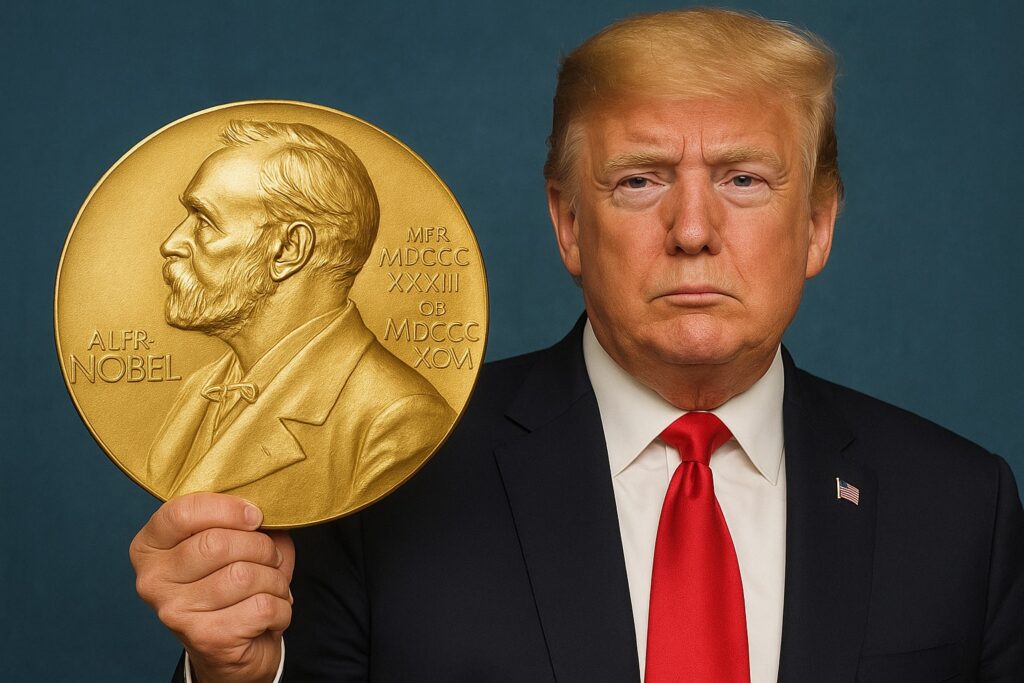
But, we never heard that any of them, like the current president, Donald Trump, mobilized support on their own to win the Peace Prize. He says he deserves the peace prize for ending conflicts in different parts of the world. A US president, who said a few days back that he had stopped five international wars in the five months since he became president for a second term in January, blamed former President Joe Biden for the continuing war in Ukraine.
Last week, the Norwegian press reported that Trump, who has been in the limelight controversially in the international stage for his aggressive tariffs on the countries, said during a phone call with Norwegian Finance Minister Jens Stoltenberg last month that he wanted the Peace Prize. Stoltenberg told the media that various officials of the White House, including the US Treasury Secretary and the US Trade Representative, had also spoken to him in this regard.
A few days ago, White House Press Secretary Karolyn Leavitt said that President Trump ended six conflicts between India-Pakistan, Israel-Iran, Thailand-Cambodia, Rwanda-Democratic Republic of Congo, Serbia-Kosovo, and Egypt-Ethiopia. He brokered one peace deal or ceasefire per month and it was ‘well past time that he should be awarded the Nobel Peace Prize’, she said.
Trump has claimed that he had brokered a truce between India and Pakistan three months ago, but India has vehemently refuted it. He has so far said several times that the two South Asian nuclear-armed countries stopped the fighting at his request. Last week also, Trump had said that the conflict between India and Pakistan would have turned into a nuclear war had it not been for his intervention.
While India has repeatedly claimed that the four-day conflict came to an end following direct communication between the military top brass of the two countries, Pakistan has so far not refuted Trump’s claim. Instead, in June, following a White House meeting between Pakistani army chief Field Marshal Asim Munir and Trump, Islamabad announced that it would nominate the US president for the Nobel Peace Prize for his decisive diplomatic intervention and important leadership during the conflict.
Meanwhile, during a visit to the United States in July, Israeli Prime Minister Benjamin Netanyahu nominated Trump for the Peace Prize and presented him with a letter he sent to the Nobel Committee. On August 7, Cambodian Prime Minister Hun Manet announced that he nominated Trump after a July ceasefire between Cambodia and Thailand that ended a five-day long clash between Thai and Cambodian forces at their disputed border in July. The skirmish left more than 40 people dead on both sides and forced some 300,000 to flee.
Former Soviet Republics Armenia and Azerbaijan signalled support for Nobel nomination for Trump after a White House “Peace Summit” on August 8 that culminated in a joint agreement between Armenian Prime Minister Nikol Pashinyan and Azerbaijani President Ilham Aliyev.
Both leaders praised the US-hosted framework and said they would back the nomination. It is reported that Pashinyan jokingly asked Trump if a draft of the nomination letter was available so he could sign right there and Aliyev joined in to say he’d sign too. The Armenian leader said that no leader other than Trump would have been able to broker peace between his country and Azerbaijan.
The leaders of Rwanda and the Democratic Republic of Congo have expressed support for nominating the US president for a peace prize for his role in ending the decades-long conflict between their two countries. Interestingly, so far, five world leaders have endorsed Trump for the Peace Prize.
It is unclear whether Trump’s name was nominated ahead of the Norwegian Nobel Committee’s deadline (January 31, 2025), as the actual official nominations made for the peace prize are kept confidential. There were reports in some US media that Trump’s name had been submitted before the deadline. The Nobel Peace Prize winners (one or more) will be announced on October 10. The award ceremony will be held on December 10 in Oslo, Norway.
It is important to note that support of the leaders of the countries that have nominated the US president for the Peace Prize, especially Rwanda, Israel, Gabon, Azerbaijan and Cambodia, will have a negative impact on the consideration of the Nobel Committee, as they are autocrats, military rulers and internationally sanctioned.
Trump’s White House has become one of the few venues that officially host the Israeli Prime Minister since he was declared as wanted for prosecution for war crimes by the International Criminal Court (ICC). The Israeli government overall is also subject to an ongoing genocide prosecution by the International Court of Justice (ICJ).
Though Trump has all the power to force Israel to stop the Palestinian genocide, he is not doing anything. Instead, he has been encouraging the Israeli Prime Minister to continue the butchery.
Indian political observers have said the Nobel Committee should take note of how Trump allowed Pakistan army chief Munir to make a nuclear threat against India from US soil.
Seshadri Chari, one of India’s best-known journalists, wrote on the digital platform ‘The Print’ few days ago, “Pakistan Army chief, Field Marshal Asim Munir, has threatened India with a nuclear attack if it dares to build a dam on the Indus River. More alarming than the threat itself is that he issued this warning while on American soil, in the presence of several senior military officers from the Trump administration. As reported by The Print, Munir is learnt to have said, “We are a nuclear nation. If we think we are going down, we will take half the world down with us if we faced with an existential threat from New Delhi.”
“This is probably the first time a foreign army chief has used American soil to issue a nuclear threat against India — and “half of the world.” That the Trump administration has remained a mute spectator to such an irresponsible and dangerous statement is disturbing. It should concern the Norwegian Nobel Committee, the body that awards the Nobel Peace Prize.
Significantly, Munir’s threats also belie Trump’s claims about brokering peace between India and Pakistan. While New Delhi was cautious in its response to Trump’s earlier claims, it should not let Munir’s remarks slide.”
Since his first term in office, Trump has described himself as a man of peace. He also boasted that he was the first president since Jimmy Carter not to send any US soldiers into a foreign combat. He said that if he had been president of the United States, the attack on Israel by Hamas on October 7, 2023 would never have taken place.
But Trump said, immediately after returning to White House in January, that he could not rule out the possibility of using military force to bring Greenland, the world’s largest island that belongs to Denmark, under US control. He even talked about the US owning the Panama Canal and making Canada his country’s 51st state.
Above all, Trump said, he would send Palestinians from Gaza to other countries and turn the valley into the Riviera of the Middle East, arrogantly ignoring the untold sufferings of the innocent Palestinians.
He called Ukrainian President Volodymyr Zelenskyy to the White House a few months back and bullied him in the mistaken belief that he could end the war in Ukraine by developing cordial relations with Russia and appeasing President Vladimir Putin. At the same time, he recently threatened to impose a 100 percent tariff on Russia if Putin did not comply with the ceasefire proposal within fifty days.
But in the end, Trump had no choice but to hold talks with Putin. Ahead of his meeting with Putin on August 15, European countries worried that the US president might turn out to be the new Neville Chamberlain – the British Prime Minister who along with the French premier Paul Daladier, gave Czechoslovakia up to Hitler at the 1938 Munich Conference.
European countries are fearful that Trump would agree to Putin’s desire to attach the Ukrainian territories captured during war. But he was unable to make any progress on a ceasefire in Ukraine at his Alaska meeting with the Russian leader.
It seems that, lacking proper clarity on the geopolitical situation, Trump, who is obsessed with seeing an end to the Ukraine war on his terms, believes that Zelenskyy can be manipulated to his liking.
As a result of Trump’s global tariff war, there is a great deal of confusion in international trade relations. Countries with weak economies are forced to act according to his whims and fancies without any other option. Sri Lanka is also at risk. He uses tariffs as a geopolitical tool to assert American dominance.
In a recent letter to President Anura Kumara Dissanayake, Trump said that the US decision on tariffs on Sri Lanka was not only related to trade and the economy, but also to the entire bilateral relationship. He is also trying to intimidate economically powerful countries like India, South Africa and Brazil with tariffs.
His actions in the first eight months of his second term have thrown the rules-based international order into disarray. Trump ordered the bombing of Iran’s nuclear facilities at a time when his administration was negotiating with Iran over its nuclear program.
Trump has long coveted the Nobel Peace Prize, and his friends, including lawmakers, had nominated him for the honour numerous times. He has mocked former President Barack Obama, who won the award in 2009, saying he didn’t know “what the hell he got it for.” But, now the whole world is asking Trump what he wants to win the Nobel Peace Prize for.
Be that as it may, there is no guarantee that any conflict that Trump boastfully claims to have ended through his mediation efforts will not erupt again. Trump’s desire for the Nobel Peace Prize could have some meaning if he did something significant to pressure or persuade Israel to cease the killing of Palestinians in Gaza, which has shaken the conscience of the entire world.
Trump has complained several times that he had not received the Peace Prize. The fact is that he knows very well he won’t get it. He has already posted on his ‘Truth Social ‘ that no matter what he does, they will not give him the peace prize.
It would be no surprise if Trump imposed tough tariffs on Norway if the Nobel committee does not award him the prize.