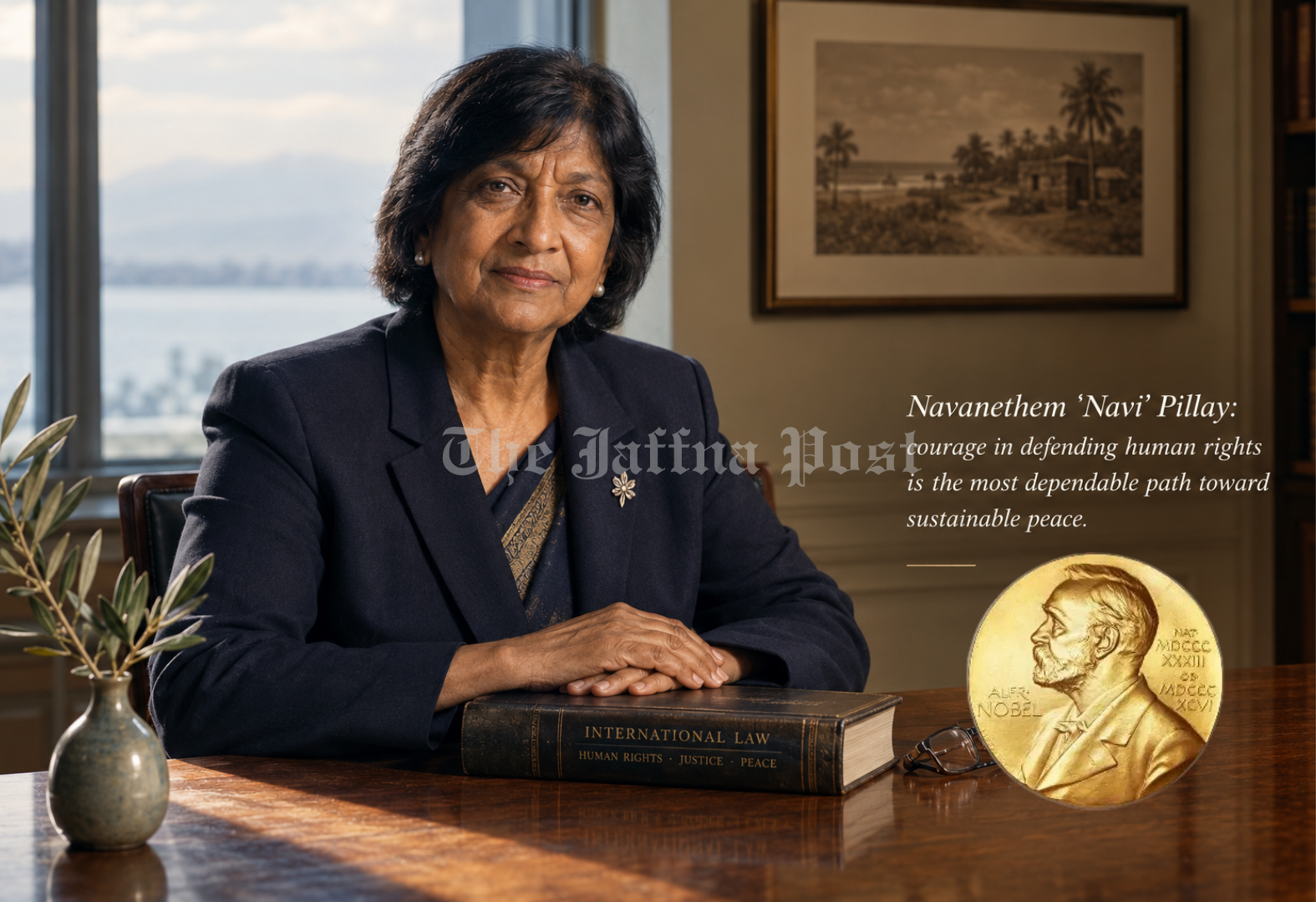

The announcement that former United Nations High Commissioner for Human Rights, Navanethem ‘Navi’ Pillay, has been awarded the 2026 Nobel Peace Prize brings a critical period of international support for human rights back into the spotlight.
As the Nobel Committee announced the award in recognition of Navi Pillay’s exceptional courage and significant contributions to expanding the reach and influence of international law, her decades-long career stands as a testament to her unwavering ethical stance. However, nowhere else has her legacy generated as complex and lasting debates as in Sri Lanka.
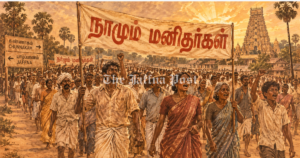
Pillay’s tenure as the UN High Commissioner for Human Rights from 2008 to 2014 coincided with one of the most critical phases in Sri Lanka’s post-independence history. A major turning point occurred during her week-long official fact-finding mission in August 2013, when she visited war-affected areas including Jaffna, Kilinochchi, and Trincomalee.
Meeting directly with victims of the civil war, local communities, and families of the disappeared, she issued a stern warning that the island nation of Sri Lanka was drifting toward authoritarianism within a ‘climate of fear.

At the time, her precise assessments and subsequent reports in Geneva sparked fierce opposition in the domestic political arena. International oversight was criticized as an interference in the country’s sovereignty.
However, viewed through the lens of history, Pillay’s resolute stance underscored a fundamental truth; lasting peace cannot be built upon unaddressed grievances and institutional silence. Her call for accountability and systemic legal reforms was not an act of hostility against a nation, but rather a demand for genuine reconciliation centered on human rights and the rule of law.
Today, as the international community celebrates Navi Pillay’s recognition on the global stage, Sri Lanka also stands at a crucial juncture in its own journey. The country is navigating ongoing challenges toward economic recovery, governance reform, and fostering ethnic harmony.
This recognition bestowed upon Pillay by the Nobel Committee serves as a reminder that principles of international law are not mere theoretical ideas, but essential frameworks designed to protect human dignity worldwide.
For Sri Lanka, reflecting on Navi Pillay’s legacy should not be about reopening past polarizations, but rather an opportunity for constructive self-reflection. True sovereignty and peace are strengthened, not diminished, by respecting the truth, addressing historical injustices, and protecting democratic freedoms.
As Pillay’s life’s work demonstrates, courage in defending human rights is the most dependable path toward sustainable peace.
Trump and Pillay
Meanwhile, the announcement of the Nobel Peace Prize has once again brought into focus two differing perspectives on establishing peace and human rights in the world. Following the announcement of this year’s Nobel Peace Prize awarded to Navi Pillay, harsh criticisms from US President Donald Trump’s camp have sparked controversy.

In frustration and annoyance over missing out on the Nobel Peace Prize, Trump reshared a post written by his lawyer, David Schoen, on his social media account. The post accused Navi Pillay of being a ‘sworn enemy of the US and Israel’ and claimed that the Nobel Committee had lost its credibility. Additionally, Trump’s supporters argue that the Nobel Peace Prize should have been awarded for his foreign policy achievements, such as the Abraham Accords.
However, the Nobel Committee’s decision conveys a different, crucial message to the world. As noted by the Chairman of the Nobel Committee, Jørgen Watne Frydnes, the award was presented to Navi Pillay to ensure that the law is upheld against war crimes, crimes against humanity, and genocide. In an era where international laws and institutions are facing severe strain, this award emphasizes that international legal norms matter more than the arbitrary power politics of individuals.
Trump’s repeated claims that he stopped several wars and that he alone deserved the award highlight an approach that views peace merely as political deals and individual achievements. True peace, however, cannot be created through political agreements alone; it must be built upon justice and human rights.
Attending a legal conference at the Nuremberg court last week Navi Pillay responded to the warm reception she received by jokingly remarking, “If you clap a little more, I might have to share this prize with Trump”. Her humor served as a subtle satire on the false pride of power politicians.
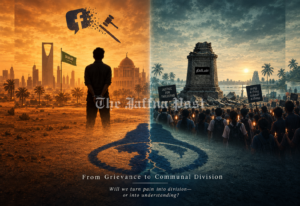
Ultimately, this controversy is not merely about individual grievances. It poses a fundamental question about who will lead the world and how. Is world peace about arbitrary agreements made by powerful individuals, or is it governed by international law applicable to all?
Through this award to Navi Pillay, the Nobel Committee has delivered a clear answer: “Peace is not possible without justice.”