It seems that two former presidents of Sri Lanka still believe that they have a ‘recovery’ in politics.
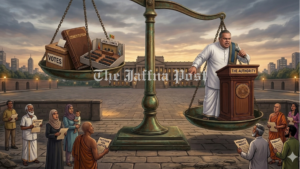
Ranil Wickremesinghe, who is accused of misusing public funds for a personal foreign visit, has stepped up efforts to unite opposition parties to defeat the ‘constitutional dictatorship’ of the National People’s Power (NPP) government.
Mahinda Rajapaksa who was compelled to vacate the grand Government palace in Colombo after Parliament passed a law removing presidential privileges, is trying to regain support among the people by claiming that he has been subjected to great injustice and that the NPP government is engaging in ‘political terrorism’.
When Wickremesinghe was arrested in August and remanded (in the ICU of the Colombo National Hospital), almost all opposition parties came out in his support. Even politicians who had serious political differences with him, accused the government of political vengeance.
Wickremesinghe and his United National Party (UNP) politicians hoped to use the momentum generated among the opposition parties at the time to mobilise against the government in the immediate aftermath of his arrest. However, in a few weeks’ time, that enthusiasm had been lost. Wickremesinghe then showed interest in using the UNP’s 79th annual convention held on September 20 as an opportunity to unite the opposition.
About 40 registered political parties were invited to the convention. They included every political party represented in the current parliament except for the ruling NPP. Some invitees such as former Presidents Chandrika Bandaranaike Kumaratunga and Maithripala Sirisena, while expressing regret at not being able to attend, had sent their congratulatory messages. Opposition and Samagi Jana Balawegaya (SJB) Leader Sajith Premadasa was absent as well, but the party was represented by several senior members, including SJB general secretary Ranjith Madduma Bandara, national organiser Tissa Atthanayake and MP Kabir Hashim. Madduma Bandara read Premadasa’s message at the convention.
Neither Sri Lanka Podujana Peramuna (SLPP) president Mahinda Rajapaksa nor his son and national organiser of the party Namal Rajapaksa attended the convention. General Secretary Sagara Kariyawasam represented the SLPP and addressed the gathering. While leaders of all Tamil and Muslim parties aligned with the SJB participated in the convention, none of the leaders of the Tamil parties from the North and East attended, despite being invited.
This year’s annual convention was different in that rather than honour the UNP’s leaders and showcase the party’s achievements, the event sought to build on the theme of the unity among the parties, as the organisers honoured not just UNP leaders but those from other parties as well.
Accordingly, aside from UNP leaders such as D. S. Senanayake, Dudley Senanayake, J. R. Jayawardene, R. Premadasa, Lalith Athulathmudali and Gamini Dissanayake, the event also honoured leaders from other parties, including former Prime Minsters S. W. R. D. Bandaranaike and Srimavo Bandaranaike, as well as eminent politicians of yesteryear Dr. N. M. Perera, Dr. Colvin R. de Silva, Pieter Keuneman, D. A. Rajapaksa, G. G. Ponnambalam, S. J V. Chelvanayakam, Savumiamoorthy Thondaman and R. Sampanthan.
Wickremasinghe’s speech at the convention was his first public address since his arrest in August. He made it clear that his arrest was the main reason why his party’s annual convention was held in a different way than usual. He tried to explain that his visit to the United Kingdom in September 2023, on the way home, following the visits to Cuba and the United States was also official one.
The UNP leader stressed the need for political parties to work together to defeat the constitutional dictatorship that is taking shape in the country today, rather than talking about the party. Several other politicians who spoke at the convention also pointed out that a constitutional dictatorship was emerging in the country under the watch of President Anura Kumara Dissanayake and the NPP.
It is true that fractured opposition parties have been waiting for an opportunity to mobilise against the government, but the question is whether Wickremesinghe has actually become a leader strong enough to lead efforts to unify the parties after his arrest.
Thanking all political parties for extending support to him when he was arrested and remanded, Wickremasinghe appealed to the opposition parties to come together and hold a thousand public meetings, as the UNP led by J. R. Jayewardene had done in the year 1975 during the United Front government.
However, his party doesn’t have the organisational framework or people’s support strong enough to lead such a massive political campaign. The UNP, which has been under his leadership for more than three decades, is at its weakest point in its nearly eight-decade history. And none of the current main opposition parties have strong structures to hold large public meetings. At the same time, doubts are being raised about the impact of the proposed mobilization of other parties under the guidance of a weak UNP. The views expressed by representatives of other parties at the convention clearly indicate this.
Madduma Bandara and Sagara Kariyawasam declared that their parties had no political agreement with the UNP, but they were attending the convention to extend their support and solidarity to the joint opposition efforts to oppose the emerging threat to democracy.
The old main parties, such as the Sri Lanka Freedom Party, have all split into several groups and they cannot but participate in efforts to unite the opposition in order to find relevance and a space for themselves in today’s political landscape.
After Wickremesinghe’s arrest, the UNP appears to be making efforts on both fronts to build its support. Its aim is to negotiate with the SJB on the one hand and eventually bring the two parties together and, on the other hand, to form a broad anti-government front with the other parties.
As for Sajith Premadasa, he is very careful not to fall into this ‘trap’ of the UNP. He may perhaps agree to a merger of the two parties if Wickremesinghe steps down from the leadership and if there is a strong possibility of him getting the leadership of the merged party in the future. But there is no sign of the former president stepping down from the leadership of the party or from politics. Therefore, it is certain Premadasa will focus on further strengthening his leadership in the SJB.
Despite criticism of his leadership within the party, he recently announced that he had decided to contest the next presidential election. We have to look at his announcement not only as an expression of his position that he is not going to cede the leadership of the SJB to anyone, but also as a doubt about the possibility of the NPP government abolishing the executive presidential system despite its election promise.
Another important question is how far the call to mobilise people against the alleged ‘constitutional dictatorship’ by raising issues like Wickremesinghe’s arrest without bothering to take on the government will go, since it has failed to deliver on most of the promises made to the people.
In this context, Mahinda Rajapaksa, who has vacated the Government palace in the heart of Colombo and moved to his home district of Tangalle in Hambantota following the recent legislation passed in Parliament to abolish the exorbitant privileges enjoyed by former presidents, has accused the NPP government of engaging in ‘political terrorism.’
A large number of opposition politicians and supporters visit his Tangalle residence every day, as well as foreign diplomats from Colombo. While the Chinese ambassador met Mahinda on his way out of Colombo, the Indian High Commissioner went to Hambantota to meet him. It is not understood what message the diplomats are trying to convey to Sri Lankans or the government through these meetings with the former president. Meanwhile, Wickremasinghe also went to Tangalle and had discussion with Mahinda.
The people of the country do not seem to think that his inability to continue living in a luxurious Colombo residence has affected him or that the government has done him a great injustice. It seems that Opposition politicians are not able to understand the real sentiments of the populace.
But Mahinda seems to be hoping to exploit the current opportunity to regain his party’s influence, in an effort to show that people still have sympathy for him. Even after the ‘Aragalaya’ experience, he was not free from the thinking that the Sinhala people were forever indebted to him and his family for ending the war.