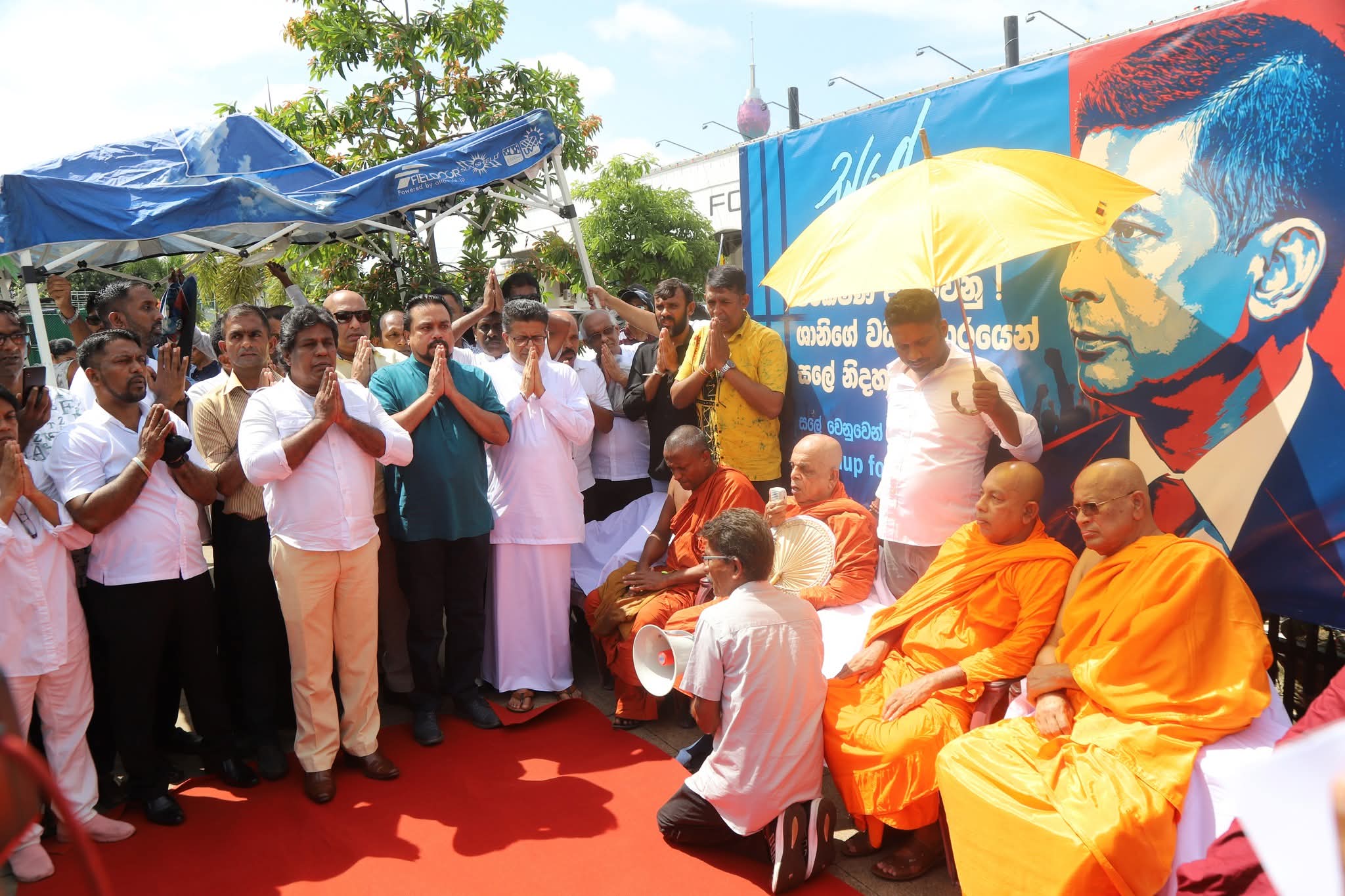

The satyagraha protest launched last week in front of the Colombo Fort Railway Station by some opposition politicians—along with family members and Buddhist monks—alleging that injustice is being meted out to the former head of the State Intelligence Service (retired Major General) Suresh Salley, has been ‘temporarily’ called off.
Salley was arrested in late February as a continuation of the investigations into the Easter Sunday bomb attacks and is being detained under the Prevention of Terrorism Act (PTA).
Salley had launched a hunger strike while in detention, and as his health deteriorated, he was admitted to the Colombo National Hospital. During this time, the protest was spearheaded by politicians identified as hardline Sinhala-Buddhist nationalists: Wimal Weerawansa, leader of the National Freedom Front; Udaya Gammanpila, leader of the Pivithuru Hela Urumaya; and Dilith Jayaweera, leader of the Mawbima Janata Party.
Political parties that have rallied in support of Salley, including the Rajapaksas’ Sri Lanka Podujana Peramuna (SLPP), view his detention as politically purely motivated.
These parties do not seem concerned with uncovering the masterminds behind the Easter Sunday bombings—the biggest terrorist incident to shake Sri Lanka since the end of the civil war—and holding them accountable.
Instead, these nationalist politicians argue that detaining and humiliating a leading military intelligence officer, who played a crucial role in defeating the LTTE in the war, will demoralise the country’s security apparatus.
Their argument carries an undertone that members of the security forces who won the war should neither be investigated nor punished, even if they have committed offenses. They view the security forces as a ‘protected’ institution.
At the same time, suspicions are gaining traction in current political debates that these protests are actually being carried out with the ulterior motive of protecting the real masterminds of the Easter Sunday attacks.
The fact that those who remained silent for more than three months after Sallay’s arrest suddenly took to the streets following a recent court order strengthens this suspicion.
Whenever the tracks of an investigation turn toward powerful institutional figures or a specific political faction, one can observe strategic moves being made to divert public attention. Last week’s protests are viewed by the public through that very same lens.
The failure over the past seven years to identify and punish the masterminds behind the highly coordinated Easter bombings has created a massive vacuum which has now been filled with various doubts, arguments, and conspiracy theories.
The National People’s Power (NPP) government, which came to power promising the public that it would eradicate the culture of impunity where criminals escape punishment, bears the responsibility to conduct swift, transparent, and impartial investigations into various high-profile cases, including the Easter Sunday attacks. It is also facing intense pressure regarding this.
The extensive politicisation of the Easter attacks issue has caused numerous disruptions and diversions in the investigations. Government leaders allege that the opposition’s approaches are aimed at creating distractions for political gain, rather than ensuring genuine accountability.
Last week, Public Security Minister Ananda Wijepala stated in Parliament that Sallay had refused to provide the passwords for his personal computer and mobile phone, and that this lack of cooperation is an attempt to stonewall the investigation.
However, can one really expect a former intelligence chief—who was well aware that he was under intense surveillance—to store any incriminating information against himself on his mobile phone or personal computer?
Opposition politicians counter-argue that the NPP government is targeting state intelligence personnel to satisfy specific political platforms or international pressure, rather than acting on systematic evidence.
Whatever the case may be, the public widely believes that politicians are staging political dramas simply to shield a mastermind. The investigations conducted up to this point are the primary reason for this belief.
Because successive Presidential Commissions of Inquiry, committee reports, and police investigations have often contradicted one another and left crucial questions unanswered, there is a widespread perception that the truth is being actively concealed by the political elite.
The NPP government bears the absolute responsibility to ensure that the current investigations progress in a way that clears the deep-seated skepticism prevailing in the public sphere.
However, the Janatha Vimukthi Peramuna (JVP), which leads the current government, has a political history of being easily swayed by nationalist sentiments. The political forces backing Sallay are trying to stir up nationalist sentiments as a tactic to stall the government’s efforts to expedite the investigation into the Easter bombing masterminds.
Nevertheless, these forces have become severely weakened and are unable to mobilise the public in the south. These political factions, which rely entirely on majority ethnocentric mobilisation for their political survival, have conveniently seized upon the immediate opportunity presented by the Sallay issue to try their luck once again.