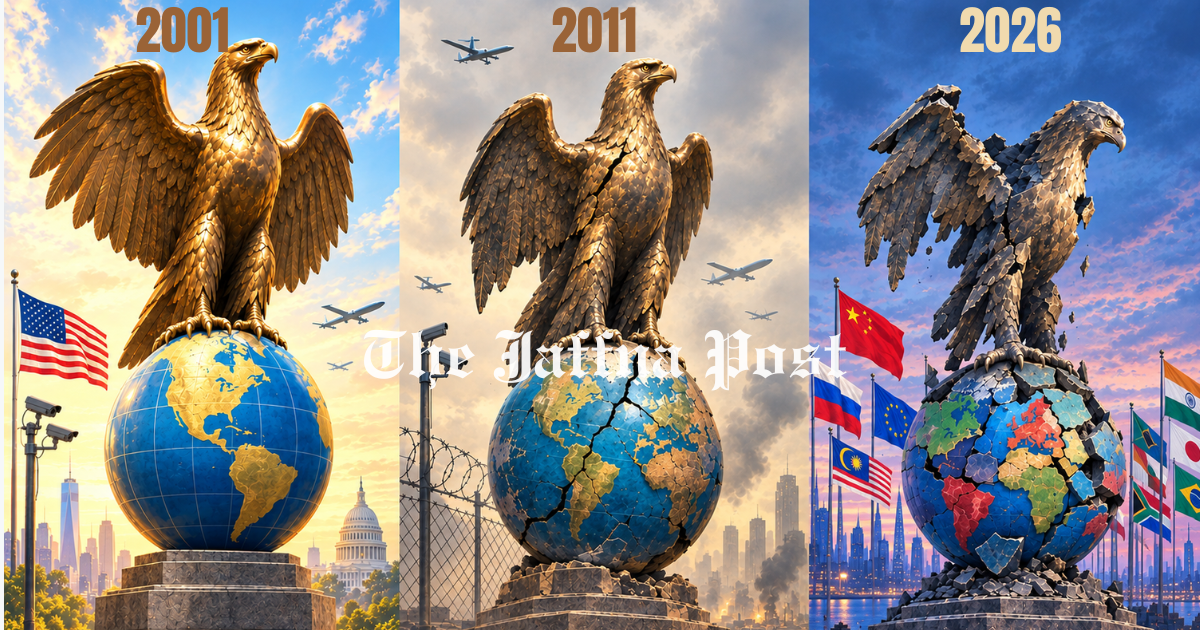

A quarter of a century has passed since September 11, 2001, when airplane attacks targeted the World Trade Center’s Twin Towers in New York and the Pentagon in Washington. The smoke that billowed high into the sky that day permanently altered the global political map. After that, nothing remained as it was before.
America’s declaration of a ‘Global War on Terror’ was not merely a military campaign, it served as a historical turning point that fundamentally and radically reshaped post-World War II international laws, the principles of national sovereignty, and global perspectives on human rights. Over these 25 years, the single factor of ‘security’ has eclipsed democracy and individual liberty.
The Global War on Terror, launched with the invasions of Afghanistan and Iraq by the United States and its Western allies, inverted the respect the international community traditionally accorded to state sovereignty.
Military actions conducted without UN approval under the new doctrine of ‘preemptive strike’ exposed the weakness of international institutions. Consequently, the devastation and countless human casualties in the Middle East and South Asian regions, rather than eradicating terrorism, created fertile ground for regional extremist movements to proliferate.
The war on terror breached battlefield boundaries and intruded directly into the daily lives of global citizens. Starting with America’s ‘Patriot Act’ and extending through stringent anti-terrorism legislation enacted worldwide, state surveillance powers became boundless. The dangerous trend of sacrificing freedom for the sake of security became a global norm.
The hypocrisy of Western nations claiming to protect human rights stood exposed to the world. Historically vital protections like international human rights laws and Geneva Conventions were systematically violated under the guise of ‘national security’. Over time, this served as a harmful precedent for authoritarian regimes globally to justify repressions against their own citizens. As Sri Lankans, we experienced this extensively.
Although the Global War on Terror began against terrorist organizations (primarily Al-Qaeda), it ultimately evolved into a war for regime change under the pretext of ‘spreading democracy’ across Afghanistan, West Asia, and North Africa, tailored to serve American interests and worldview.
The regime-change wars started in Iraq and, amid the 2011 ‘Arab Spring’ uprisings, transformed into bombings against Colonel Gaddafi’s forces under the guise of ‘protecting’ Libyan citizens. The then-US President Barack Obama publicly admitted to leading that effort from behind.
The overthrow of Gaddafi’s regime shattered Libya, turning what was once one of Africa’s most stable nations into a site of collapse. The fall of the Libyan state opened the doors to terrorism across Africa, as weapons leaked across borders into the hands of various militant and terrorist groups. For over 15 years, jihadi groups have been expanding their influence across several North African countries.
Twenty-five years after the 9/11 attacks, the ‘War on Terror’ has exposed the weaknesses and limitations of American global dominance. The withdrawal of US troops from Afghanistan after two decades of occupation highlighted the strategic failure of this war.
While the US concentrated its attention and resources militarily and economically on these wars, rival superpowers like China and Russia capitalized on the opportunity to strengthen their global standing. As a result, the post 9/11 unipolar American dominance has faded, giving way to an emerging multipolar world order.
Donald Trump’s ‘America First’ policy and his disregard for international law further destabilized an international order that was already weakened in the decades following 9/11. By pushing aside international treaties, climate agreements, and global institutions to prioritize unilateral trade wars and threats, he contributed to a major global economic crisis. He has openly stated a lack of concern for international law.
Trump’s aggressive approach to handling global diplomatic crises deepened international instability. Ultimately, 25 years of invasions post 9/11, military buildups, and unilateral foreign policy have exposed the limits of America’s global hegemony.
In an article titled ‘A unilateral America in a post-unipolar world’ published recently, Stanly Johny, the International Affairs Editor of The Hindu, succinctly summarized the contrast between the United States before 9/11 and the United States today, twenty-five years later.
“When the September 11 attacks occurred in 2001, the United States was at the peak of its power. Its Cold War rival, the Soviet Union, had collapsed a decade earlier. Russia was struggling to recover from the chaos of the post-Soviet transition, while China remained a close economic partner of the US.
“In Eastern Europe, the US had successfully carried out military interventions, and NATO had completed its initial expansion into Russia’s neighborhood. The US also maintained a formidable military presence in West Asia.
“Twenty-five years after 9/11, terrorist groups have not only survived the War on Terror, but have also evolved into local groups operating under a transnational jihadi umbrella. Despite America’s commitment to Europe through NATO, fractures within the transatlantic alliance are widening. Traditional US allies grow increasingly frustrated with Washington’s new transactional approach to diplomacy.
“In West Asia, Israel—America’s closest ally—is pulling Washington deeper into a regional vortex. While the US remains bogged down in West Asia, China has emerged as the second pillar of a growing multipolar order. At the same time, Russia poses a grave challenge to the US-led security framework in Europe.
“As the reckless war with Iran illustrates, the US continues to act as a unilateral hegemon. However, its unilateral actions clash daily with the evolving realities of a post-unipolar world.”
Finally, when the then-President George W. Bush declared the global ‘War on Terror’ following the 9/11 attacks, Cuban President Fidel Castro offered a remarkably prophetic insight:
“In the name of a global war on terrorism, the United States and Western nations will erase the line separating blatant terrorism from legitimate armed struggle.”