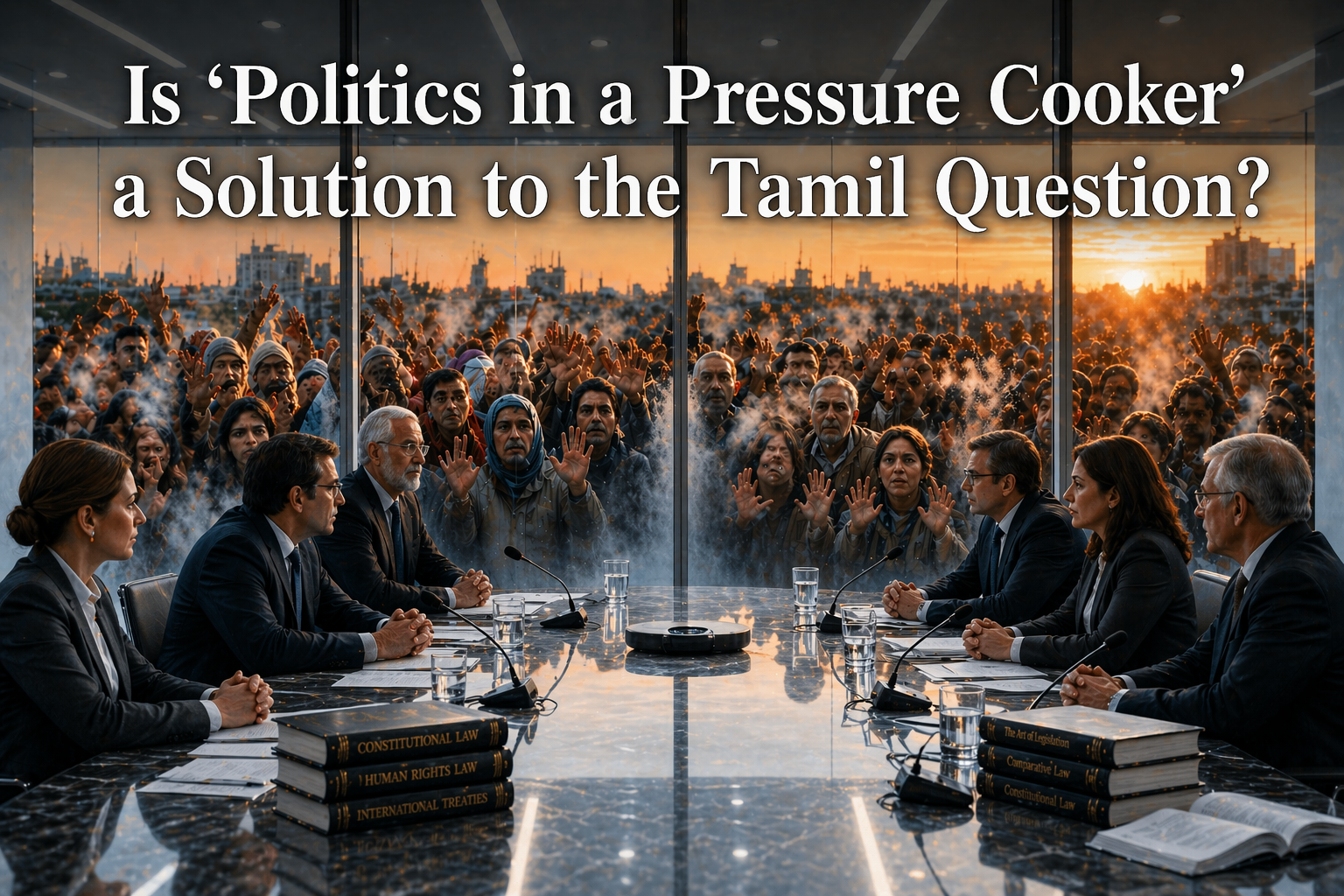

One of the most pressing questions facing the Tamil people of the North and East today is this: Where do we stand? Despite more than seventy-five years of political struggle, marked by immense sacrifice and shifting political landscapes, a strong and growing sentiment persists across many sections of the community that a clear and unified political direction has yet to emerge.
While it is true that new organisations and ideological initiatives continue to take shape, a fundamental question must be asked: are these efforts genuinely improving the lives of ordinary people? This question demands serious and honest examination.
Political Confusion in the North and East: Ideological Structures or Ground Level Solutions?
In this context, entities such as the Eelam Tamil Constitutional Assembly have attracted considerable attention. However, there remains a noticeable lack of clarity among the public regarding their core purpose.
A constitution, by definition, is the legal foundation of a state. It defines governance structures, power-sharing mechanisms, and the role of the judiciary. In a situation where there is no recognised political authority, the formation of such bodies naturally raises questions about their practical intent.
Is this an intellectual exercise? A preparatory step for the future? Or an attempt to construct a political imagination among the people?
When such questions are left unanswered, the credibility of these institutions inevitably comes into question. Furthermore, at a time when people are struggling with immediate and pressing challenges, prioritising abstract future political frameworks may reflect a misalignment of priorities.
The Role of Legal Professionals: Theory or Practice?
The political and legal initiatives led by legal professionals are also subject to similar scrutiny. Lawyers play a vital role in safeguarding the rights of a community. However, an important question arises: are the solutions they propose practically implementable, or do they remain confined to theoretical debate?
Legal discourse is often complex and inaccessible to the general public. Therefore, there is a clear responsibility for legal professionals to translate their expertise into practical, people oriented solutions that can be understood and utilised by the wider community.
The Reality on the Ground
The challenges faced by people in the Northern and Eastern Provinces today are both serious and immediate. Issues such as land appropriation, displacement, unemployment, youth disillusionment, and inadequate access to education and healthcare directly affect daily life.
These are not abstract political concepts. They are lived realities.’Yet, the apparent lack of direct engagement by political organisations in addressing these issues has contributed to a growing sense of frustration and loss of trust among the people.
Ideology vs Reality: A Growing Disconnect
On one hand, people are struggling with basic livelihood issues. On the other, political actors continue to focus primarily on long-term theoretical solutions.
If the gap between these two continues to widen, it risks completely eroding public confidence in political institutions. Politics is not only about the future; it is equally about addressing present realities.
Repeating the Same Mistakes?
Is it productive to continue approaching a seventy-five year old unresolved issue using the same methods?
Without acknowledging past failures and learning from them, repackaging old political strategies under new names does not constitute progress. Instead, it risks trapping the community in a repetitive political cycle.
The Question of Representation
The way these organisations are formed also raises important concerns. Structures that lack direct public participation struggle to achieve legitimacy and sustainability.
The voices, needs, and expectations of the people must be central to any political initiative. Otherwise, such bodies risk becoming limited to narrow intellectual circles, disconnected from the broader community.
The Critique of Elite Politics
There is a growing perception that political discourse is dominated by elite groups, while the concerns of grassroots communities are neglected. This form of elite politics risks deepening social divisions.
Politics must be inclusive. It cannot remain confined to intellectual discussions among a select few.
A New Political Direction: What Needs to Be Done?
Given the current situation, there is an urgent need to reassess the political future of Tamils in the North and East. The formation of new organisations is not inherently problematic. However, their value must be measured by the tangible benefits they deliver to the people.
Future political approaches should prioritise three key areas: immediate solutions to ground level issues, direct public participation, and honest lessons drawn from past experiences.
The Need for a Unified Approach
There is a clear need for collaboration among intellectual and legal institutions. Rather than operating in isolation or fragmentation, these groups must come together to establish a common platform.
Such a platform should be capable of sustained engagement with the government and other stakeholders.
At a time when social challenges are intensifying, including poverty, unemployment, crime, and youth frustration, political dialogue must be continuous and meaningful.
If this does not occur, there is a strong possibility that new political movements, driven by youth, will emerge to challenge the current leadership.
Conclusion
The political journey of the Tamils in the North and East is far from over. It is currently at a critical turning point. The decisions made today will shape the direction of tomorrow.
Ideological efforts are necessary. However, they must be grounded in reality.
A people-centered, accountable, and practical political approach is the only viable path forward. Without this, the cycle of repeating past mistakes will continue indefinitely.