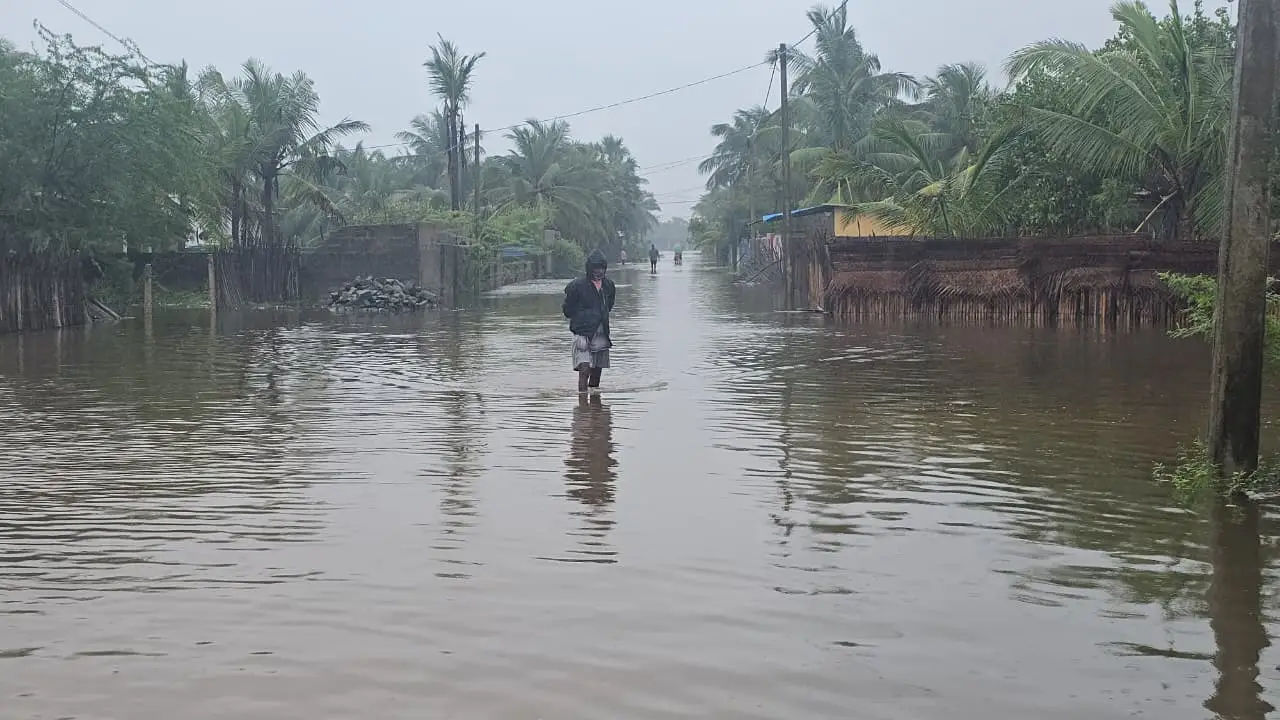

Cyclone Ditwah, which made landfall on 28 November 2025, has been described as one of the most devastating ecological disasters in modern Sri Lankan history. Affecting all 25 districts and impacting nearly two million people, it caused an estimated US$4.1 billion in physical damage.
While national attention initially focused on flooding, displacement, and infrastructure destruction, the deeper consequences are now emerging in rural regions where livelihoods depend not on formal financial systems but on living assets.
Nowhere is this more visible than in Mannar District in the Northern Province.
In rural Mannar, economic security does not rest primarily in bank accounts, insurance, or formal employment. It rests in what local communities often describe as a ‘living bank’ – cattle, goats, poultry, land, and small agricultural assets that families depend on during hardship.
These assets function as savings, credit, food supply, and labour support simultaneously. When crisis strikes, they are sold, consumed, or traded to stabilise household survival. When they are destroyed, the household economy collapses.
Cyclone Ditwah directly struck this foundation.
According to the Department of Animal Production and Health, floods and landslides affected approximately 35,000 cattle and 15,000 goats, with Mannar accounting for the overwhelming majority of losses in the Northern Province. Large numbers of local cattle breeds died, while pasturelands and natural grazing areas were severely damaged. Surviving dairy animals weakened due to nutritional loss, increasing the risk of disease and further mortality.
For many farming families, this was not the loss of livestock alone. It was the disappearance of their primary financial reserve.
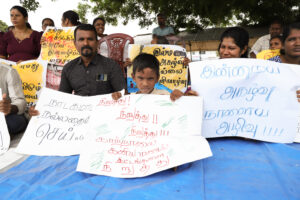
The Mannar District Secretariat reported that more than 127,000 people were affected and hundreds of houses damaged. Entire cattle-raising regions including Nanattan, Musali, and Manthai East, faced widespread agricultural and livestock devastation. Floodwaters destroyed over 17,000 acres of rice cultivation, submerging farmland and removing both immediate income and future harvest potential.
This occurred in a district already experiencing cumulative economic stress. Cold spells in 2022, drought in 2023, disease outbreaks such as foot-and-mouth disease, and recurring feed shortages had already weakened the cattle economy.
Decades of war had further eroded rural resilience, limiting savings, infrastructure development, and institutional support. The cyclone therefore did not create vulnerability, but rather it exposed and accelerated it.
The financial consequences are now becoming visible. Rural households in Sri Lanka already face high indebtedness, with roughly 38% carrying debt prior to the disaster. Many farmers had taken loans expecting Maha season harvests to cover repayments. With crops destroyed, animals dead, and equipment damaged, repayment capacity has collapsed. Without intervention, families may be forced to sell land to survive, transforming a temporary environmental shock into permanent economic dispossession.
This is why the loss of the ‘living bank’ matters. Natural disasters regularly destroy infrastructure, but recovery is possible when households retain productive assets. In Mannar, however, the cyclone removed the very mechanism rural communities use to recover.
Livestock deaths eliminate milk production, transport labour, fertilisation capacity, and emergency income simultaneously. The disaster therefore moves beyond livelihood disruption into structural impoverishment.
Infrastructure failures worsened these impacts. Flood-prone regions such as Mannar, located near lagoons and low-lying river plains, remain highly exposed. Drainage systems rely on outdated rainfall data, coastal protection reflects historical rather than current storm patterns, and wetland barriers have been reduced through development. As a result, flooding is no longer an exceptional event but a recurring structural risk.
The cyclone demonstrated that vulnerability in Mannar is not simply environmental. It is institutional.
Emergency assistance appropriately prioritised food, shelter, and clean water. However, recovery policies that focus only on humanitarian relief overlook the central issue: rural economic systems based on living assets cannot recover through short-term aid alone. Without livestock restoration, grazing rehabilitation, and debt protection, affected families remain economically paralysed long after floodwaters recede.
The situation therefore represents more than a natural disaster. It reveals the intersection of environmental exposure, economic marginalisation, and governance gaps. When repeated shocks destroy productive assets in already vulnerable regions, recovery becomes impossible without structural policy intervention. The risk is not only poverty, but land transfer, rural depopulation, and long-term decline in local agricultural capacity.
Mannar’s crisis illustrates a broader national challenge. Climate-intensified disasters are increasing in frequency and severity, yet rural economic protection mechanisms remain underdeveloped. Development planning has historically emphasised infrastructure and relief rather than asset resilience. As climate risks intensify, this approach becomes increasingly unsustainable.
A meaningful recovery strategy must therefore move beyond reconstruction toward protection of productive systems. Restoring livestock populations, rehabilitating grazing ecosystems, restructuring rural debt, and strengthening climate-adapted land management are essential to prevent temporary disaster from becoming permanent economic displacement. Without such measures, affected communities will not recover, and instead will exit agriculture entirely.
Cyclone Ditwah was an environmental event, but its consequences in Mannar are economic and political. The destruction of the living bank has exposed the fragility of rural survival systems and the limits of existing recovery frameworks. Genuine reconstruction depends not only on rebuilding infrastructure but on rebuilding the assets that allow communities to sustain themselves.
If recovery policies fail to address this, the disaster will not end with reconstruction. It will continue through indebtedness, land loss, and the slow disappearance of rural livelihoods.
Photo courtesy of TamilGuardian.com
[Co-authored by: Venthan Kathiramalai]
Venthan Kathiramalai is a Lecturer in Law at Arden University, UK. He holds an LL.B and LL.M in Law, as well as a B.A. in Theology, and is currently completing an M.Sc. in Security, Peace-building and Diplomacy at Loughborough University and is also undertaking an M.Sc. in Applied Neuroscience at King’s College London.
His teaching focuses on International Commercial Law, Criminal Law, Contract Law, and Public Law. His interests center on empowerment, governance, and policy development, responsibility, and long-term societal vision.
Alongside his academic work, he hosts Venthan’s Perspective, a platform for conversations with thought-provoking individuals aimed at encouraging reflection and purposeful action. He writes on human dynamics, people skills, ethics and virtues, leadership, and public life, and is involved in community-focused initiatives.