Time-Energy Accounting for Sri Lanka’s Sovereign Economic Transformation
Sri Lanka stands at the crossroads of financial subjugation and sovereign renewal. With a looming sovereign debt crisis, the nation faces stark choices: continue under the dictates of external creditors or pioneer a post-debt economy grounded in self-sufficiency, ecological stewardship, and labour-based justice. This white paper proposes a comprehensive framework to enable the latter through:
- Time–Energy Accounting (TEA) as a real-time, distributed alternative to fiat-based economic transactions
- Mahasammata, a citizen-defined moral consensus and foundational social contract
- Gramaraj, a decentralized governance model rooted in Sri Lanka’s puranagama heritage
- Oxygen Tokens, building upon Ranil Senanayake’s ecological valuation to integrate nature’s services into the accounting core
Together, these frameworks enable a radical yet rooted transformation toward local productive sovereignty.
1. PHILOSOPHICAL FOUNDATION: THE MAHASAMMATA CONSENSUS
The Mahasammata principle revives the ancient model of legitimacy via social consensus—”If man lives in dhamma, the land and the people will be safe.” It replaces coercive rule with participatory governance and places meritorious service, mutual obligation, and ecological balance at the heart of economic and legal systems.
The ten rules of Mahasammata are not merely ethical codes but structural elements of a functioning, efficient society. Rule 5, in particular, encompasses the foundations of contract, tort, and civil duty, enabling the formation of binding agreements, the recognition of harms and remedies, and the affirmation of civic responsibilities among individuals and between individuals and the community. It forms the legal infrastructure through which obligations are voluntarily entered into and disputes are resolved, without reliance on a centralized legal apparatus.
This distributed normativity ensures that justice and fairness are embedded in the everyday social transactions of Mahasammata society, and allows society to operate without expansive legal bureaucracy. Citizens of Mahasammata are those who affirm and live by this consensus.
2. ECONOMIC SYSTEM: TIME–ENERGY ACCOUNTING (TEA)
TEA is a direct challenge to the abstraction of value inherent in fiat currency. Drawing from Buckminster Fuller, F. Mansoor’s 2018 paper, and principles of Payment for Ecosystem Services (PES), TEA measures value as the inverse of energy consumed—rewarding ecological efficiency, human effort, and productive utility.
2.1 Core Value Formula
Economic value (ECO) is defined as:
ECO(V ) = [ 1/((eCOB/AQI).EDV) ] × L
Where:
- EDV: Energy Delivered Value = e1 × t1 + e2 × t2 + … + en × tn = ∑(ei × ti), calculated via Energy Delivered Index (EDX) and collates the overall cost of delivering the Energy that is used in the production across fossil to renewable sources, where t is a weight that is universally agreed by consensus as a proxy for the time and energy that has gone into locating, converting and delivering to end user
- EDX is the average weight applied as restitution of primary ecological services consumed in an economic unit as established by a Competent Authority
- Oxygen Token: O is the Gross Oxygen the eco-system of the production area generates
- eCOB: Energy Cost of Breathing in that economic unit, what an economic actor consumes in energy on average in a 24 hour period
- AQI: Air Quality Index as a proxy for photosynthetic biomass
- L: Labour premium based on quality, quantity, supply, and demand; Utility: Determined by central accounting codes, adjustable by market demand
This framework rewards:
• Local production over imported goods
• Labour-intensive, ecologically sustainable practices
• Community-defined utility rather than capital accumulation
2.2 Instantaneous Valuation
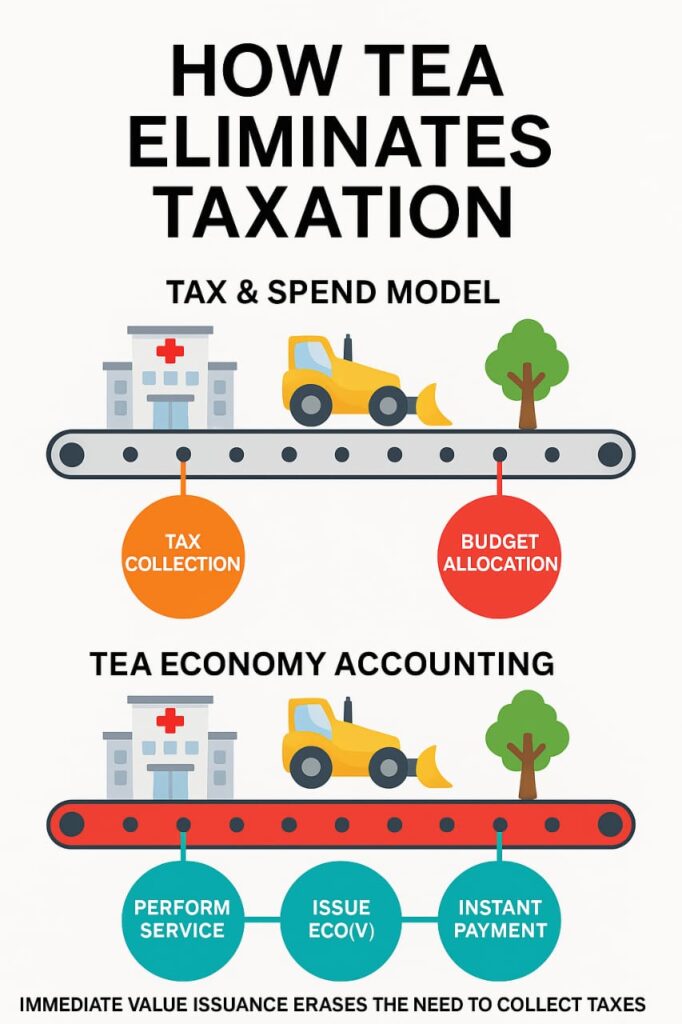
By integrating Distributed Ledger Technology (DLT), TEA ensures that value is assigned the moment work is done—such as a rural doctor’s service at the end of her day. This data is transmitted, validated, and added to the national TEA income, separate from fiat currency.
3. ECOLOGICAL SERVICES: OXYGEN TOKENS & PES
Senanayake’s Oxygen Economy correctly identifies the critical value of biospheric function, particularly photosynthesis. However, its reliance on fiat pricing introduces external distortions.
TEA internalizes PES through Oxygen Tokens: These tokens are implemented as unitized credits denominated in oxygen value and linked to specific geospatial zones based on their photosynthetic activity. Monitoring, Reporting, and Verification (MRV) systems—utilizing satellite imagery, drone-based LIDAR, and AQI sensors—continuously assess oxygen production potential of each locality. Token issuance is automated via smart contracts on Distributed Ledger Technology (DLT), ensuring transparency and traceability.
Real-world examples include pilot reforestation and agroecology projects in South Asia and Latin America that use blockchain to track biomass restoration and compensate local communities. Oxygen Tokens thus become a measurable, transferrable, and stake-based reflection of ecological stewardship.
• Valued in energy units, not fiat
• Credited to stewards of photosynthetic biomass (farmers, forest communities)
• Monitored via MRV systems linked to AQI, biomass density, and sequestered carbon
This resolves a long-standing debate between TEA and Oxygen Economy advocates: rather than pricing nature, TEA counts nature’s labour as value.
4. GOVERNANCE FRAMEWORK: GRAMARAJ
Gramaraj’s model offers a fully realized separation of powers and a robust anti-corruption framework that complements TEA’s societal architecture:
• Local democratic legitimacy via elected sector councils
• Independent oversight through citizen-led commissions and a professional civil service
• Legal integrity via judicial services grounded in Mahasammata’s Rule 5 principles
This creates a governance scaffold where TEA can operate as a real-time economic engine grounded in accountability, subsidiarity, and transparency.
4.1 Structure
Gramaraj revives the puranagama’s cascade model: This system ensures democratic accountability at every level by structuring governance from the bottom up. Each GN division (∼1,500 people) elects five sectoral representatives accountable to their immediate community.
These representatives carry mandates to the District Councils and Parliament, where their actions can be publicly reviewed and, if necessary, recalled. This design embeds subsidiarity—ensuring that decisions are made at the most immediate level possible— while upward integration maintains coherence.
Through this mechanism, political power is not concentrated but diffused through layers of transparent representation and participatory governance.
- Each GN division (\~1,500 people) elects 5 sectoral representatives (Agriculture, Education, Health, Infrastructure, Commerce)
- These feed into District Councils and Parliament, with recallable mandates
- A Ceremonial President oversees Supervisory Commissions (Judiciary, Audit, Human Rights, Environment)
4.2 Anti-Corruption Architecture
A professional civil service free of political appointments, monitored by citizen-led commissions, ensures:
• Zero tolerance for political patronage;
• Transparent oversight of all TEA processes;
• Decentralized, non-monetized incentives for community service.
4.3 Governance
Annex: Mapping TEA into Gramaraj’s Constitutional Design
1. Local Executive (Production & Delivery)
• Entities: GN-level Sector Councils (Agriculture, Health, Education, Infrastructure, Commerce)
• Function: Record, verify, and transmit TEA credits; set sector priorities
• Legitimacy: Directly elected by \~1,500 citizens per GN unit
2. Legislative Oversight
• Entities: District Councils and National Parliament (elected via cascade)
• Function: Ratify utility codes, sectoral TEA allocations, ecological mandates
• Legal Foundation: Rule 5 enshrines consensual obligations and harm–remedy norms
3. Judiciary / Legal Integrity
• Entities: Independent Judicial Commissions (e.g., Community Dispute Resolution Boards)
• Function: Resolve disputes, enforce ecological and labour contracts, interpret TEA obligations
4. Administrative Infrastructure
• Entities: Professional Civil Service (non-political)
• Function: Operate TEA ledgers, Oxygen Token MRV systems, compliance audits
5. Oversight & Integrity Commissions
• Entities: Human Rights, Environment, Audit, Ombudsman
• Function: Verify TEA and Oxygen Token issuance, prevent fraud, uphold Mahasammata principles
5. DUAL CURRENCY MODEL
Sri Lanka can maintain the LKR for debt servicing and exports, while running TEA for local production: While this dual-currency system enables sovereign resilience, it also presents risks that must be actively managed. Parallel systems may generate arbitrage opportunities—where goods or labour are traded between the TEA and LKR economies for personal gain—undermining the integrity of either system.
Additionally, black markets may emerge where TEA credits are unofficially exchanged for LKR or foreign currencies, distorting pricing signals. To mitigate these, regulatory safeguards, strict audit trails, and technological enforcement via distributed ledgers must be integrated. Public education and legal clarity on usage domains will be essential to minimize friction and maintain system coherence.
• State workers (doctors, teachers, etc.) receive TEA credits daily
• TEA credits fund local economies, social services, and infrastructure
• No new sovereign debt is incurred for internal productivity
6. ROLLOUT PLAN
Phase I – Legal & Technological Foundation
• Enact enabling legislation for TEA and Gramaraj Councils;
• Pilot TEA in selected puranagama-based villages;
• Establish MRV systems and AQI-linked Oxygen Token protocols.
Phase II – Integration & Scaling
• Integrate TEA payments in health, education, agriculture sectors
• Link Gramaraj sectoral councils to TEA accounting networks
• Create local TEA markets
Phase III – National Transition
• Tie TEA credits to global PES markets via biodiversity treaties
• Create a TEA-LKR exchange system (with oversight)
• Embed Mahasammata into constitutional law
7. CONTRIBUTORS & INTELLECTUAL FOUNDATIONS
• Farmer Mudiyanse Tennekoon – Puranagama insights
• Manik Sandrasagra, Patrick Harrigan – Cultural restoration
• Ranil Senanayake – Oxygen Economy and ecological valuation
• Amrik Jayewardene – Post-colonial critique
• Buckminster Fuller – Time–Energy Accounting
• C.H. Douglas – Social Credit
• J.W. Smith – Cooperative Capitalism