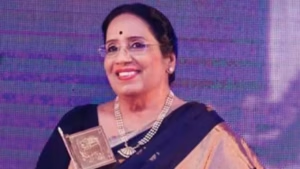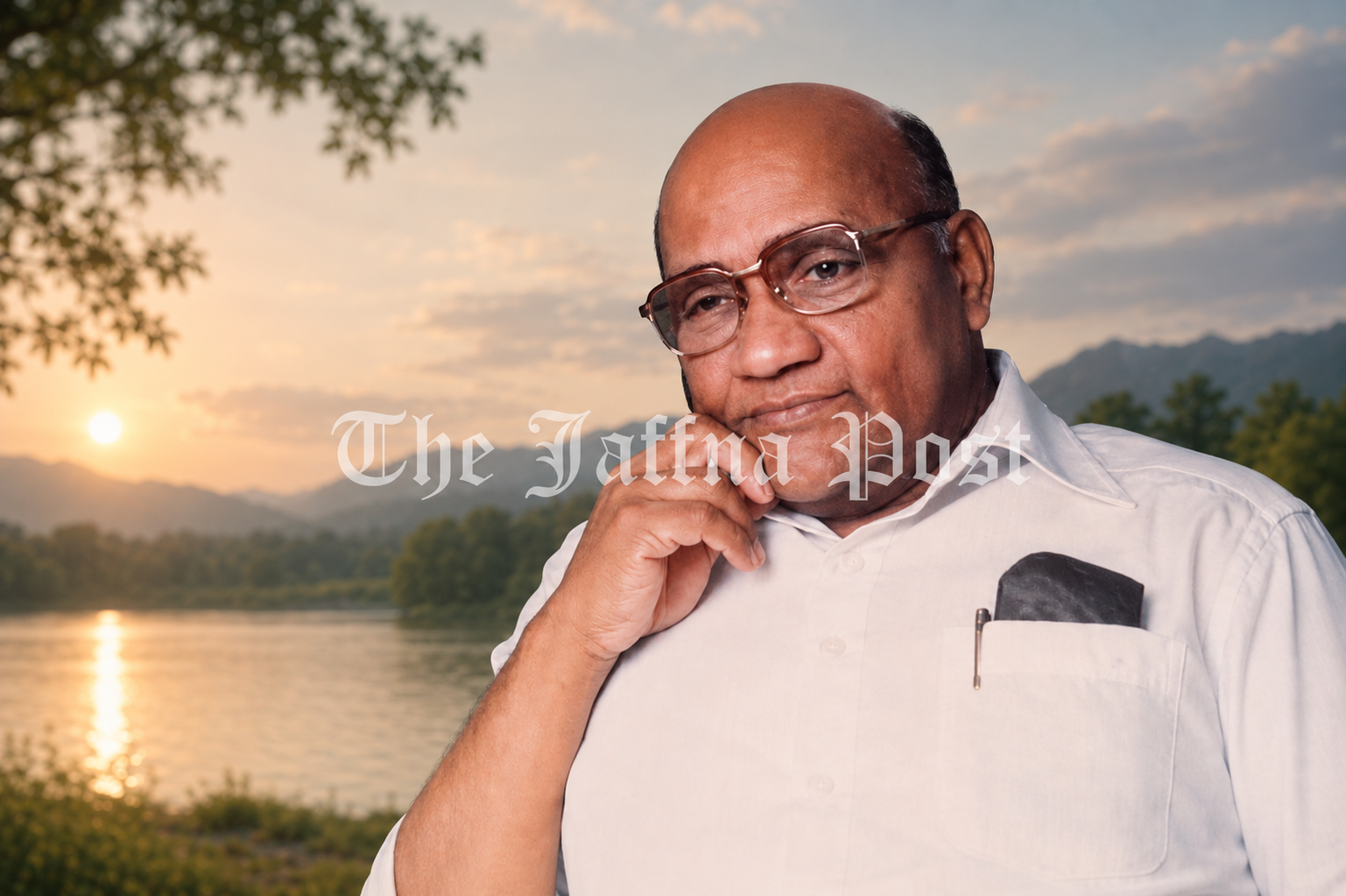

A memorial lecture was held on August 29 at the Jaffna Public Library Auditorium to mark the 99th birth anniversary of the late Appapillai Amirthalingam, former Secretary-General of the Tamil United Liberation Front (TULF) and one of the leaders who shaped the course of Sri Lankan Tamil politics in the last century.
Organized by the Amirthalingam Memorial Trust, the event was presided over by Dharmalingam Siddharthan, leader of the People’s Liberation Organisation of Tamil Eelam (PLOTE) and former Member of Parliament.
Dr. Jehan Perera, Executive Director of the National Peace Council, delivered the memorial address on the theme ‘Amirthalingam’s Legacy and Sri Lanka’s Democratic Choices for a Shared Future’.
Dr. Jehan Perera’s speech, delivered in English, was not merely a tribute to a political leader or a re-reading of past memories. Rather, it served as an insightful analysis, and in a way, a warning on post-independence Sri Lanka’s ethnic conflict, the decline of democratic institutions, and the choices available to address the contemporary constitutional challenges facing the country. He noted that speaking about Amirthalingam is not about an individual, but about discussing one of the most tumultuous chapters in Sri Lanka’s history.
Dr. Jehan Perera is a prominent civil society representative who consistently advocates for the political rights of minority communities and a reasonable political solution to the national ethnic problem. He maintains a firm stance that the ethnic issue is not merely a matter of economic or social development, but fundamentally one of power-sharing, political rights, and identity.
Moving beyond southern Sri Lankan majoritarian mindsets, he continuously emphasizes the need to adopt a pluralistic system of governance that recognizes the distinct political aspirations of the Tamil and Muslim communities. Alongside the issues of Sri Lankan Tamils, Dr. Perera has also actively voiced support for the solutions and aspirations of the Hill Country (Malaiyaha) Tamil community.
His approach aims to build a bridge of dialogue between southern society and the northern, eastern, and hill-country communities. Even amidst fierce nationalist pushback in the South, he stands firm in his conviction that recognizing the legitimate political aspirations of minority communities is the only path to Sri Lanka’s long-term peace and stability.
As one of the notable liberal democratic intellectuals in Southern Sri Lanka, Dr. Jehan Perera avoids a harsh tone in his writing and presentation style. One of his defining qualities is analyzing issues objectively without giving in to emotional sentimentality, while still stating his positions with absolute clarity. His characteristic trait of stating facts plainly without alienating the stakeholders involved was evident throughout this memorial lecture.
Key excerpts from his speech
“The memory of families carrying losses and scars—not only in the North and East, but also in the South and the Hill Country—must transform into true wisdom. If that memory remains merely a grievance, it will only serve to perpetuate conflict. Conversely, when it turns into wisdom, it creates a responsibility for future generations. (By wisdom, he refers to the practical discernment and capacity to make sound judgments using experience.) Coexistence is not a rule written solely in constitutional documents; it is a daily practice that must be maintained with eternal vigilance.
“When the Ilankai Thamil Arasu Kachchi (Federal Party) was founded under the leadership of S. J. V. Chelvanayakam, the leaders’ goal was not the division of the country; their objective was to achieve power-sharing within a united Sri Lanka. However, when successive non-violent struggles and negotiations from the Banda-Chelva Pact to the Dudley-Chelva Pact collapsed due to electoral pressures, the confidence in Tamil politics was shattered.
“The 1976 Vaddukoddai Resolution was neither a sudden emotional decision nor something born out of a vacuum. It was the accumulated expression of decades of constitutional disappointments. The overwhelming mandate secured by the TULF under the leadership of A. Amirthalingam in the 1977 general elections was the democratic manifestation of the frustration that prevailed among the Tamil people. Amirthalingam’s position—carrying the public mandate to divide the country while simultaneously serving as the Leader of the Opposition in Parliament—represented one of the most contradictory, yet difficult, democratic moments in Sri Lankan politics.
“Sri Lanka’s history of conflict stems from two distinct forms of unilateralism. Sinhala majoritarianism believed that majority strength alone should determine the nature of the state. Tamil separatism, driven by continuous betrayals, believed that a separate state was the only solution.
“Majority rule is essential for democracy, but majoritarian ownership of the state is entirely different. Elections may decide the government, but they should not determine who holds greater ownership over this country. Furthermore, instead of asking ‘Who controls the state?’, raising the question ‘How can every community become a shareholder in this state?’ is what will build a pluralistic democracy.
“It is a reality that the 13th Amendment was born in 1987 amidst Indian intervention and armed conflict, and that neither the LTTE nor the geopolitical pressures of that era exist in the same form today. However, within the current constitutional framework, the 13th Amendment remains the only provision that possesses legal legitimacy for power-sharing. Therefore, rejecting it is not prudent. Correcting its weaknesses and implementing it fully would be the responsible course of action.
“Provincial Council elections have been frozen without being conducted for over a decade. Sharing police and land powers will strengthen the country’s security rather than weaken it. Reconciliation cannot be kept on hold until all economic problems are solved.
“The assassination of Amirthalingam in July 1989 was part of a calculated, cruel effort to eliminate alternative democratic voices and bridge-builders between ethnic communities in Tamil society. Sri Lanka has repeatedly paid the price for losing such leaders.
“Democratic politics is not a path where the ultimate goal can be reached all at once. It is a continuous search for self-respect without humiliation, justice without revenge, and equality without domination. Realizing the reality that politics rarely offers perfect choices, having the courage to negotiate even with incomplete opportunities was the hallmark of Amirthalingam’s leadership. On that path, alongside the rule of law and corruption-free governance promised by the National People’s Power government, the country must move toward a new constitutional future that treats all communities as equal partners.”
The main message of Jehan Perera’s speech is that Sri Lanka must break free from past bitterness and build a ‘pluralistic democracy’ that embraces all communities through practical constitutional solutions. It emphasizes that in the post-civil war era, taking a pragmatic approach—utilizing existing legal frameworks like the 13th Amendment to incrementally secure powers—is wiser than waiting for maximalist demands and losing available opportunities in the process.
Another key emphasis of Jehan Perera is that the Tamil people, who have been affected by war and political oppression, should not merely store their losses and memories as grievances. Instead, they must use those experiences as wisdom to make practical decisions and evaluations demanded by current realities.
This memorial lecture serves as a reminder of the political void created within the Tamil community during that era by the loss of moderate leaders who were willing to engage in talks, such as Amirthalingam. That void remains unfilled to this day.
Jehan Perera’s speech will undoubtedly be approached and interpreted from various angles by different factions in Sri Lanka’s current political context.
While moderate-minded Tamil political forces will welcome the view that the 13th Amendment should not be rejected but used as a tool to advance devolution of power, hardline Tamil nationalist forces like the Tamil National People’s Front will view Jehan Perera’s speech with severe criticism.
They will argue that the 13th Amendment is insufficient to fulfill the legitimate political aspirations of the Tamil people and that Jehan’s emphasis acts as an attempt to gloss over the serious flaws in the Provincial Councils system. They will also contend that the approach of seeking a consensus within a unitary state has already failed.
However, among the Tamil public in general, there is a deep-seated suspicion that regardless of which government comes to power in Southern Sri Lanka, it will not deliver a meaningful devolution of power, including police and land powers, that can fulfill their legitimate political aspirations even to a minimal extent.
The National People’s Power government promised the people that it would hold Provincial Council elections within a year of taking office. However, it is currently employing tactics to delay these elections further. Its apparent indifference toward resolving humanitarian issues resulting from the war, such as the release of lands and demilitarization, even after more than 17 years since the end of the conflict, has further reinforced the Tamil people’s skepticism.
In such a context, while calling for a “change of mindset” in Southern Sri Lankan society is theoretically welcome, the question of how feasible it is in practice remains a constant one.