
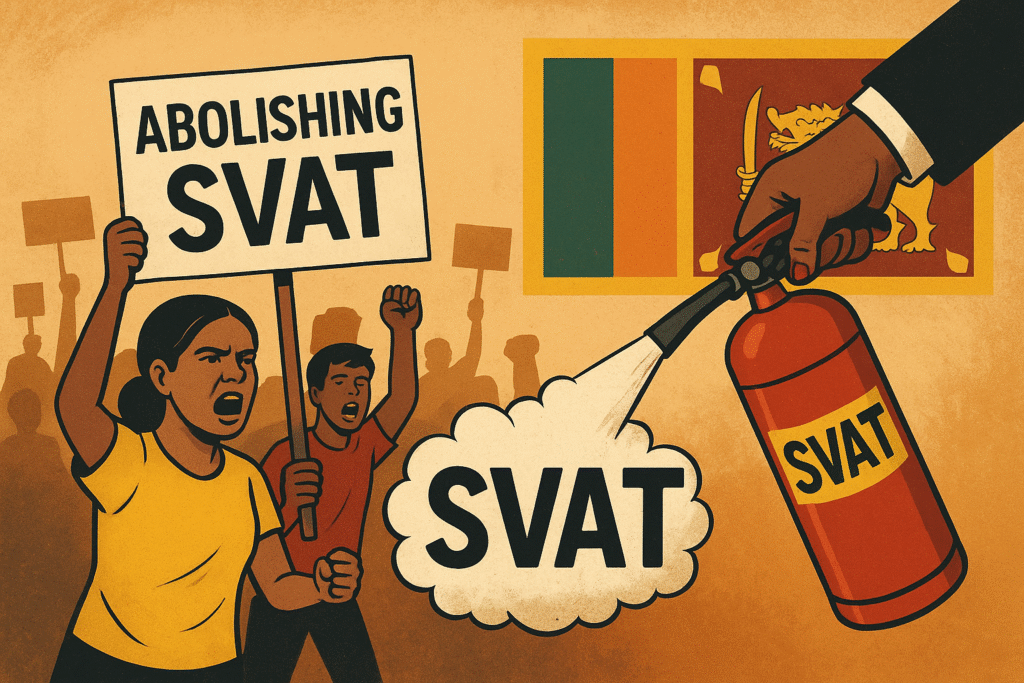
After several postponements, initially by Ranil’s government in April 2024, and finally by NPP Government, steps are being taken to go back into inefficient VAT implementation. SVAT or Simplified VAT was a progressive step in the efficient implementation VAT tax collection. It is being withdrawn from October 1st 2025, under the IMF’s iron fist. President met with one of the export sector, Garment Industries, representatives recently, I do not know whether this was taken up and what decision was made.
However, It is wise move by the industry to it to the judicial intervention..
Suitability of high indirect taxes to Sri Lanka
First of all, suitability of indirect tax system introduced by liberal governments of the west after cutting down progressive and more equitable direct taxes, for a less equitably income distributed country like Sri Lanka, especially single VAT percentage, is a big question. In a country with more equitable income distribution, tax on expenditure by individuals does not skew the income distribution much. But with high percentage of families unable to meet their basic need of three meals a day, is it suitable. We follow blindly, whatever the west does. High indirect taxes are not surprising under neo liberal governments, but is it proper even under a left oriented government. In the modern world, where government of the proletariat is a dead concept, only pragmatic left policy can be a more equitable distribution of wealth. It has to be more direct taxes and less indirect taxes.
Working class treated badly
Only people who were adversely affected by the debt restructuring is the ‘working class of this country only their funds, EPF debt was badly affected. All the dollar loams of the ‘capitalist’ class of banks and their customers were more than well compensated by restructuring, Government of the working-class is going along with that injustice committed on the working class.
Protection to privileged Working elites
Even the high earning central bank ‘working’ elites are protected having separate fund with guaranteed income, supplemented by central bank money.
Remittance to professional bodies abroad and tuition fees remitted to foreign universities does not attract VAT. I do not think they attract withholding tax either. Companies who provide digital services did not attract VAT for a long time; still there is a delay in its implementation. It could have been easily implemented by placing the burden on the local banks issuing credit cards and remitting for these services to collect VAT on cash basis and pay it to the government. One Indian company told me, when we were implementing a system for credit card payments that, if an Indian pays in USD by credit card in India, VAT will be recovered by the bank. I am not sure really whether it is so. But it could be an easy way to collect VAT from people, who can afford foreign services and products. We have still not implemented more difficult process of registration and collection and remittance of VAT by foreign digital service suppliers above threshold. Compliance could be extremely difficult to monitor.
Without focusing on collecting additional VAT from people who can afford, why is the government focusing on matters that will not improve the net tax collection at all but make total collection system inefficient. More work and no additional revenue.
Following the footsteps of defeated RW
NPP in its election platforms said they will review IMF agreement but are following the footsteps of neo liberal Ranil Wickremasinghe in every step of the way.
Is it because NPP gave election pledges just to win the election or they do not have with them experts who can manage IMF or by sticking to their comrades only as policy do not want to get independent experts, Only NPP leaders will have the answer to this question?
VAT System Principle
Principle of the VAT tax system is that, on behalf of the government, supplier of goods and services, charges tax to customers, collects it and remits to the government. For example, if the supplier sells at LKR 200, then he will collect another 18% that is LKR 36 from the buyer and will remit it to the government. In the invoice tax amount should be clearly stated. However, if he has bought services from another supplier for LKR 50 and has paid tax of 9 (18%) known as the input tax, he can deduct that tax from the LKR 36 known as output tax and will remit only LKR 27. That is, business enteritis will collect output tax from buyer, deduct what they have paid on input to their supplier and will remit the balance. It amounts to, tax paid by each business entity is 18% on value addition by the business entity in the supply chain and the thus the name Value Added Tax.
Government will get LKR 9 from the first company as it has output tax and no input tax as the first member in the supply chain and from the second company 27. Government will get total of 36 as VAT. That is the tax 18% on final consumption value of 200 at the end of the supply chain.
Zero Rated Exporter
Tax on export revenue is zero, ‘You cannot export tax’ as the saying goes. Exporters are called zero rated. Exporters will not have output tax or will have zero percent output tax on their sales value as tax, therefore by the principle of net of output tax less input tax, export company tax payment is zero minus Input tax, which is negative amount equal to the input tax That is whatever they paid as input tax will have to be refunded by government.
In the previous example, if the second company sells to an export company, export company will who is charged LKR 36 VAT, will get a refund of LKR 36. All what is collected from two suppliers in the supply chain will be refunded by the government. That is net Tax revenue to the government from the export supply chain will be zero as we cannot export tax and be noncompetitive. VAT tax revenue will come from the domestic and imported supply chain only.
Simplified VAT System
SVAT principle is that export companies need not pay the Input tax and get refund later; instead, they should not be charged VAT and VAT should not be collected from them by their suppliers. The VAT tax on input is suspended to SVAT registered export companies. Their suppliers charge and show in the invoice not VAT but suspended VAT (SVAT) which is not collectable by suppliers and not payable by exporter-buyers and not remitted to the government This will eliminate refund process altogether.
SVAT implementation reduces the work of the system without reducing the tax collected by government and credit should go to the ingenuity of the people who introduced it. It was introduced not to improve the efficiency of the system though. It was introduced as a means of eliminating refund process altogether after a high value, estimated to be 5 billion, fraud in the VAT refund process the government experienced. Just after the VAT scam, export companies did not get the refund for two to three years before the implementation of the SVAT system. Industry some refunds of 2010, are still not done. SVAT system really improves the efficiency of the system by eliminating paying first and refunding later, double work without any benefit of extra tax revenue and possible scams on the refund.
In summary, normal VAT will reduce the working capital of the zero-rated export companies whose existence and growth are essential to any economy especially our bankrupted economy. Government wants to hold on to the exporter’s money for significant amount of time. Government will hold Input tax of the export companies during the time government bureaucracy takes to refund. It will verify the returns with the returns of the suppliers to the export company. It will go through elaborate process of approval of payments. Going by previous experience, best could be six months; worst could be even a year or at times more especially when supplier of export companies does not file returns on time. Now that the government officers are scared of being implicated in corruption, delay could be even longer. In addition, initial delay could be more as process need to be reestablished, as they have not done refund for several years under SVAT.
This excess cashflow of government will not grow. Its static value will depend on how lethargic the bureaucracy is in the refund process. After initial high inflow when SVAT is withdrawn, inflow and out flow will be same after some time. Government could have printed once that amount of money even, without jeopardizing the export sector performance.
Extending VAT
Ideally, the concept should have been extended without limiting it to just export companies only. The rule should have been that VAT tax should not be collected when the sales is made to a VAT registered company. Only should be collected from non-VAT registered companies and individuals, that is people at the end of the VAT registered supply chain.
For example, let us assume, there are three organization in a supply chain with
- first company’s only invoice is 50+9 VAT to second company
- Second company’s whose only sales invoice is to third company at 200+36 VAT and
- Third company invoice is at 500+90 VAT to non-VAT registered entities.
First company Output Tax is 9 and input tax is 0. Therefore, VAT payable is 9.
Second company Output Tax is 36 and input tax is 9; Therefore, VAT payable is 27.
Third Company output tax 90 and input tax is 36 and therefore VAT payable is 54.
Total VAT government will get is 9+27+54 is 90.
If you extend the principle of SVAT to all, by collecting VAT from the sales to non-VAT registered companies and VAT exempted companies. VAT registered companies will have no input tax as they will not be subjected to tax by the extended SVAT rule. They will only remit what they collect as tax to non-VAT registered and VAT exempted entities.
In the example first company to second will not have any tax at all as the second company is VAT registered. Its sales invoice will be 50 only. Second company will not collect any tax from the third company as the third company is VAT registered. It is invoice value will be just 200. Third company is selling to non-VAT Registered company as such it will charge 500+ 90 VAT and remit that tax to Government as there are no input taxes.
Government will therefore get in a single payment 90 tax under extended SVAT system while LKR 90 will come from three transactions under normal VAT system.
This would have improved the efficiency of the economy by reducing the amount of tax payment transactions in the economy without reducing the collection of VAT tax. Compliance could have been improved by a proper computerized or using current IT hype word digitalization. Compliance could also be improved as the companies paying VAT will be from companies that sell to non-VAT registered.
First in the world
We may be the first country in the world to implement this SVAT to all companies and may be the world would have followed us. There have been instances where the world followed us, Thanks Late Professor Senaka Bibile who against the strong protest of pharmaceutical multinationals advised the then government to introduce the regulations to insist on drugs labels carrying generic name in 70s. Today more than 140 countries have the same regulation following Sri Lanka.
I benefited from this process when I was in Bangladesh, and I ran short of prescription drug when I went to the pharmacist with the label with a brand name not available in Bangladesh, he managed to read with magnifying glass – drug companies print the generic name n the smallest possible- the generic name of the drug and gave me the drug manufactured and marketed under different brand name in Bangladesh.
Compliance
There would have more compliance and higher collection by reducing the number of entities from whom tax need to be collected without change in the total tax collected. I recently read an article written by an ex Inland Revenue Commissioner who has advocated eliminating trading from VAT as it was conceived initially, so that enforcing compliance is easier with reduced number of Tax payers. He argued that percentage of value added is very low in trading and it can be compensated by adding few percent to VAT of manufacturing and service sectors.
To enable compliance audit, all companies should be asked to file reruns showing details of sales to all entities both VAT registered and non-VAT registered as at present. Auditing could have been automated by a suitable system
Leak in VAT could be compared by a Tax administration software that will match the returns from Suppliers and Customers. Inland Revenue department appears to have wasted billions on a computer system to administer tax. System development and implementation was going on for more than a decade by a ‘international’ firm from Singapore I have seen articles praising the system by some ‘professionals’ praising it that it will help 100% compliance. Previous governments ministerial committee just before its term, said that it is a failure and I know some people employed by that company and it was not a surprise for me that it failed. Previous government’s ministerial committee wanted to change the vendor after more than a decade of incomplete imp[lamentation and billions of rupees spent. I do not know the status of the system now. I wonder what the presidential adviser on digital economy and ICTA doing ignoring this economically important and critical aspect.
Conclusion
Instead of proper implementation of tax collection, supported by a computerized tax administration system, government seems to be making doing business difficult for companies, especially export companies to do business, a suicidal attempt for the economy by withdrawing SVAT, a process created by the ingenuity of the Sri Lankans on the recommendations of what appears to be stupidity of IMF officials, it it was on their advice.















A great article on SVAT by Ram. Deserves wider publicity in Sinhalese and Tamil for mass education.