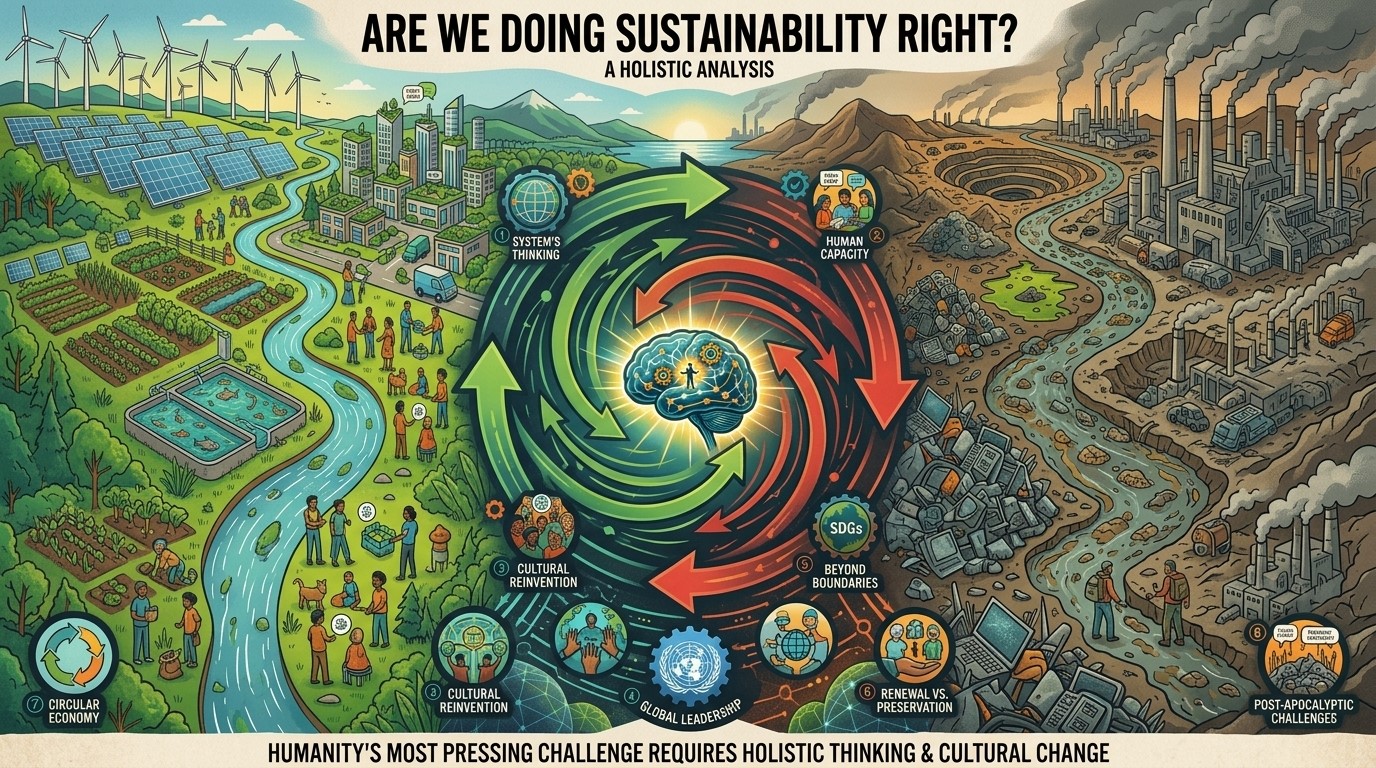

September brings global leaders to the UN Headquarters in New York to discuss some of humanity’s most pressing challenges, including sustainable development and progress towards the Sustainable Development Goals (SDGs). It is also a useful moment to ask an uncomfortable question: Are we doing sustainability right?
Sustainable development is commonly defined as development that meets the needs of the present without compromising the ability of future generations to meet their own needs.
The language of sustainability is now everywhere. Governments have policies and targets. Businesses have sustainability strategies. The UN has frameworks and goals. Scientists develop solutions. Civil society campaigns for change. Consumers are encouraged to make more responsible choices.
And yet, we continue to pollute, deplete resources and place increasing pressure on ecosystems, with social and economic consequences. So perhaps the problem is not simply a lack of policies, technology or knowledge.
What if sustainability is also fundamentally a human capacity problem?
Here is my argument: Sustainability is a system not a department
Sustainability is often discussed primarily as an environmental issue: climate change, carbon emissions, waste, biodiversity, water and energy. These are critical but sustainability is much bigger than the environment.
A country’s ability to sustain itself also depends on its people, institutions, economy, social cohesion and capacity to adapt. An economy that destroys the environmental foundations on which it depends is not sustainable.
An institution that cannot retain knowledge, learn from its mistakes or adapt to change is not sustainable. A society that leaves large sections of its population without opportunity is not sustainable.
Similarly, an organization that achieves short term gains while undermining the conditions required for its long-term survival is not sustainable. Sustainability is therefore not one sector. It is a system.
Consider something as ordinary as a plastic bottle. A company produces it, a supply chain transports it, a retailer sells it, a consumer buys it and eventually disposes it. A waste management system then processes it or fails to.
Government regulates the system, while civil society advocates for change and the media shapes public understanding. Eventually, the consequences may or may not reach rivers, oceans, ecosystems and communities.
Where exactly does the sustainability problem begin?
With the consumer. The company. The government. The waste-management system. The answer is uncomfortable because it is often all of them at once. The system produced the outcome.
This is why sustainability cannot simply sit inside a sustainability department. A company can have a sustainability strategy while its incentives continue to reward unsustainable behaviour. A government can have an environmental policy while implementation remains weak.
A country can make international commitments while everyday behaviour remains unchanged. A sustainability report may describe the ambition however it does not automatically create the capacity to achieve it.
The missing piece may be human capacity
This brings me to the part of the sustainability conversation I think deserves much more attention: the individual.Not because one individual can solve climate change, they cannot but because every institution, policy, business and system we have created is ultimately operated by human beings.
Policymakers, CEOs, scientists, journalists, civil society leaders and consumers are all individuals. Policies are created by people, strategies are developed by people, investments are approved by people, resources are consumed by people and institutions are operated by people.
So perhaps the question should not only be: how do we make our institutions sustainable? It should also be: are we developing people capable of making those institutions sustainable?
This is where sustainability becomes a question of human capacity. Can we think beyond the immediate, see interconnected systems, question inherited assumptions, navigate complexity, adapt to change and imagine a future different from the one we inherited?
These are not technological capabilities. They are human ones. And without them, even the most sophisticated policies and technologies can be poorly designed, poorly implemented or used in ways that create new problems.
Viewing the whole system: why sustainability requires 360-degree view
Perhaps one of the greatest gaps in our current approach to sustainability is not information. It is the ability to connect information.
We know that climate change affects food security. We know environmental degradation can affect livelihoods. We know economic instability can contribute to migration. We know technological change can affect employment, education, privacy and social behaviour.
We know that political decisions can have environmental and economic consequences. But knowing these facts individually is not the same as understanding how they interact.
A person making a decision needs to ask more than, “Does this work?” They also need to ask: “What does this affect? What happens next? Who else is affected? What happens if this continues for ten years?” That is the essence of systems thinking.
This is increasingly important because the problems confronting us do not respect departmental boundaries. An environmental challenge can have economic consequences, economic pressures can create social tensions, social issues can become political concerns and political decisions can expose institutional weaknesses. A solution designed for one part of the system can therefore create unintended consequences somewhere else.
This means sustainability cannot simply be about giving people more information. It must also be about developing their capacity to interpret, connect, question and act on that information. That requires education, critical thinking, communication and imagination. It requires cultures that value curiosity rather than simply rewarding predictability.
Sustainability requires human and cultural reinvention
This is why I believe human reinvention should be part of the sustainability conversation. The world is changing. Therefore, the people operating it must be capable of changing with it. We need to learn, unlearn and adapt. We need to question inherited assumptions and reconsider what we have always considered normal.
And this is where culture becomes particularly interesting. Culture shapes what societies value. It influences what we consider normal, desirable and worth protecting. It carries knowledge across generations, creates identity and belonging and can preserve traditional knowledge while also giving communities the confidence to adapt. It can encourage dialogue, imagination and social cohesion. It can also shape consumption, lifestyles and our relationship with the natural world.
This is not simply a philosophical argument. The UN General Assembly has proclaimed 2027–2036 as the International Decade of Culture for Sustainable Development, with UNESCO leading its implementation. The decade recognizes culture as an integral part of sustainable development and seeks to strengthen its place within development policies and practice.
That is significant because culture has often been treated as something that sits alongside development – heritage, art, tourism, museums, festivals and creative industries. But culture can also influence how people understand development itself. UNESCO has previously identified links between culture and all 17 Sustainable Development Goals.
If sustainability requires people who can think differently, adapt, cooperate and imagine alternatives, then culture matters because culture helps shape the people who make up the system.
The question is no longer simply: How do we make development sustainable? Perhaps it is also: What kinds of people, values and cultures do we need to sustain the future?
From preservation to renewal
There is one final question I think deserves much more attention: What exactly are we trying to sustain? We sometimes treat sustainability as preserving everything that exists. But some things need to be protected, reformed, transformed or replaced.
Sustainability cannot mean preserving the present indefinitely. It must mean creating systems capable of adapting to a future we cannot fully predict. That means sustainability is not simply about maintaining. It is about renewing ecosystems, institutions, economies and communities and perhaps, most importantly, renewing ourselves.
The ultimate challenge is not simply whether humanity can invent enough technology to solve the problems we have created. It is whether we can develop the judgement to use that technology wisely. Whether we can cooperate across differences. Whether we can think beyond our immediate interests. Whether we can learn from the past without becoming trapped by it and whether we can imagine something better before we know exactly how to build it.
Are we doing sustainability right?
We have spent years building the machinery of sustainability – frameworks, institutions, policies, technology, data and international commitments. But a sustainable system is only as capable as the people operating it. That is the part of the conversation we still underestimate.
We continue to approach sustainability in fragments, even though the challenges are deeply interconnected. Our greatest sustainability investment, therefore, is not only in better technologies or stronger policies, but in human capacity – the capacity to think critically, see systems, anticipate consequences, adapt, cooperate, question, imagine, care and act.
Institutions, policies, markets and societies do not operate themselves. People do and every system is ultimately designed, operated and changed by people.
So, the question is not how do we build a sustainable world, it is how do we build people capable of building one? Because the future does not sustain itself. We do.