For years now, Sri Lankan Airlines has been flying without a steady hand at the controls of its leadership. The national carrier, once a symbol of ambition and regional competitiveness, remains unable to appoint a CEO with the skill, independence, and authority needed to steer it out of turbulence.
The vacancy has become more than a managerial gap; it reflects deeper governance failures that continue to weigh down the airline’s future.
In a country where institutions often bend under political pressure, the question of whether Sri Lankan Airlines should have a separate Chief Executive Officer (CEO) and Managing Director (MD) has resurfaced. It is not a theoretical debate. It is a practical one, shaped by years of financial losses, stalled restructuring, and leadership instability.
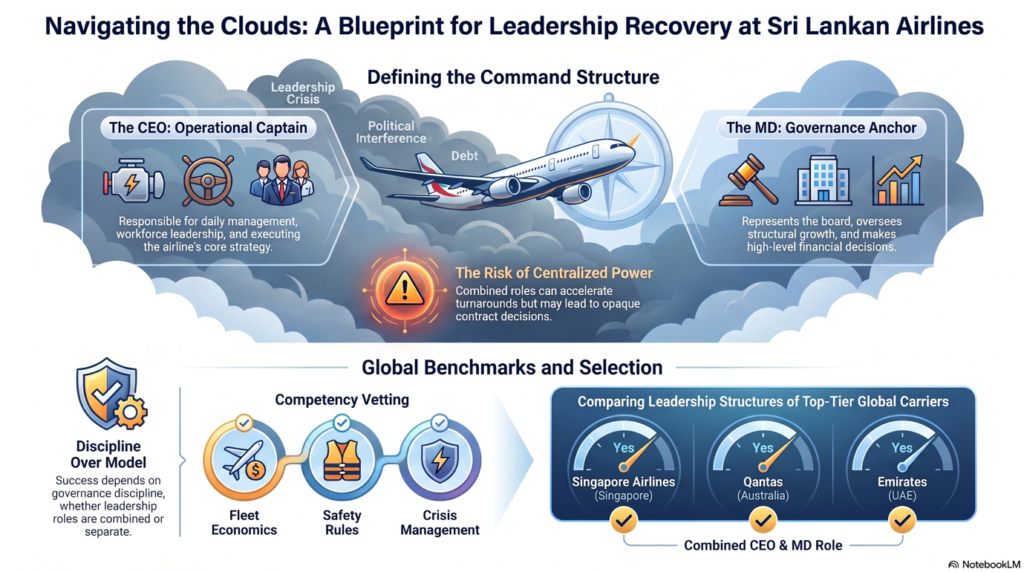
The two hats: why CEO and MD roles matter
In the corporate world, the CEO and MD roles are often treated as interchangeable. But in aviation—especially in a state‑owned carrier—the distinction can be the difference between stability and chaos.
- CEO — The operational captain. Responsible for daily management, workforce leadership, and executing strategy.
- MD — The governance anchor. Represents the board, oversees structural growth, and makes high‑level financial decisions.
- Combined Role — A single ‘CEO & MD’ can accelerate turnarounds but also concentrates power in ways that can be dangerous in politically exposed organisations.
Sri Lankan Airlines has experienced firsthand what happens when authority is unclear or overly centralised: procurement controversies, opaque contract decisions, and strategic drift. A clearly defined leadership structure is not a luxury; it is a necessity.
A carrier in crisis needs more than titles
Sri Lankan Airlines is not just another company searching for a leader. It is a national institution that has endured years of political interference, mounting debt, and delayed restructuring. In such an environment, governance is not an abstract principle; it is the foundation of survival.
Accountability
Separating roles, or enforcing strict board oversight, helps prevent unilateral decision‑making. In an airline where fleet purchases, route planning, and leasing agreements involve millions of dollars, unchecked authority is a recipe for disaster.
Crisis Management
The airline’s financial distress demands leadership that can navigate fuel price shocks, labour negotiations, safety compliance, and global competition. Transparent structures help ensure that decisions are made for the airline’s future, not for political convenience.
Global Practice
Many of the world’s leading airlines combine the CEO and MD roles. Others separate them. What matters is not the model, but the discipline behind it.
How the world’s best airlines do It
A look at global carriers shows a pattern: strong leadership, clear accountability, and governance aligned with strategy.
| Airline | Country | Combined CEO & MD Role | Example |
| Singapore Airlines | Singapore | Yes | Goh Choon Phong serves as CEO and sits on the Board |
| Qantas | Australia | Yes | Vanessa Hudson is Managing Director and CEO |
| Ryanair | Ireland | Yes | Michael O’Leary has historically held combined authority |
| Emirates | UAE | Yes | Sir Tim Clark serves as President, equivalent to CEO |
| AirAsia | Malaysia | Yes | Tony Fernandes has long combined executive leadership |
| Virgin Atlantic | UK | Yes | Executive authority is vested in a single CEO |
A few carriers such as Malaysia Airlines and Fiji Airways maintain more distinct CEO/MD structures. Their choice reflects governance priorities, not tradition.
Does a CEO need aviation experience?
This question divides boardrooms everywhere. The short answer: not always, but it helps.
Why industry expertise matters
- Instant credibility with staff and regulators
- Faster decision‑making
- Established networks with suppliers and lessors
- Better risk assessment
The case for generalists
Generalist CEOs can bring fresh thinking, break old habits, and drive cultural transformation. Many successful companies rely on technical teams while the CEO focuses on strategy and organisational health.
The real issue is not whether the CEO is an aviation veteran or a cross‑industry leader. It is whether the person is competent, independent, and capable of building a high‑performing team.
What a proper CEO/MD selection process looks like
Sri Lankan Airlines needs to apply the basics, something global carriers treat as standard.
Governance and preparation
- Define the mandate: turnaround, continuity, or restructuring
- Form a dedicated search committee
- Clearly outline dual CEO/MD duties and accountability
Competency and industry vetting
- Assess aviation knowledge: fleet economics, safety, slot rules
- Evaluate crisis‑management experience
- Test stakeholder fluency with regulators, unions, and investors
Selection execution
- Use a specialised aviation executive search firm
- Conduct structured interviews and crisis simulations
- Complete 360‑degree references and regulatory fitness checks
These are not extraordinary steps. They are the basics.
The leadership model Sri Lanka needs
Sri Lankan Airlines does not need another autocrat. It needs a leader who listens, collaborates, and builds trust. The country has seen the damage that authoritarian leadership can inflict on institutions. Sri Lankan Airlines requires a CEO with integrity, competence, independence, and the ability to build a high-performing team.
The government must resolve the leadership issue through a transparent, evidence‑based process. The airline’s future depends on it.
This article is based on LEADS Forum conversations