
Over the past two years, India’s foreign minister has come to Colombo again and again, and in September its defense minister arrived for the first time in decades. Warm statements each time. High-powered delegations. Reviews of old partnerships and reaffirmations of old assurances. And almost nothing new concluded, least of all from the foreign minister, the very man who could move the investment and trade deals we so badly need. Everyone smiled. Little moved.
That diplomatic traffic is a small portrait of a large problem. Sri Lanka’s foreign policy today generates a great deal of motion and almost no outcomes. We are forever negotiating, forever balancing, forever hosting. We conclude almost nothing. And in a world reorganising itself at speed, a country that mistakes activity for achievement is a country quietly falling behind.
The art of applying and not arriving
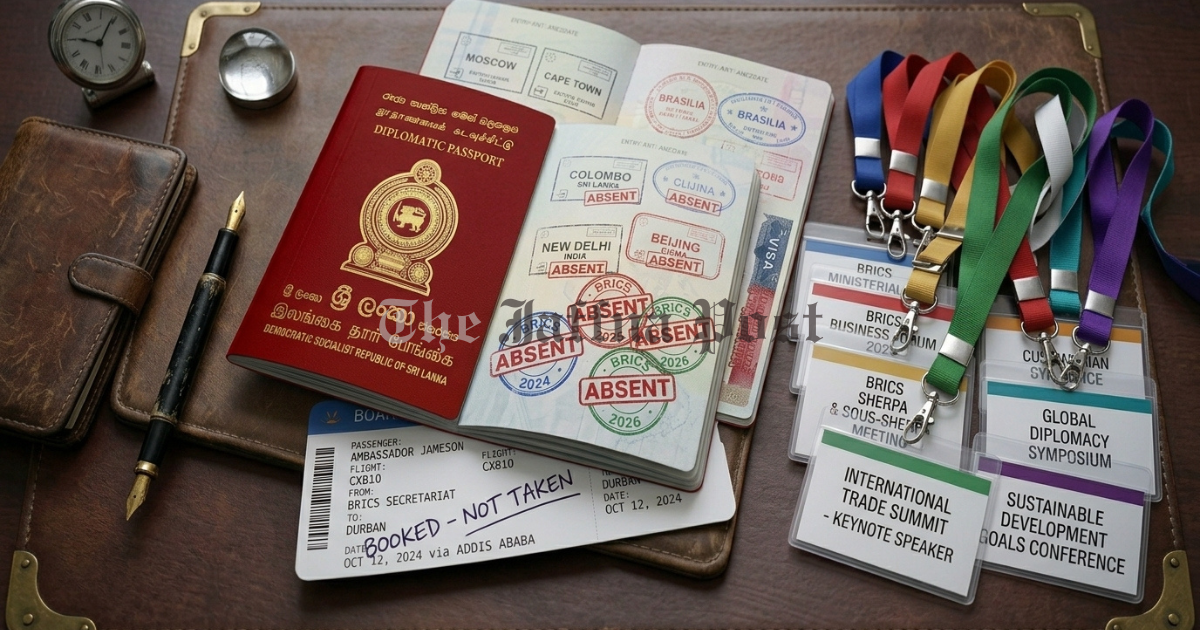
Consider BRICS (Brazil, Russia, India, China, and South Africa). Sri Lanka announced its interest in joining the bloc, reasoning, sensibly enough, that a grouping now containing most of the world’s population and a rising share of its output was worth being inside. Then we simply did not turn up. As the former diplomat Dayan Jayatilleka recently pointed out, Sri Lanka was absent from the 2024, 2025 and 2026 summits, and having stayed away, failed even to secure an invitation to the last one. Other interested countries did the work and got in or were made partners. We applied, skipped the meetings, and were left outside. The aspiration was stated. The follow-through never came.
Now consider trade, where the pattern is not new but chronic. Our free trade agreement with India has been in force since 2000, and we have spent the years since negotiating a deeper economic agreement, the Economic and Technology Co-operation Agreement (ETCA), through twelve rounds, on hold since 2018. The China agreement reached six rounds and has sat frozen since 2017. Thailand remains perpetually “under negotiation.”
The Regional Comprehensive Economic Partnership (RCEP), the largest trading bloc on earth, sitting right across our most important sea lanes, remains an aspiration we are doing “preliminary work” on. And the one comprehensive agreement we did sign, with Singapore in 2018, we never fully implemented on our own side. We could not execute the deal we actually closed.
This is not the record of a country being cautious. It is the record of a country that cannot finish things.
Balancing is not a strategy it is a substitute for one
The government’s defenders will call this balance. We hedge between India and China, the argument goes, and keep everyone comfortable. There is a respectable tradition behind that instinct, our own non-aligned history, and I have defended the principle of strategic independence before. But independence and indecision are not the same thing, and we have been confusing them.
Look at how others played a harder version of this game and won. South Korea and Taiwan did not spend the Cold War delicately balancing Washington and Moscow. They chose, firmly, planted themselves in the American camp, and then extracted everything that choice could yield: security guarantees, guaranteed access to the largest market on earth, capital, technology. And they married that strategic clarity to industrial policy they actually executed, picking sectors, backing firms, building the shipyards and chip fabs and steel mills that turned poor agrarian societies into advanced economies within a generation. They did not wait until they were rich to build. They built their way out of poverty, deliberately, while aligned.
Balancing bought them nothing because they did not balance. Deciding bought them everything.
Sri Lanka, by contrast, has turned hedging into a way of avoiding decisions altogether. We keep India close enough not to alarm it and China close enough not to lose its money, and in the space between the two we build nothing of our own. We get the anxieties of non-alignment without its dividends.
The missing half: a policy to grow
Foreign policy is not an end in itself. For a country in our position, it is supposed to be an instrument of growth, the thing that opens markets, pulls in investment, and lets us earn the foreign exchange to service a debt that will shadow us for a generation. And here sits the deepest failure, because we do not have the domestic half of the equation either.
We have produced industrial policy documents for decades. There is a draft National Policy for Industrial Development, complete with a diagnostic report. There are ministries, task forces, expert roundtables, a National Export Development Plan. What there is not, after all these years and all these papers, is an industrial strategy actually implemented and driving the economy.
Look at India, the same neighbour whose defense minister we hosted to no effect. Set aside the headlines and look at what parts of India actually did. According to a recent report in The Economist, a cluster of western and southern states has quietly become a genuine manufacturing base, adding around half of India’s industrial output.
It did not happen by accident or by slogan; India’s own flagship “Make in India” campaign badly missed its targets, and manufacturing’s share of the economy barely moved for a decade. What worked was narrower and more deliberate: state governments that aggressively courted investors, built the land and power and water to receive them, cleared the bureaucratic path rather than obstructing it, and anchored industrial clusters around big firms that pulled in suppliers behind them.
Over time, assembly of imported parts gave way to components made locally, and the value captured at home climbed. The Economist cites one industry estimate that the value added within India’s smartphone manufacturing rose from around four and a half billion dollars in 2021 to over seventeen billion last year.
India is still only partway up that mountain; its output per worker trails smaller Asian economies, and much of the recent surge owes something to a cheap rupee. But partway is a universe beyond where we are. The lesson is not that India is a miracle. It is that even an imperfect, patiently executed industrial strategy compounds into something real, while a perfect strategy that stays in a drawer produces nothing at all. We have the drawer. They built the factories.
The honest objection, and the answer
The fair response is that this government operates under real constraints. It took office during a fragile stabilisation, bound by an IMF programme that limits what it can spend, and it has spent recent months responding to Cyclone Ditwah, which killed hundreds and reshaped the India relationship around disaster relief. All true, and it deserves acknowledgement.
But it does not excuse the drift. If anything, inheriting a stabilised economy raises the expectation rather than lowering it: the hardest work, pulling the country back from default, had already been done by the time this government took office. The things left undone since are precisely the low-cost, high-return moves a recovering country should seize first.
Concluding an FTA does not breach an IMF ceiling. Finishing ETCA costs political will, not billions. Showing up to a BRICS summit costs a plane ticket. Implementing the industrial policy already drafted costs decisions, not fortunes. The tigers built their industries under constraints far tighter than ours. Constraint is a reason to choose faster, not an excuse to choose never.
What delivery would look like
None of this requires us to abandon strategic independence or to pick a permanent patron. It requires us to decide what we are actually trying to build and then to finish the things that build it. Conclude the agreements we have spent a decade negotiating. Pick the sectors we intend to grow and back them in earnest. Walk into the rooms we have asked to enter. Treat foreign policy as the servant of an economic strategy rather than a substitute for one.
A small country at the centre of the world’s busiest ocean has leverage, if it is willing to use it with purpose. What it cannot afford is to keep mistaking motion for progress, hosting summits and reviewing MoUs while the decade slips past and the debt comes due. We have been very busy. We have built very little. The two facts are connected, and only we can change them.