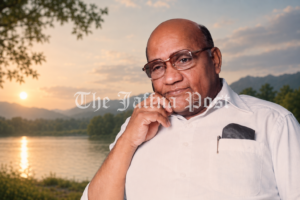

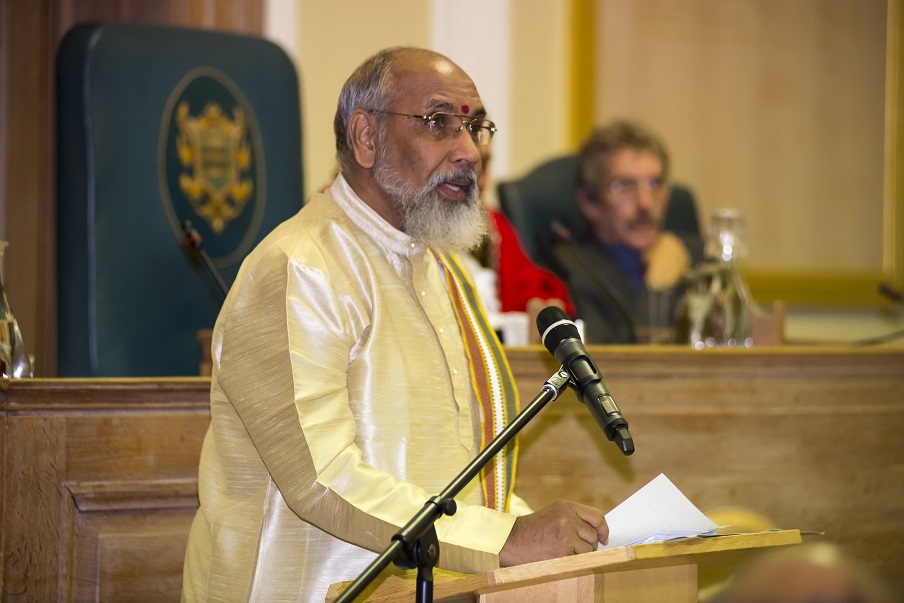
The first Northern Provincial Council Chief Minister and retired judge of the Supreme Court C.V. Wigneswaran has urged the National People’s Power (NPP) Government to expedite the process to hold the Provincial Council elections. He has pointed out that the NPP Government was delaying holding the PC polls due to uncertainty of its popularity.
C.V. Wigneswaran functioned as first Chief Minister of demerged Northern Province and even remained as a Parliamentarian from 2020 to 2024.
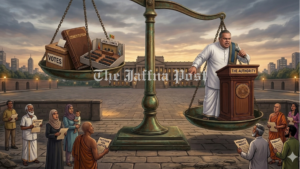
Commenting on the delay in holding the Provincial Council polls for all nine provinces in the Island, Wigneswaran has mentioned that the setback suffered by the ruling NPP Government in the recently held Local Government polls has led to the postponement of Provincial Council polls in the country.
According to Wigneswaran, the PC polls have been postponed continuously from 2018 and now the NPP Government is making further delays in holding the polls citing a number of reasons, including financial constraints, the need to conduct a delimitation exercise, and the economic crisis.
In the meantime, the delay in holding PC Elections in Sri Lanka has even sparked concerns over managing the infrastructure facilities in the country. The premier areas in the provinces such as education, healthcare, and infrastructure development are expected to be neglected, since these areas come under the purview of the Local Government bodies.
The terms of the Provincial Councils expire every five years, and new elections are supposed to be held within six months of the expiry of the term.
This delay has had a number of negative repercussions. First, it has deprived the people of Sri Lanka of their right to elect their representatives at the provincial level. Second, it has weakened the devolved Government system and made it difficult for Provincial Councils to effectively perform their duties. Third, the delay has contributed to the erosion of public trust in the Government.
The negative aspects of not holding the PC polls have been observed as follows:
The delay has made it difficult for Provincial Councils to plan and implement long-term development projects. As a result, public services such as education, healthcare, as well as infrastructure development have deteriorated in many parts of the island.
The lack of effective governance at the provincial level has led to an increase in crime and violence in many parts of Sri Lanka.
The delay in holding the PC Elections has contributed to growing social unrest in the country. People are frustrated with the Government’s failure to hold elections and address their concerns.
The delay in holding PC Elections would weaken democracy in Sri Lanka. It has shown that the Government is willing to violate the fundamental rights the Sri Lankan Parliament passed in the 13th Amendment to the 1978 Constitution of Sri Lanka.
The Indo-Lanka Accord also required the merger of the Eastern and Northern provinces into one administrative unit. The accord required a referendum to be held by 31 December 1988 in the Eastern Province to decide whether the merger should be permanent. On September 2nd and 8th 1988, President J.R. Jayawardena proclaimed enabling the Eastern and Northern provinces to be one administrative unit administered by one elected council, creating the North Eastern Province.
Elections in the newly merged North Eastern Province were held on 19 November 1988. On 1 March 1990, just as the Indian Peace Keeping Force was preparing to withdraw from Sri Lanka, the first Chief Minister of the merged North and East, Annamalai Varatharajaperumal moved a motion in the North Eastern Provincial Council declaring independent Tamil Eelam.
On 14 July 2006, after a long campaign against the North and East merger, the JVP filed three separate petitions with the Supreme Court of Sri Lanka requesting a separate Provincial Council for the East.
On 16 October 2006, the Supreme Court ruled that the proclamations issued by President Jayewardene were null and void and had no legal effect. The North Eastern Province was formally demerged into the Eastern and Northern provinces on 1 January 2007.
Since then, former LTTE member Sivanesathurai Chandrakumar alias Pillaiyan who had left the LTTE and remained in the good books of former President Mahinda Rajapakse, became the first Chief Minister of the demerged Eastern Province.
Later when the Provincial Council election was held for the Northern Province in 2013, C. V. Wigneswaran became the first Chief Minister of the demerged Northern Province.
Meanwhile, in a recent move, the Democratic Tamil National Front (DTNA) has announced that it would support whichever Tamil party is in the frontline, to form local Government administration the North and East.
Wigneswaran emphasising the need of expediting the process to hold the PC polls, and the DTNA’s support to any Tamil party to lead the Local Government councils in the North and East, could be seen as an appreciative political development in the Tamil political scene.