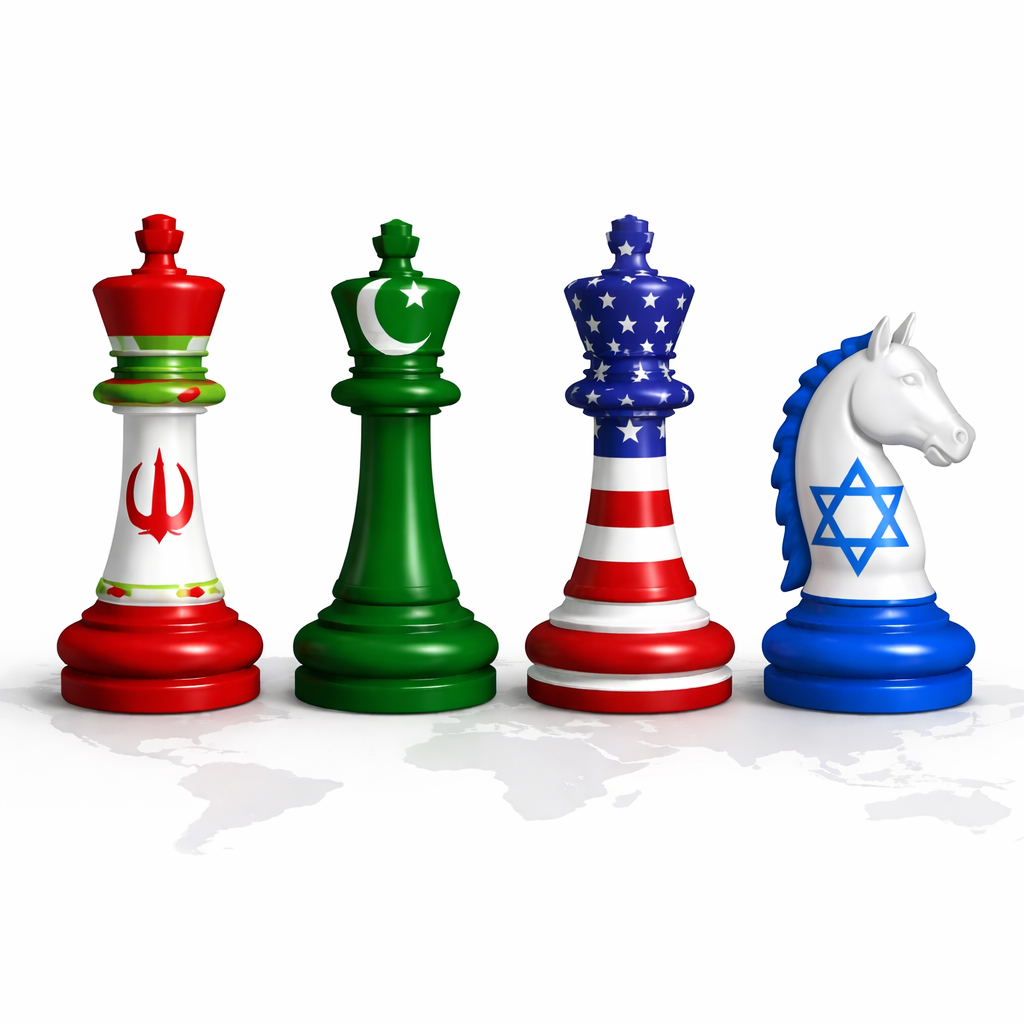

Despite the fact that the United States and Iran have offered differing interpretations regarding the course of the war, the truth remains that both nations faced an urgent necessity to agree to a ceasefire. However, the announced two-week ceasefire remains deeply precarious.
Israeli Prime Minister Benjamin Netanyahu and US President Donald Trump both asserted that Lebanon was not included in the ceasefire arrangement. Conversely, Pakistani Prime Minister Shehbaz Sharif posted on the ‘X’ social media platform that Lebanon was indeed covered by the ceasefire. Following the ceasefire announcement, within a mere ten minutes last Wednesday evening, Israeli warplanes launched 100 strikes on Lebanon, killing more than 250 people.
While the Lebanese Prime Minister requested the Pakistani Prime Minister to facilitate the implementation of the ceasefire in his country as well, reports emerged that Netanyahu had instructed his cabinet to hold talks with the Lebanese government.
Iran, declaring that it could not comply with the ceasefire conditions unless Israel halted its attacks on Lebanon, has refused to reopen the Strait of Hormuz. The situation persists where ships can only traverse the strait with Iran’s permission and upon payment of a fee.
Although Pakistan is making arrangements for negotiations between the US and Iran, any diplomatic effort to end the war will prove futile unless the United States restrains Netanyahu—its ‘unbridled horse’ in the Middle East.
The widespread opinion among international military and political observers is that the war is entering a new phase of uncertainty. Whether the ceasefire will even last for two weeks remains a question mark. Regime change has not occurred in Iran.
In the days leading up to the ceasefire announcement, the remarks made by Donald Trump, Vice President J.D. Vance, and Defense Secretary Pete Hegseth—speaking as if from a bloodthirsty dreamworld—reveal a sense of arrogance, suggesting they believe they can do whatever they desire in the world without any concern for the consequences.
On Tuesday night, Trump warned on social media that if his terms were not accepted and an agreement was not reached within a specific deadline to reopen the Strait of Hormuz, “Iran’s entire civilization would be destroyed.”
He further stated that if the strait remained closed, Tuesday would be “a day for destroying power plants and bridges… Open the strait or you will have to live in hell.” What can the destruction of a civilization be called other than genocide? Through this, Trump exposes himself to the world as an enemy of humanity.
Responding to Trump’s threat, Tehran warned that the United States and its allies would go without oil and gas for many years. There remains a wide gap between the 15-point proposal put forward by the US and Iran’s 10-point plan.
Meanwhile, US Vice President J.D. Vance, during a visit to Hungary, stated that his country possesses tools they have not yet decided to use. Although he did not provide details, the White House later issued a clarification stating that his remarks did not imply the use of nuclear weapons.
Defense Secretary Pete Hegseth described the military action against Iran, ‘Operation Epic Fury’ as a “21st-century crusade to break the teeth of the ungodly.”
All of these individuals are issuing threats using words that the civilized world finds loathsome and disgraceful, acting as if they hold the power to unleash death and destruction across the globe from the Pentagon.
In reality, the threats of catastrophe issued by Trump and his associates should be viewed as a sign of strategic weakness rather than a symbol of strength. If Trump’s threats, filled with low-standard language that in no way aligns with human values, were to be implemented, they would be considered war crimes.
The Geneva Conventions prohibit carrying out attacks on civilian targets. It cannot be expected that a president who publicly declares he has no concern for international laws will conduct a war while respecting the Geneva Conventions.
The International Criminal Court (ICC) has issued arrest warrants for Russian military officials who carried out attacks on Ukraine’s energy infrastructure. Launching missiles at cities to terrorize civilians and break their morale is a war crime. This same rule applies to the United States as well. If Trump’s threat to “send Iran back to the Stone Age” is implemented, it would constitute a crime against humanity.
World nations have little choice but to hope that this illegal war waged by the US and Israel against Iran does not reach a catastrophic phase, bringing about unprecedented and devastating consequences. With the United Nations rendered helpless, the fact that Trump is stepping forward to talk with Iran through the mediation of Pakistan, a country that follows his lead, reveals the true nature of the current world order.
Although Trump boasts of having destroyed Iran’s military capabilities, the continued closure of the Strait of Hormuz proves his claims are empty threats. America’s allies have categorically refused to support Trump’s foolish war, which lacks both a clear strategic plan and legal justification.
Trump operates with blatant contradictions. Agreeing to a ceasefire with a country whose military power he claims has already been destroyed is the pinnacle of these inconsistencies. We live in a world where millions of lives and the future of the global economy depend on the whims of a US President guided by selfish instincts and a circle of sycophants. The Trump clique openly prides itself on its intent to commit war crimes.
It is doubtful whether Trump possesses the mental state to understand that his provocative, outrageous, and vulgar rhetoric, along with threats of genocide, disgraces his office and creates negative repercussions in international diplomacy. He fails to realize that to escape the predicament he created, he must learn to restrain his mouth.
The ‘Madman Theory’
In light of the criticisms regarding Trump’s habit of making contradictory announcements minute by minute, some international political analysts recall the ‘Madman Theory’ said to have been practiced by former US President Richard Nixon.
The essence of this Madman Theory is for a national leader to behave in a way that makes enemies doubt his mental stability. By making adversaries believe he is a madman capable of doing anything, he seeks to intimidate them into making favorable compromises.
Before he became President in 1968, Nixon described a certain theory to his future White House Chief of Staff, Bob Haldeman. He believed this theory could bring the Vietnam War to an end, as noted by Irish investigative journalist and author Anthony Summers in his book, ‘The Arrogance of Power.’
Robert Tait, a correspondent for The Guardian in Washington, mentioned this in an article last week.
According to Summers’ book, Nixon told Bob Haldeman;
“Bob, I call it the ‘Madman Theory.’ I want the North Vietnamese to believe I’ve reached the point where I might do anything to stop the war. Just slip the word to them that, ‘For God’s sake, you know Nixon is obsessed about Communism. We can’t restrain him when he’s angry —and he has his hand on the nuclear button.’ Within two days, Ho Chi Minh himself will be in Paris begging for peace.”
Nixon repeatedly used this strategy in the following years. He instructed his aides to convey to Soviet officials that he was “somewhat crazy” and capable of extreme violence.
In 1972, even as the Vietnam War intensified despite these pretenses, Summers records that Nixon told his National Security Advisor, Henry Kissinger, that he wanted to use nuclear weapons against Communist North Vietnam.
Despite the massive bombings, casualties, and destruction Nixon unleashed on North Vietnam, the Vietnamese Communists eventually made history by liberating their country from American occupation and unifying it in April 1975.
The current situation with Trump brings to mind Nixon’s past pretentions. Following aggressive threats to completely destroy Iranian civilization—vowing to annihilate bridges, railway stations, oil fields, and civilian targets—Trump found himself in a position where he had to agree to a ceasefire just a day later.
Even after nearly six weeks of bombing, Iran showed no signs of surrendering. Like Nixon, Trump likely needed a tactic to avoid appearing weak. He may have believed that threats of mass destruction would be a convenient tool.
As Ali Vaez, the Iran Project Director for the International Crisis Group, suggested: since Trump could not claim any clear victory in this conflict, he attempted to perform a “massive shock action” to prevent critics from finding holes in his narrative. He tried to declare that very action as a victory to escape the crisis he had created. However, it did not work.