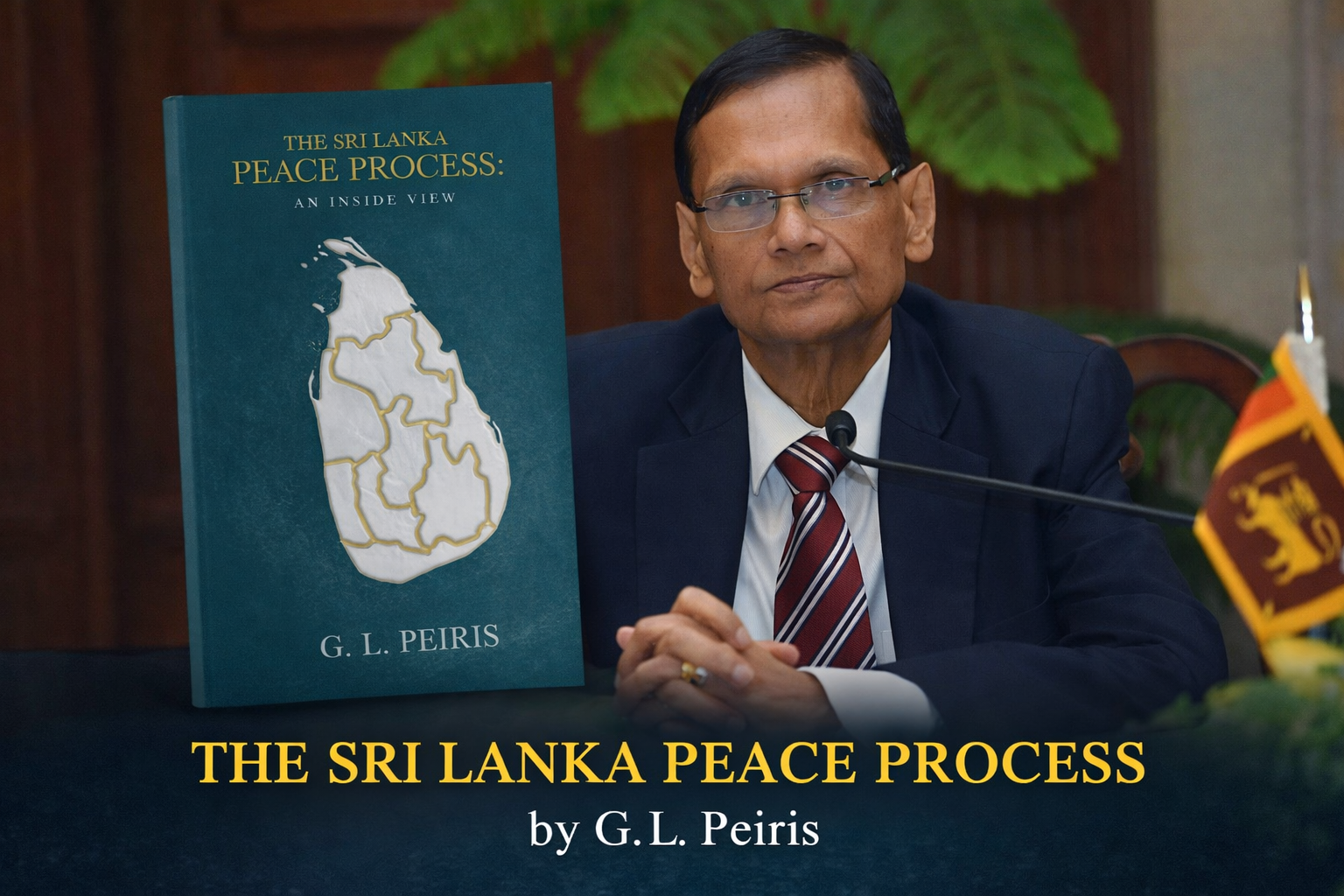

Professor G.L. Peiris, who headed the government delegation during the various rounds of Norwegian-mediated peace talks between the Government of Sri Lanka and the LTTE in the early part of this century, recently released a book titled “The Peace Process in Sri Lanka: An Inside View.”
While we may hold distinct opinions regarding the sincerity with which the government pursued the peace process at that time, Professor Peiris’s book warrants widespread attention as he participated as the government’s chief negotiator.
In the very first paragraph of the first chapter, his observations regarding the origin of the idea of power-sharing in Sri Lanka are essential for the younger generation of all communities to understand—especially in the current context where all Tamil nationalist political parties are insisting on a permanent solution to the national ethnic issue based on a federal system.
Writing that the themes of power-sharing, devolution, and federalism explored in his book do not have their origins in ethnicity-related issues, the Professor reminds us that federalism was proposed as a suitable governance structure for Sri Lanka in an entirely different context.
He notes that, initially, the federal proposal was not linked to Tamil aspirations, but rather to the aspirations of the Kandyan Sinhalese.
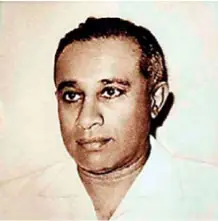
There is a fitting, though perhaps coincidental relevance to the Professor mentioning this now, as this year marks exactly one century since former Prime Minister S.W.R.D. Bandaranaike first called for a federal system of government in Sri Lanka.
D.B.S. Jeyaraj, a veteran Sri Lankan journalist and political analyst living in Canada, recently authored an English article titled ‘Bandaranaike’s Clarion Call for a Federal System 100 Years Ago’.
Jeyaraj began his article by quoting constitutional expert Dr. Rohan Edirisinha’s piece,
‘Federalism: Myths and Realities’. Edirisinha noted that long before Tamil political leaders advocated for federalism, a young S.W.R.D. Bandaranaike in the early 1920s, and Kandyan Sinhalese representatives before the Donoughmore Commission in the late 1920s, campaigned for it. The Kandyan Sinhalese even proposed a federal Sri Lanka consisting of three provinces, including one for the North-East.
Jeyaraj wrote:
“Bandaranaike, a preeminent intellectual among the political leaders of that era, argued as early as 1926 that only a form of federalism could be the solution to Sri Lanka’s governance problems.
In 1927, the Kandyan Sinhalese proposed a federal arrangement with two units for the Low-Country and Kandyan Sinhalese, and one unit for the Tamils in the North-East.
When proposed by the Sinhalese, the Sri Lankan Tamils rejected federalism. Had the Tamil political leaders utilized that opportunity to demand federalism for the North-Eastern Tamils from the British rulers, there was every possibility it would have been accepted.
During the British colonial period, Tamil political leaders did not demand federalism or a separate state. Instead, they put forward these demands only after the British departed from Sri Lanka.”
A hundred years ago, Bandaranaike wrote six letters to the ‘Morning Leader’ newspaper arguing that federalism was best for Sri Lanka. On July 26, 1926, he traveled to Jaffna to deliver the ‘Jaffna Lecture’ to convince the Tamils. Speaking on the topic “Federalism is the Only Solution to Our Political Problems,” he argued that regional autonomy was the correct way to address ethnic differences.
However, the Tamils rejected his plea to join the advocacy for federalism. The Jaffna Student Congress (later renamed the Jaffna Youth Congress) opposed the federal proposal.
After returning to the country in 1925 following a brilliant education at Oxford University, Bandaranaike was a member of the Ceylon National Congress while also founding the Progressive National Party to achieve political autonomy. The constitution of that party included a blueprint for the federal system Bandaranaike had in mind.
Identifying the Low-country Sinhalese, Kandyan Sinhalese, and Tamils as the primary groups of the country, that constitution insisted on a structure based on nine provinces, each possessing complete autonomy.
Jeyaraj noted that all members of the Progressive National Party supported Bandaranaike’s idea, except for his close friend, the scholar James T. Ratnam. At that time, the proposal for federalism did not incite communal feelings or opposition from the Sinhalese; the harshest opposition came not from a Sinhalese, but from a Tamil.
It is also noteworthy that Leonard Woolf, a famous British Civil Service officer in Sri Lanka during the colonial era, suggested in the late 1930s that the Swiss Canton system was most suitable for Sri Lanka.
In a 1938 report to the British government, Leonard Woolf suggested creating five cantons: a Low-country Sinhalese province, a Kandyan Sinhalese province, a Tamil Northern province, a Tamil Eastern province, and a fifth canton encompassing the tea plantation areas where Hill Country Tamils of Indian origin were the majority.
As far as we know, Leonard Woolf was the only person to recommend a separate canton for the plantation workers to protect their national interests.
Anticipating the argument that Sri Lanka was too small for a canton system, he pointed out that Sri Lanka’s area was 10,000 square miles larger than Switzerland’s. Regarding ethnic populations, he compared the German speakers of Switzerland to the Sinhalese, French speakers to the Tamils, and Italian speakers to the Muslims.
These were suggestions made by a progressive Englishman who lived in Sri Lanka for seven years as a colonial administrator and understood its people intimately.
Had the Tamil leaders of the time joined Bandaranaike in campaigning for federalism, the political history of Sri Lanka would certainly have been different.
However, following the introduction of universal franchise and territorial representation through the Donoughmore Constitution in 1931, Bandaranaike’s political outlook began to change.
We shall look at the subsequent political developments in the next part of this article.