
It is unavoidable that the title of this article reminds readers of the famous Russian writer Leo Tolstoy’s epic novel War and Peace. It is a historical fiction by him that follows the lives of five aristocratic families in Russia during the Napoleonic era, exploring themes of war, peace, and the human condition. It is one of the longest novels in the world.
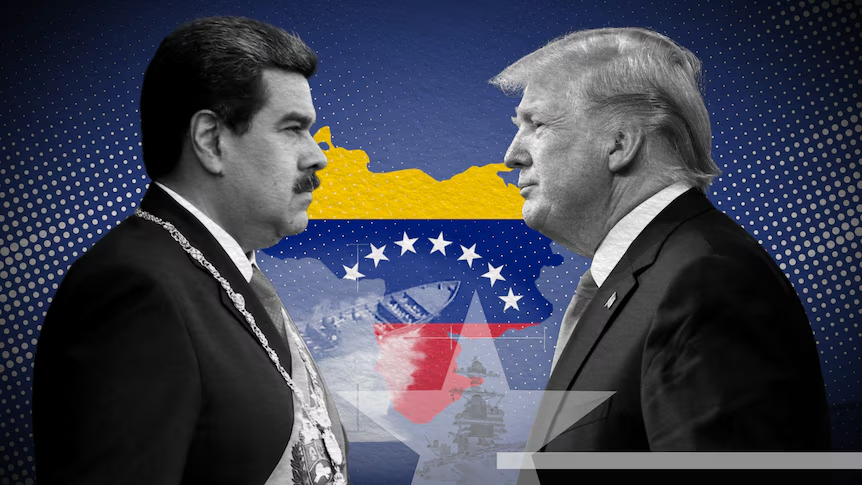
The article is nothing to do with the novel, but, the writer deems it fit to use the title because of the contradictory actions of US President Donald Trump who, on the one hand, projects himself as a leader who is working hard to establish peace in the world and, on the other, is engaged in preparations for war in the immediate neighbourhood.
Donald Trump has been repeatedly saying that it is he who stopped the war between India and Pakistan in May this year. While New Delhi has categorically stated that it was determined to cease hostilities after the communications between the military top brass of the two countries, Trump does not seem to care about it.
According to international media, the US president has so far said about 70 times that he has stopped the conflict between the two South Asian nuclear-armed rivals. He finally said it in a speech on December 10 in a city in the state of Pennsylvania. He proudly claims to have stopped eight wars in the 10 months since his assumption as President for the second term.
The wars that Trump claims to have stopped are between Israel and Hamas in the Gaza Strip in the Middle East, Israel and Iran, India and Pakistan, Thailand and Cambodia, Armenia and Azerbaijan, between Egypt and Ethiopia, Serbia and Kosovo, and Rwanda and the Democratic Republic of Congo.
He said that he stopped these wars mostly by threatening to impose heavy trade tariffs and aspired to be awarded the 2025 Nobel Peace Prize for his untiring efforts to stop these international conflicts and work for peace in the world.
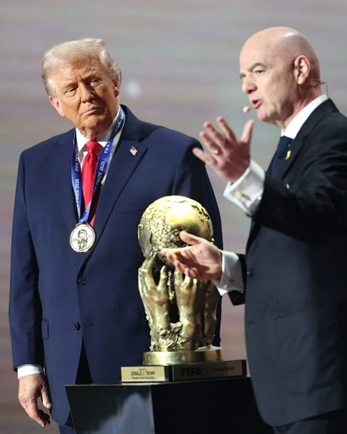
But unfortunately, in the end, Trump only received a peace prize from the Federation of International Football Associations (FIFA). That prize too, awarded at a glittering event in Washington a few days ago in connection with next year’s World Cup, has turned out to be a subject of controversy.
The FIFA President, Gianni Infantino, is accused of violating the governing body’s regulations of political neutrality by awarding the peace prize to the US president. The federation’s ethical committee has been asked to conduct an inquiry against him.
Meanwhile, tensions between the countries involved in any war, which Trump claimed he had stopped, have yet to ease.
We can only imagine that Trump has brought peace to the world if we ignore the genocides in Gaza and Sudan, Russia’s continued attacks on Ukraine, the fighting in the eastern region of Congo, Israel’s attacks on Lebanon, the Myanmar military’s air bombardments, and the escalating political violence in the United States.
Conflicts between Thailand and Cambodia, which stopped fighting in July, flared up again last week. The new clashes along the border show how fragile the ceasefire announced with Trump’s help is. Referring to the renewed fighting between the two Southeast Asian countries, in last week’s Pennsylvania speech, Trump said that he would speak by phone with leaders of those countries to end the conflict, asking the audience who else could say he/she is going to stop the war through a phone call.
Trump, who boasted that he did not send US troops to war in any part of the world during his first term, is now responsible for increasing tensions in many regions through his arbitrary and maverick actions during the first year of his second term.
He has previously said he would not rule out sending troops to capture the Danish-owned island of Greenland and the Panama Canal, and is now preparing a military offensive under the guise of anti-drug trafficking operations aimed at bringing about regime change in Venezuela, an oil-rich South American country. He has also warned of attacks inside Mexico in the war on drugs.
The United States has stepped up pressure on Venezuelan President Nicolas Maduro in recent weeks by launching attacks in the Caribbean and the Pacific against alleged drug traffickers. This is the first time since the invasion of Panama in 1989, that there is a massive U.S. military buildup in the Caribbean.
Trump said two weeks ago that Venezuela’s airspace should be considered completely closed. U.S. warships are in the Caribbean Sea within striking distance of Venezuela. Several people have been killed in recent weeks in attacks by US forces on alleged drug-smuggling boats.
The US government, which accuses Maduro of leading a drug cartel designated by Washington as a foreign terrorist organization, has offered no concrete evidence.
The US seized an oil tanker off the coast of Venezuela on December 10, accusing it of carrying oil banned for export and extending sanctions against Venezuela. While Maduro has accused the US president of ushering in an ‘age of naval piracy’ in the Caribbean, Venezuela’s right-wing opposition leader, Maria Corina Machado, who won the Nobel Peace Prize this year fully supports US actions.
Maduro, who has been president of Venezuela since 2013 following the death of popular president Hugo Chavez, is accused of rigging the 2024 presidential election.
Millions of people fled the country as the economy suffered a severe setback under Maduro’s watch. Although he is responsible for the current situation in his country, Washington’s sanctions have also contributed greatly to the worsening situation.
The United States and several European countries have recognized Juan Guaido, a prominent opposition figure who ran against Maduro, as president in an effort to undermine the latter’s government.
The Nobel Peace Prize has been awarded to opposition leader Machado for her courageous campaign against Maduro, whom she accuses of running an autocratic, anti-democratic regime. As soon as the Nobel Peace Prize was announced in October, Machado declared that she attributed it to the US president. She thanked Trump for his decisive support for the democratic struggle against the Maduro regime.
Machado has been in hiding since last year’s election. Her attempt to secretly leave her hideout by sea and travel to Norway to personally receive the Nobel Peace Prize at a ceremony in Oslo on December 10, International Human Rights Day, was not successful.
Machado was unable to reach Oslo in time. Her daughter received the prize on behalf of her. But she went to Oslo late and was given an arousing welcome. She thanked the United States for helping her leave her country and come to Europe.
There is opposition in the US Congress to Trump’s plan to send US troops into Venezuela to topple Maduro’s regime. Following last week’s seizure of oil tanker, some Democratic members of the Congress described Trump’s actions as ‘sleepwalking into war’.
The killing of civilians by US forces in the Caribbean is a flagrant violation of international law. The threats by the Trump administration against Maduro, irrespective of the character of his regime, amount to an assault on Venezuela’s sovereignty
More importantly, the US seems unwilling to learn from its past mistakes. At one point during the Vietnam War, Robert McNamara, the US Secretary of Defense (and later president of the World Bank), recalled a quote by the German philosopher Hegel: “The only lesson one can learn from history is that no one learns from history.”
US invaded Afghanistan in 2001 following 9/11 only to leave 20 years later after cutting a deal with the Taliban. America’s 2003 invasion of Iraq turned out to be one of the worst humanitarian catastrophes.
Now we see the absurdity of Donald Trump, who claims credit for ending many wars and aspired for the Nobel Peace Prize, is getting ready to make the same mistakes in Venezuela.
Title image source: https://www.abc.net.au/