India was compelled to interfere in the North and East crisis following the influx of Lankan Tamil refugees to the State of Tamil Nadu soon after the communal upheaval in July 1983.
Late Indian Prime Minister Indira Gandhi who had vast experience in dealing with political and military affairs of her country started handling the Lankan Tamil issue in a sympathetic manner by supporting the Tamil Nadu State Government to accommodate Tamil refugees who had arrived into the state through Palk Straits, risking their lives.
Many Lankan Tamil politicians as well as Tamil people still believe that if Indira Gandhi had lived, the Tamil issue would have been settled in a conducive way and the late Indian Prime Minister would have even created a fully-fledged Tamil State with greater autonomy granted to the North and East.
However, it was unfortunate Indira Gandhi was killed by Sikh militants following her military action to flush out the Sikh militants from the Golden Temple in Amritsar in Punjab.
Indira Gandhi’s death created an uneasy situation in the North and East of Sri Lanka and the people in the region even mourned her death in a big way. Following her death, eldest son Rajiv Gandhi became the Prime Minister of India and he was considered as a new generation leader of India.
As far as the Lankan Tamil issue was concerned, Sri Lanka, including the people in the North and East hoped Rajiv Gandhi would be the figurehead to embark on finding a meaningful solution to the North and East crisis.
Rajiv Gandhi lived up to the expectations of the Tamils community by involving himself in bringing peace to the island and fulfilling the political aspirations of the people in the North and East.
He had extensive talks with both moderates and extremists, including the Liberation Tigers of Tamil Eelam (LTTE). Rajiv Gandhi had even invited Velupillai Prabhakaran to New Delhi and had talks with him, assuring that he would stand by the security of Tamils in Sri Lanka. Gandhi had urged Prabhakaran to accept the Indo-Lanka Accord and elaborated on the details of the Accord.
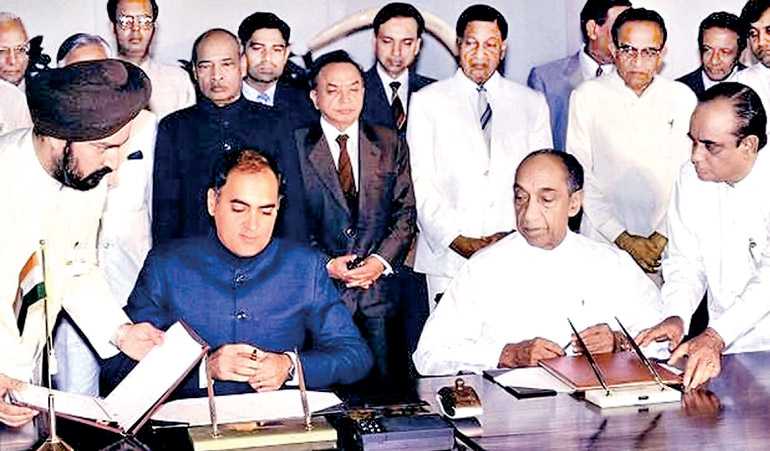
Rajiv Gandhi arrived in Sri Lanka to sign the Indo-Lanka Accord after the talks he had with LTTE leader Velupillai Prabhakaran.
The Indo-Lanka Accord which paved the way for the 13th Amendment to the Constitution was signed between former Lankan President J. R. Jayawardena and Rajiv Gandhi in Colombo.
Gandhi’s Lankan assignment turned deadly when a Navy sailor assaulted him with his rifle when the Indian Prime Minister was inspecting a guard of honor accorded to him outside the President’s House in Colombo.
Four years after the rifle attack on Rajiv Gandhi in Colombo, a Lankan female suicide bomber killed him at Sriperumbudur in Tamil Nadu on May 18 , 1991.
The LTTE first denied its involvement in the assassination of Rajiv Gandhi. Several years later it was found that Rajiv Gandhi was assassinated by the outfit in response to the Indian Peace Keeping Force’s confrontation against the LTTE with regard to the implementation of the Indo-Lanka Accord.
If the Indo-Lanka Accord which paved the way for the 13th Amendment had succeeded, India’s support in developing the North and East, as well as enhancing the island’s political activities by fulfilling the political aspirations of North and East Tamils, would have been a success story. Instead, Tamils were even taken for a ride by the Tamil militants who failed in reaching their political goals.
When the LTTE leader Prabhakaran assassinated Rajiv Gandhi on May 18 in 1991, he wouldn’t have thought that thirteen years later, in the same month, he would face the same fate with the total annihilation of his militant LTTE outfit.
Last week, the death of LTTE leader Velupillai Prabhakaran on May 18th was marked as Remembrance Day of the Armed Forces who had defeated the LTTE in Sri Lanka. On the other hand Lankan Tamils living in various parts of the world marked May 18th to remember Prabhakaran.
In India, May 21 of this year was remembered as the 34th death anniversary of their `flamboyant’ Prime Minister, Rajiv Gandhi.
Indians considered Rajiv Gandhi as their leader for the 21st century. The death of Rajiv Gandhi created a huge vacuum in Lankan Tamil politics, making the full implementation of the 13th Amendment to the Constitution a distant dream.