
The recent Northern Investment Summit 2026 (NIS26) marked a structural shift in the economic narrative of Northern Sri Lanka. It was not convened as a ceremonial forum, but as a transition mechanism from discussion to execution. Part 1 of the summit aligned stakeholders, diaspora networks, and institutional actors. Part 2 now moves decisively into implementation architecture.
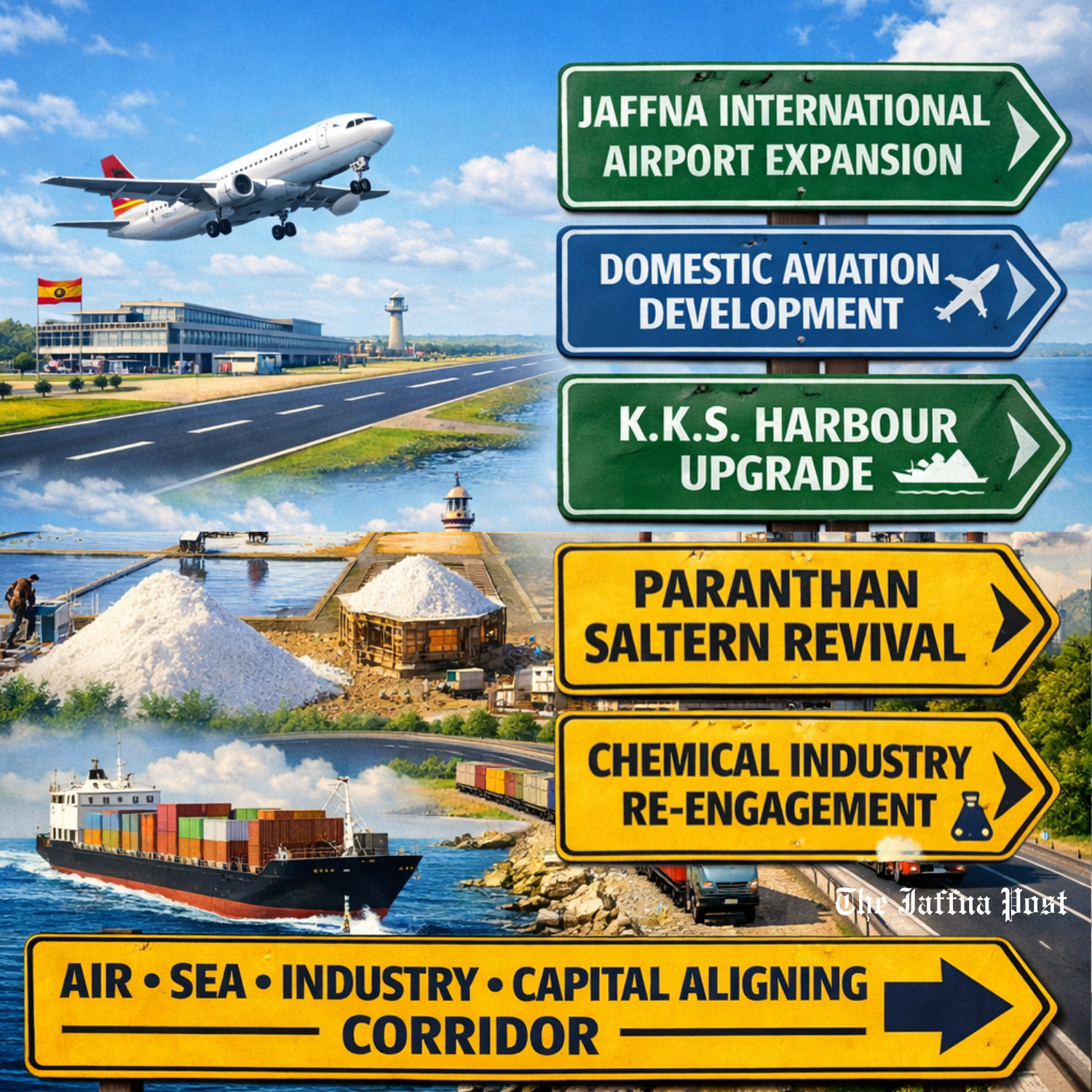
For the first time in decades, multiple infrastructure signals are pointing in the same direction: Jaffna International Airport expansion, Katunayake to Jaffna domestic aviation development, Kankesanthurai KKS Harbour upgrade, Paranthan saltern revival, chemical industry re-engagement, and structured diaspora capital mobilisation. Air, sea, industry, and capital are aligning within a single corridor.
Connectivity remains the central trigger. Traveling by road from Colombo to Jaffna typically takes around 7 to 9 hours, while a flight covers the same distance in just 60 to 75 minutes. Jaffna to South India is just 35 minutes. Time compression translates directly into productivity, tourism efficiency, investor mobility, and diaspora engagement.
The strengthening of Jaffna International Airport including runway capability, passenger throughput and cargo scalability, positions the North as a regional gateway rather than a peripheral extension. The parallel upgrade of KKS Harbour provides maritime balance, enabling short sea shipping integration, industrial logistics efficiency, and fisheries export growth.
Industrial reactivation through the Paranthan saltern and responsible chemical sector re- engagement reduces import dependency and strengthens domestic value chains. When infrastructure layers interact, multiplier effects compound.
If improved connectivity generates even 100 additional tourists per day alongside increased diaspora visitation and freight efficiency, the five-year regional multiplier impact could be substantial. Infrastructure is not expenditure; it is economic leverage.
The decisive phase now requires disciplined Public-Private Partnership activation. Sri Lanka’s fiscal space remains limited. Aviation expansion, port modernisation, and industrial revival must be supported through blended financing, risk-sharing structures, and transparent governance mechanisms. Public-Private Partnership frameworks provide capital efficiency, investor confidence, and execution accountability.
Implementation momentum is already visible. The NIS26 digital Investment Portal being structured in collaboration with Vavuniya University, is integrating into a formal gov.lk domain platform to ensure transparency and institutional credibility. Completion is scheduled before 15 March.
The NIS26 consolidated summit report will be formally delivered to relevant ministries, regulatory bodies, and diplomatic missions. Divisional Secretariats are preparing district-level project projections, while a One Stop Investment Secretariat is being established to streamline investor facilitation.
This is no longer a post-conflict recovery narrative. It is an activation phase. Balanced regional growth strengthens national resilience. Distributed infrastructure widens the tax base, improves export logistics, and enhances long-term stability.
The decade 2026 to 2035 can define Northern Sri Lanka’s transformation. The signals are aligned. Execution must now follow.