
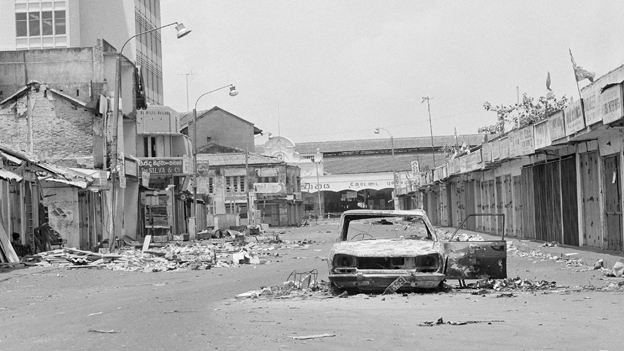
We are commemorating the 42nd anniversary of 1983 Black July ethnic violence unleashed against Tamils throughout Sri Lanka with the support of the then government of President J.R. Jayewardene, 16 years after the end of the civil war that ensued the violence that marked a watershed in the inter-ethnic relations of the country.
Sri Lankans cannot live without being haunted by the memories of Black July and the horrors of the civil war. However, most people living today, especially the younger generation, do not have direct experience and knowledge of that July pogrom.
While demands have been made over the years for accountability for human rights violations and war crimes in the final stages of the civil war, we must not forget that the truth about the Black July events of more than four decades ago has not yet been revealed and no one has been held accountable for it. After all, there is no guarantee that another Black July will not occur.
Today’s younger generations of all communities cannot hope for a peaceful future unless they fully understand the past and gain insight into the political root causes of the national ethnic crisis that led to Black July and the Civil War.
Black July brought shame to Sri Lanka in front of the civilized world. But it is even more shameful than Black July, that 42 years on there is still no acceptable political solution to the ethnic problem that can at least satisfy the minimum legitimate political aspirations of the minority communities.
Although there were opportunities to find a political solution after Black July and the end of the civil war, they were deliberately squandered by Southern Sri Lankan polity. The previous rulers were only interested in majoritarian mobilisation against the political rights of the minority communities.
Even after the new government of the National People’s Power (NPP) came to power, no interest was shown in creating a conducive atmosphere for a political solution to the ethnic problem. On the contrary, the new government is adopting approaches that tend to appease the nationalist forces that have long been an obstacle to solving the ethnic problem.
President Anura Kumara Dissanayake and the leaders of the NPP claim that their policy is to treat all communities equally. But the story of this egalitarian approach, which the government leaders incessantly claim, cannot be expected to win the confidence of the Tamil people unless they show a sincere interest in finding solutions to the various problems peculiar to the minority communities who have been subjected to racial discrimination and repression by the governments for a long time. In particular, the Tamil people who have suffered immensely during the three-decade civil war.
Against this backdrop, attention needs to be focused on two important developments in Sri Lankan politics since Black July.
The Provincial Council system was introduced by the 13th Amendment to the Constitution of Sri Lanka following the Indo-Sri Lanka Peace Accord of 29, July 1987 with a view to finding a political solution and direct intervention by India in the ethnic problem. Although politics in India and Sri Lanka have changed significantly since the Peace Accord, the only provision for devolution of power in the Sri Lankan constitution remains a talking point.
While the governments and the polity of southern Sri Lanka are largely responsible for the impediments to the proper implementation of the Provincial Council system, despite its various inadequacies, it is also true that the Tamil polity has not acted with the political wisdom required by the circumstances.
On one occasion when Chandrika Bandaranaike Kumaratunga went to New Delhi after stepping down as President, she openly admitted that all governments in Sri Lanka had ensured that the 13th Amendment was not fully implemented.
In the period since the Peace Accord, India, irrespective of the political party in power in Delhi, has consistently been urging Sri Lankan governments to fully implement the 13th Amendment. However, amidst the changed geopolitical situation, New Delhi is not in a position today to press the issue in a manner that could cause discomfort to the Sri Lankan government.
There is no doubt that Modi is purposely avoiding mentioning the 13th Amendment when he meets President Dissanayake in order not to cause inconvenience to him politically. Therefore, it is not difficult for anyone to understand how India’s intervention in the ethnic imbroglio after Black July, stands today after 42 years.
The NPP government’s position is that the provincial council system will remain in place until a new constitution is brought in. But no one knows what form the devolution of power will take in a new constitution. Given the opposition to the 13th Amendment in southern Sri Lanka, it is doubtful that the amendment will be fully incorporated into the new constitution. An important question is how India will react to the current situation if the new Constitution contains less devolution than the provisions of the 13th Amendment.
The 13th Amendment to the Constitution of Sri Lanka continues to exist to this day because it was brought in due to the intervention of India. Do the Tamil parties today have the political strength and courage to force the Government to come up with a devolution arrangement that is even less than what is in the 13 Amendment, in the event Colombo abolishes it?
Therefore, the Tamil polity has to come to a clear decision on the Provincial Council system and the 13th Amendment. Most Tamil parties are of the view that the 13th Amendment cannot be a comprehensive solution or a final solution to the ethnic problem. However, some of them have time and again spoken about the use of the 13th Amendment as an interim arrangement.
Even though the provincial council elections have not been held for the last eight years, the Tamil parties do not raise the issue with the governments. But if elections are announced, they will not hesitate to contest. There have been objections from some Lankan civil society organisations in the South to the fact that the provinces have long been administered by governors who are the direct representatives of the president. But the Tamil parties in the North and East do not talk about it.
The leaders of the Tamil political parties, who whenever meeting the Indian Prime Minister and diplomats do not fail to request them to exert pressure on the Sri Lankan government to fully implement the 13th Amendment, do not talk to the Tamil people or the government about the Amendment.
The leaders of the Tamil parties met with Indian Prime Minister Modi during his visit to Sri Lanka in early April. The statements issued by the secretary of Ilankai Thamizharazu Katchi (ITAK ) M. A. Sumanthiran and Tamil National People’s Front (TNPF) general secretary Gajendrakumar Ponnambalam separately help understand the position the Tamil parties are taking in their approach to India at present.
“We believe that the solution to the ethnic problem can only be found on the basis of the India-Sri Lanka Peace Accord. Appropriate devolution of powers should be implemented. There are many shortcomings in the implementation of the Peace Accord.
“Even the 13th Amendment has not been fully implemented. The amendment was accepted by the governments of both countries. These were mentioned the joint statements in 2010, 2011 and 2012. It states that the amendment will be fully implemented and a meaningful devolution will be built upon it. It hasn’t been done yet. It has to create a meaningful devolution based on a peace agreement, either through a new constitution or otherwise.
“As far as the ITAK is concerned, we believe that there can be meaningful devolution only through a federal system. Until that goal is achieved, the existing provincial council system should be implemented. We thank Prime Minister Modi for saying this in his press conference with President Dissanayake.
“There is an international agreement with the Sri Lankan government on how to resolve the Sri Lankan Tamils issue. It is India’s responsibility to do so. We told Prime Minister Modi that we expect India to fulfil that responsibility,” Sumanthiran said.
“We accept that only India has a national security perspective in Sri Lanka. There is no justification for any other country to approach Sri Lanka from a national security perspective. We are clear that Sri Lanka should give priority to India over any other country on the basis that India’s security is important. We recognise that India has that right, particularly in the Northern and Eastern Provinces.
“We accept that the Peace Accord is a principle-based document that has brought the Sri Lankan government closer to resolving the ethnic conflict. But since the implementation of the 13th Amendment was restricted to a unitary system, we find it difficult to benefit from it. It is necessary for India to continue to urge the Governments of Sri Lanka to implement the same, even after several decades have passed since the signing of the Accord. When the 13th Amendment was brought to Parliament, the Supreme Court had said that since it was within the unitary system, there could be no conflict or competition between the central government and the provinces for any reason.
“Although the Peace Accord has mentioned many things regarding the solution of the ethnic problem, the solution is not found because the 13th Amendment has been constricted within the unitary state. So we call upon Prime Minister Modi to invite Tamil parties to New Delhi and help us to reach a common position that India can also accept – that the federal system can be fully achieved beyond the unitary system, without violating the Peace Accord,” said Ponnambalam.
Last week, Prime Minister Harini Amarasuriya and Minister Bimal Ratnayake said that the process of drafting a new constitution has begun and that provincial council elections will be held early next year. Against this backdrop, it remains to be seen how far Tamil parties will be interested in adopting a realistic approach to meeting the needs of the people of the North and East by using those councils.