
Prologue: On the Fragility of Peace and the Architecture of Power
Any examination of Gaza’s “reconstruction” must begin with the plainest admission: there is no durable peace to reconstruct upon. What exists today is not peace, but a conditional pause — a ceasefire suspended between exhaustion and opportunity.
To imagine that Hamas will surrender its weapons and its cause — after three generations of siege, displacement, and betrayal — is to misunderstand the anatomy of resistance. For the Palestinians, armed struggle, however desperate, has always been less a military posture than an existential declaration: we still exist. Demilitarization, in such a context, cannot be imposed; it must evolve from justice, not dictate.
Israel, for its part, has never defined what “security” means in moral or territorial terms. Its successive governments have oscillated between punitive containment and annexation by stealth. That ambiguity is deliberate — it sustains the cycle of “managing” Gaza rather than resolving it.
Between these absolutes — the intransigence of resistance and the instrumentalism of occupation — the international system finds its opening.
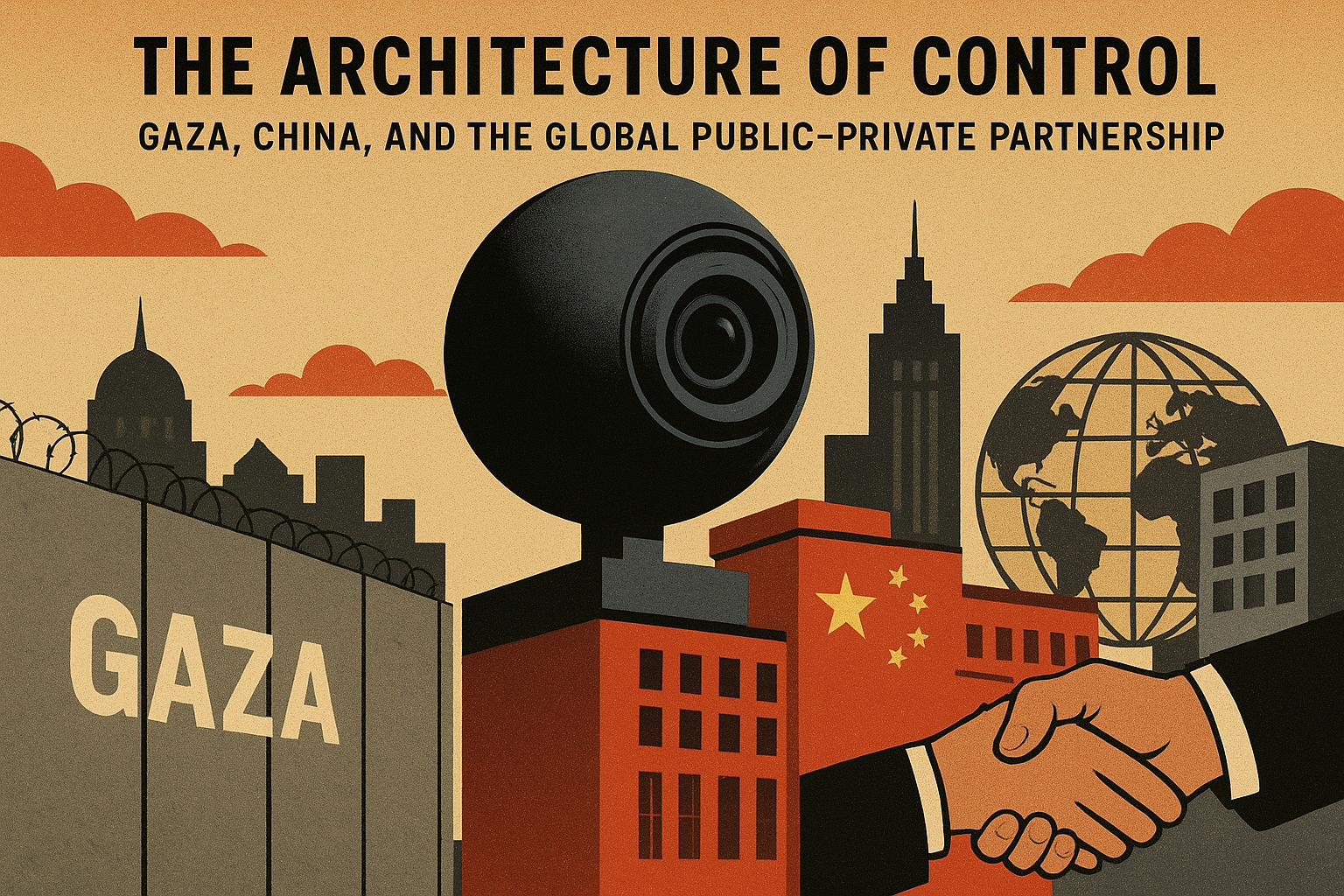
Into the vacuum steps the Global Public–Private Partnership (G3P): the transnational consortium of states, corporations, and financial institutions that now performs the functions once reserved for empires. It moves beneath the language of “aid,” “peacebuilding,” and “sustainable development,” yet its real genius lies in governance capture — turning crisis zones into laboratories for administrative control and digital compliance.
This is not conspiracy but bureaucracy — the quiet re-engineering of sovereignty through contracts, not conquest.
When we speak therefore of “peace plans,” “transitional authorities,” or “smart reconstruction,” we are describing not reconciliation between peoples, but alignment between systems:
- Between AIPAC-shaped American policy and Israel’s permanent military economy
- Between global consultancies and asset managers who convert disaster into long-term concession rights
- And between China’s state-capital model and Western financial power, each seeking to extend its influence through infrastructure, data, and digital governance
These alliances are transactional, not ideological. They share a faith in measurement, in predictability, in managed humanity. Their peace is statistical, not moral.
The following essays should therefore be read not as reportage on a functioning peace, but as a deconstruction of an aspiration — the aspiration of the G3P to turn Gaza, through captured governance and controlled reconstruction, into a model of post-sovereign order.
The tragedy is that this order would arrive not through mutual recognition or justice, but through exhaustion — when both occupier and occupied are too spent to resist the administrators waiting in the wings.