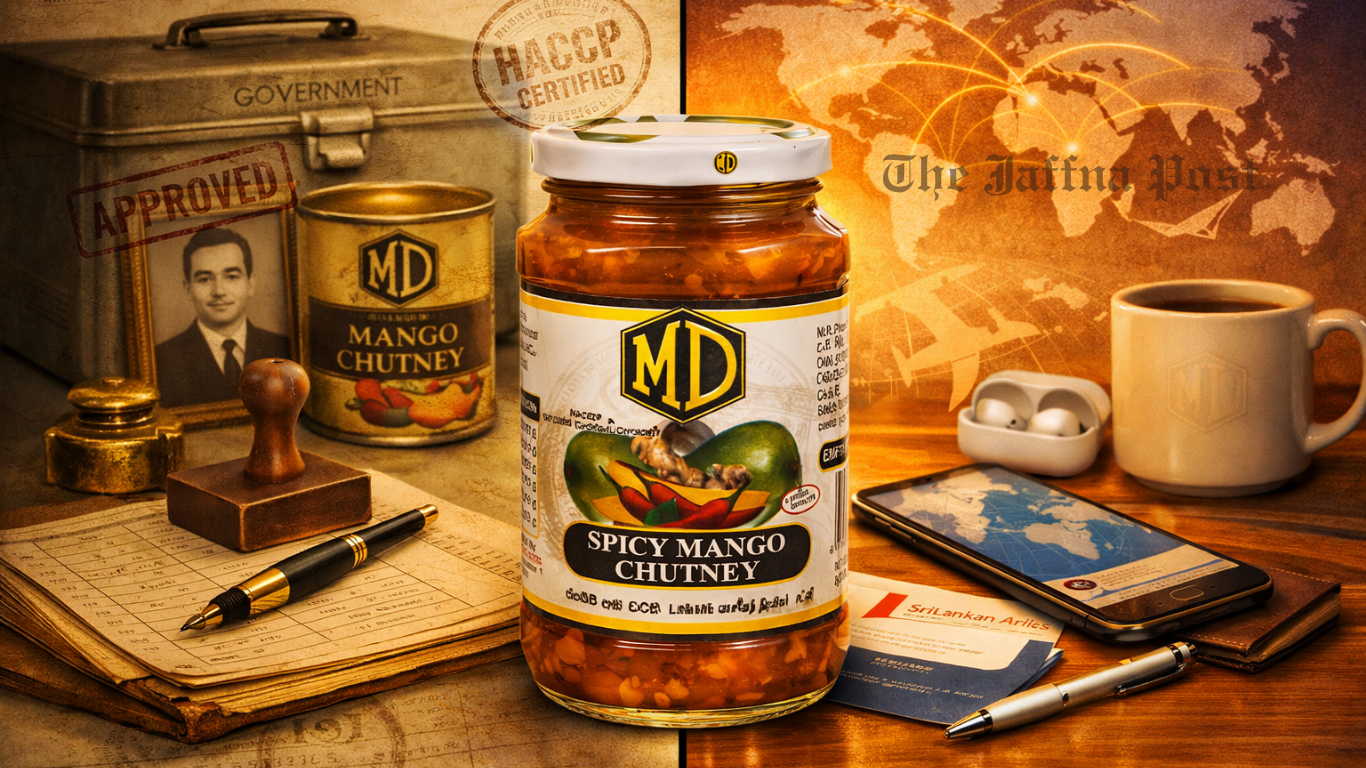

While having my lunch alone the other day, and deep in thought, my eyes rested on the small bottle of MD Mango Chutney in front of me on my dining table. Like millions of Sri Lankans, I have been buying MD products for decades, without giving much thought to the story behind the familiar label.
Yet that bottle represents a rather fascinating business lesson in Sri Lanka, and perhaps one of the strongest arguments in the continuing debate on State-Owned Enterprises (SOEs), privatisation and the proper role of government in business.
Many younger Sri Lankans probably do not realise that “MD” originally stood for the old “Marketing Department”, a government institution established many decades ago. Among its many responsibilities was the development and marketing of processed food products that quickly earned a reputation for consistency, quality and affordability.
Long before marketing became a specialised discipline and brand equity was talked about, the Marketing Department had over the years built one of the country’s most trusted consumer brands.
Building a successful brand is neither simple nor quick exercise. It requires years of commitment to quality, reliability and customer satisfaction. A brand is far more than a name, a logo or attractive packaging. It is a promise, and more importantly, it is an emotional bond built gradually between consumers and a product through repeated positive experiences over many years.
From a marketing perspective, this trust is often worth far more than the physical assets of a business. Factories, machinery and buildings may appear on a company’s balance sheet as tangible assets, but a respected brand is an intangible asset whose true value is often much greater.
The truly interesting part of the MD story began much later. Following the economic liberalisation of 1977, Sri Lanka embarked on a programme of restructuring and privatisation of many state-owned commercial enterprises. Among the assets eventually transferred to private ownership were food-processing facilities that had belonged to the former Marketing Department, including its well-known canning operations.
New owners of privatised businesses often make a costly mistake, eager to make a fresh start by redesigning everything, and attempt to build an entirely new identity. In doing so, they frequently destroy decades of accumulated goodwill.
The new owners of MD did precisely the opposite. They recognised that they had not merely purchased a food-processing factory, but had also acquired decades of consumer trust. The goodwill embodied in those two simple letters “MD” would have taken another generation to recreate.
So, they retained the familiar brand name while modernising operations, improving efficiency and expanding the product range and professional marketing. The result is that today MD has evolved into a successful, export-oriented enterprise whose products are found not only across Sri Lanka, but also in supermarkets serving Sri Lankan communities and international consumers around the world.
This is precisely where the broader debate on State-Owned Enterprises becomes relevant. The discussion is often presented as though there are only two choices: governments should either own businesses indefinitely or privatise everything.
Governments have, at different stages of a country’s development, played an important role in establishing industries where private investors were either unwilling or unable to assume the risks involved. In developing economies, this has often seen as both necessary and beneficial. Without such intervention, many industries may never have emerged.
However, creating an asset and managing it commercially over the long term are two entirely different challenges. Governments are designed to govern and administer, where the objectives are not profit, but social welfare, regulation, and national security. Commercial enterprises, on the other hand, require rapid decision-making, continuous innovation, relentless cost control, customer responsiveness and the willingness to take calculated risks. These characteristics are not really prevalent in a government bureaucracy that normally accompanies State ownership.
This explains why several State-Owned Enterprises eventually drift into inefficiency. Political appointments, ad-hoc decisions, over staffing, and cumbersome procurement become commonplace. Consequently, accountability erodes, because losses are conveniently absorbed by the Treasury. There is no competition and shareholder expectations simply does not exist.
At the end of the day these losses incurred by State-Owned Enterprises are often described as “government losses.” But in reality, all these losses are ultimately borne by taxpayers through higher taxes, increased public debt or reduced spending on important services such as health, education and infrastructure.
This does not mean that every State-Owned Enterprise performs poorly. There are several profitable SOEs, particularly in the banking sector, that have demonstrated sound commercial management, while remaining under State ownership. Nevertheless, many others continue to impose a significant financial burden on the country.
The MD story deserves careful study
The Government created a respected national brand. Private ownership preserved that brand, strengthened it and unlocked its commercial potential. Both stages were equally important. Without the Government, there may never have been an MD brand. Without private enterprise, that brand may well have faded into history like many other State ventures.
The same lesson may well have relevance for several other State-Owned Enterprises. Take Sri Lankan Airlines, for example. Despite its financial difficulties, it remains one of Sri Lanka’s most recognised international brands and continues to enjoy considerable goodwill within the global airline industry. So, the MD mantra should work?
However, years of accumulated losses have made the airline commercially unattractive to potential investors. Unless the Government is prepared to restructure the company, absorb part of its accumulated debt (“hair-cut”) and present a financially viable enterprise, meaningful privatisation will remain extremely difficult, however valuable the brand itself may be.
Across Sri Lanka there are State-Owned Enterprises possessing valuable assets that are often overlooked. Some own prime land, while others possess respected brand names, technical expertise, nationwide distribution networks or highly skilled workforces. The question is not whether they should remain wholly public or become wholly private. The challenge is how to unlock that value before it is eroded by years of losses and underinvestment.
Privatisation should therefore never become a desperate “fire sale” undertaken during times of economic crisis. It must be approached strategically. The objective should be to preserve what is valuable, introduce commercial discipline, improve governance and ensure that the national interest continues to be protected, through strong regulation rather than direct ownership.
The State’s most important role is that of policymaker, regulator and facilitator, creating an environment in which businesses can flourish. It need not necessarily remain the owner and operator of commercial enterprises competing in markets where the private sector is often better equipped to deliver efficiency and innovation.
Ultimately, the purpose of government should not be to run businesses indefinitely. Its greatest contribution may instead lie in creating the conditions under which successful enterprises are born, trusted brands are established and industries mature. Once that foundation has been laid, private enterprise may often be better placed to unlock their full commercial potential.
So that little bottle of MD Mango Chutney that sat unnoticed on my lunch table reminded me of a profound lesson in economics and marketing. Successful privatisation is not simply about selling factories or transferring ownership. It is about recognising where real value lies, preserving that value and allowing it to grow.
In the case of MD, Sri Lanka appears to have achieved that balance remarkably well. Perhaps there are lessons there that deserve far wider application.