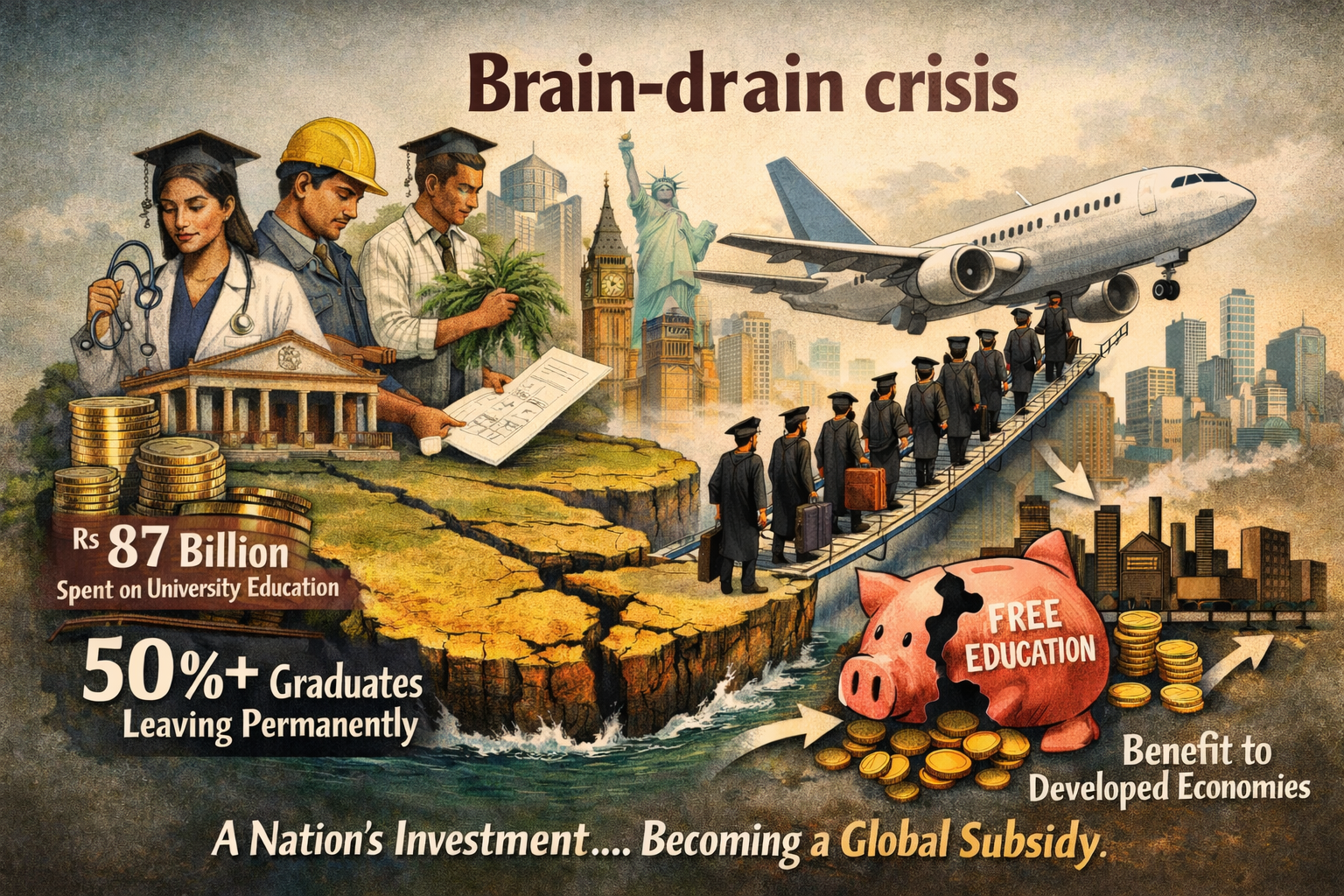

Sri Lanka is facing a structural brain drain crisis of unprecedented proportions. A recent study by the University of Peradeniya, cited by Ceylon Public Affairs, reveals that more than 50 percent of state university graduates are migrating permanently. In critical disciplines such as medicine, engineering, and agriculture, migration levels range between 80 and 90 percent.
The government reportedly spends approximately Rs 87 billion annually on university education. When publicly funded graduates leave permanently, free education risks becoming an indirect subsidy to developed economies rather than a long-term national investment. At a time when Sri Lanka continues to struggle with poverty and economic instability, this trend raises urgent policy concerns.
A national brain drain with deep regional imbalance
Sri Lanka educates roughly 42,000 undergraduates annually across arts, management, engineering, medicine, and other disciplines. The highest migration rates are recorded among science-based graduates. Low domestic wages, limited private sector absorption, constrained public sector salaries and post default instability have pushed many graduates to seek stability abroad.
This creates a middle-income trap. The country produces talent but cannot retain or productively absorb it. Nationally, this weakens healthcare, education, research capacity and industrial expansion. Regionally, the damage is deeper and more structural.
The North and East: A shrinking population base
The Jaffna district population has reportedly declined from approximately 8.3 lakhs in 1981 to around 5.3 lakhs today. This reflects the cumulative consequences of conflict, migration and limited economic expansion. When brain drain intersects with demographic decline the effect becomes systemic.
The North and East are losing working age citizens, entrepreneurs and future families. School enrolments decline. Local markets shrink. Housing demand weakens. The economic base narrows. Unlike Colombo which can draw talent from across the island, districts in the North and East have limited internal replacement capacity.
What percentage of graduates from the North and East are leaving?
There are no officially published statistics that break down graduate migration rates by province or district. National studies indicate that more than 50 percent of Sri Lanka’s state university graduates migrate permanently, with rates rising to between 80 and 90 percent in critical fields.
A reasoned assessment suggests that graduate migration from the North and East is at least equal to the national average and potentially higher in science based disciplines due to weaker private sector absorption, limited industrial clusters and strong diaspora migration networks.
In addition to degree holders, semi-skilled youth and diploma holders are also migrating at increasing rates. This compounds demographic contraction and widens the regional development gap.
Healthcare and education under strain
Hospitals and universities in the North and East operate under constraints. When medical graduates migrate at high rates, regional healthcare systems face severe shortages. Universities struggle to retain lecturers and researchers, weakening academic ecosystems and innovation capacity.
Economic and political consequences
The long-term impact includes shrinking domestic markets, declining investor confidence and reduced political leverage. Persistent outward migration signals structural fragility and gradually reduces national representation strength.
Should graduates reimburse the State?
Proposals that migrating graduates reimburse public education costs may appear logical but enforcement is difficult. Compulsion does not create retention. Opportunity does.
A structural shift is urgently required
Sri Lanka must transition from an education-only model to an education and economic retention framework. Universities must align with regional industrial development and connectivity-driven growth strategies.
The North and East cannot afford another four decades of population decline. The time for structural correction is now.