
Britain, right from the beginning of the civil strife in Sri Lanka, remained a premier supplier of military hardware to the armed forces in Sri Lanka. On the other hand the country had also granted political asylum to the theoretician of the Liberation Tigers of Tamil Eelam (LTTE) late Dr. Anton Balasingam and his Australian born wife Adele Balasingam.
Apart from granting political asylum to Balasingam and his wife, Britain even allowed a significant number of former LTTE cadres to carry out their political activities in Britain. When the LTTE was active in the island and engaged in its political activities in Britain, certain political critics in the island even commented that Britain was playing a double game with regard to the North and East crisis in Sri Lanka.
A few days ago Britain’s Foreign Secretary David Lammy expressed his concerns over the mass grave in Chemmani in Jaffna.
He had mentioned of Chemmani at the Foreign Affairs committee meeting when the British Parliamentarian of Lankan origin Uma Kumaran pointed out at the Chemmani issue. Uma Kumaran in her address at the Foreign Affairs Committee had welcomed Britain’s recent sanctions against Sri Lankan military officials implicated in serious human rights violations, preventing them from receiving any form training in Britain.
Since independence from Britain, Ceylonese Armed Forces personnel were trained at prestigious military institutions in Britain. Former President Mahinda Rajapakse’s second son Yoshitha Rajapakse, who served in the Sri Lanka Navy as a lieutenant, was even trained at Dartmouth Naval Academy in Britain.
“I’ve got very grave concerns in relation to the mass grave that has recently been discovered at Chemmani. Britain has raised it with the Sri Lankan government directly soon after the Chemmani issue was brought up. We are in close touch with families of those who disappeared across in the Island and we’re working with several non-governmental organisations on the Chemmani issue,” Lammy said.
Parliamentarian Uma Kumaran also asked whether the UK government would support the UN High Commissioner for Human Rights’ recommendation to refer alleged perpetrators of atrocities in Sri Lanka to the International Criminal Court (ICC).
Foreign Secretary Lammy responded that Sri Lanka is not a party to the ICC, noting, “The Court wouldn’t have jurisdiction to investigate any crimes that might be brought to the ICC. In the meantime Illankai Tamil Arasu Katchchi (ITAK) despite being kept away at the Chemmani mass grave site during the visit of United Nation’s Human Rights Chief Volker Turk to the site recently, has forwarded a letter to President Anura Kumara Dissanayake urging him to take immediate action to ensure truth, justice, and international collaboration in the ongoing Chemmani mass grave investigation.
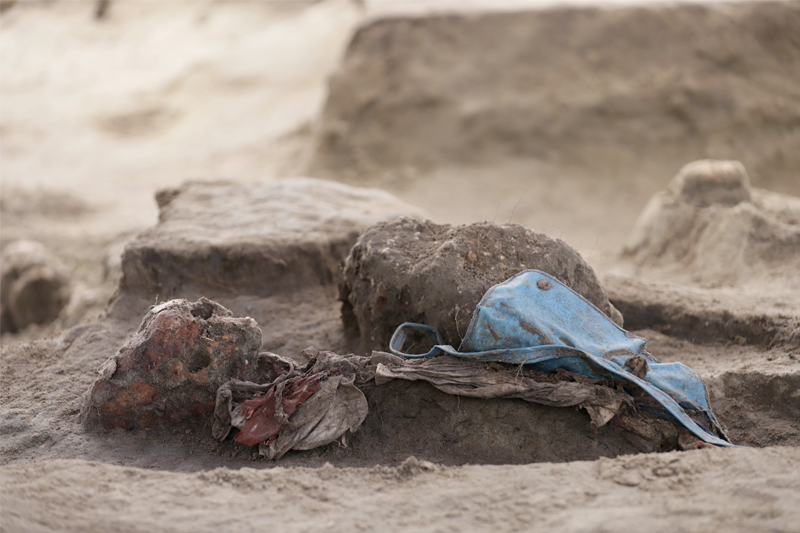
ITAK raised its concerns over the exhumation process in Chemmani and called for an independent international forensic oversight. It has emphasised that over 65 skeletons, including those of infants, have been recovered so far, affirming the scale of atrocities allegedly committed in the region.
ITAK also called for the public release of all forensic reports and DNA findings, and alerted that symbolic reconciliation would remain hollow without legal accountability. The letter was signed by senior party leaders C. V. K. Sivagnanam and M. A. Sumanthiran.
The five-point letter sent to President Anura Kumara Dissanayake by ITAK senior leaders reads as follows:
- Consolidate the legal cases related to the 1999 and 2025 exhumations into a single judicial and forensic inquiry under the Colombo and Jaffna Magistrate’s Courts.
- Engage independent, internationally respected forensic experts to oversee all stages of the investigation, ensuring forensic integrity and public trust.
- Publicise all interim and final forensic reports, DNA profiles and identification results, and facilitate access for victims’ families, civil society and international observers.
- Repatriate the remains excavated in 1999, currently believed to be held in Glasgow, so they may be examined under the same protocols and returned to their families with dignity.
- Allocate significantly enhanced financial and logistical resources to ensure that the current excavation is completed under international standards; hundreds of families continue searching for missing loved ones, and without truth and accountability, reconciliation remains a facade. Concurrently, take steps to prosecute those responsible for these heinous crimes, which is essential for national healing.