
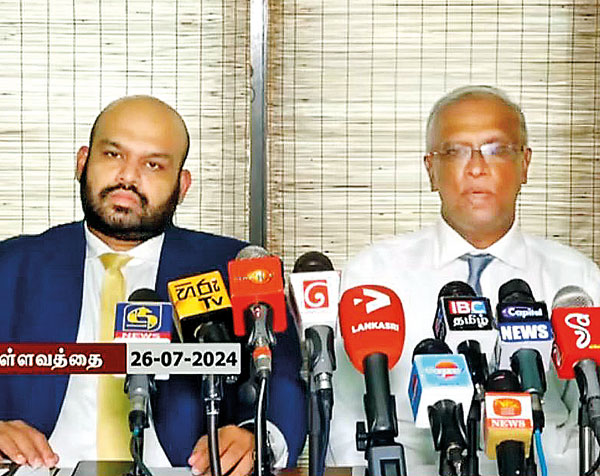
While civil society leaders such as Karu Jayasuriya, president of the National Movement for Social Justice( NMSJ) and former speaker of parliament, and Dr. Jehan Perera, executive director of the National Peace Council (NPC) have been at the forefront of urging the government to hold provincial council elections as soon as possible, most politicians in southern Sri Lanka do not care about those elections or the future of the provincial councils. The voices of politicians who constantly demand the abolition of provincial councils are also heard loudly from time to time.
However, in a strange turn of events, suddenly a group of southern politicians demanded last week that the government immediately hold provincial council elections. They accused provincial governors of arbitrarily spending funds allocated to councils and the government of delaying provincial council elections.
Addressing a media conference in Colombo, Kurunegala District Parliamentarian Dayasiri Jayasekara said, “Governors are now taking decisions unilaterally and spending the funds of the Provincial Councils as they please. For example, the Governor of North Western Province has spent Rs.3 billion without proper monitoring.” He raised the issue of the neglect of schools under the jurisdiction of the provincial councils and said that the government plans to close down schools with less than fifty students.
Pointing out that decisions like closure of schools cannot be taken unilaterally as education is a devolved subject under the 13th Amendment to the Constitution, he said that if elections are held immediately and provincial councils are made functional, they will provide a platform to effectively resolve regional issues.
Jayasekara’s position is that provincial council elections can be held under the proportional representation system by passing a simple amendment in parliament, or that elections can be held under the new mixed system by having parliament approve a delimitation report.
While former Member of Parliament Premnath Tholawatta said that the government might ignore the urgency for provincial council elections by attempting to introduce a new constitution, former Minister Buddhika Pathirana urged the government to respect the Indian Prime Minister Narendra Modi’s frequent requests to hold provincial council elections in accordance with constitutional commitments.
It is important at this stage to welcome the comments of these southern politicians rather than to imply that there are various political reasons for their sudden interest in provincial council elections and the need for functioning of provincial councils to address the regional problems.
Although provincial council elections have not been held for eight years, most politicians in Southern and Northern and Eastern provinces are not concerned about the future of the provincial councils for different reasons. Therefore, it is imperative to bring about a change in such an irresponsible attitude to the provincial governance.
It is not clear whether Jayasekara and the others who urged the government to hold early provincial council elections, reflect the official positions of their respective political parties on the issue. But their concern in highlighting problems caused by the continued administration of the provinces under governors directly appointed by the President should be welcomed and understood properly.
Leaving the governors in charge of the provinces for years without handing over their administration to the elected representatives is in fact a mockery of the concept of devolution.
There are politicians who say that nothing has gone wrong in the country because the provincial councils have not been functioning for many years. They are, in fact, against the devolutionary arrangements and hold that provincial councils were thrust upon Sri Lanka by India forcibly.
Sri Lanka has seen four Presidents and three governments since provincial council elections were postponed in 2017. Governments and opposition parties must collectively accept responsibility for the indefinite postponement of the elections.
Provincial elections could not be held because of the deplorable manner in which the provincial council elections amendment bill, which was made out to be a move to guarantee a 30 percent quota for women, was stuffed at the committee stage of the parliamentary debate with sections changing the electoral system into the mixed one as in the local government elections.
It was widely condemned at that time that what was passed by Parliament was vastly different from the bill examined by the Supreme Court. This happened during the Sirisena-Ranil government. As a result of the rejection by Parliament of the delimitation report, elections had to be postponed indefinitely.
Elections can be held only if Parliament approves a new delimitation report. Doing so would be an act of delaying the elections again. It would, therefore, be practicable for the time being to hold the Provincial Council elections under the proportional representation system fully as in the past.
The Provincial Council elections could have been held earlier if the amendment bill moved by M. A. Sumanthiran as a private member motion, had been passed by Parliament during the regime of President Ranil Wickremasinghe.
In a situation where it was largely expected that Sumanthiran’s bill would surely be passed in Parliament, the government scuttled the possibility. It seemed that the main reason for this was the decision taken by the Illankai Thamizharasu Katchi (ITAK) to support the Samagi Jana Balawegaya (SJB) candidate Sajith Premadasa in the 2024 presidential election.
The ITAK also apparently did not have the political acumen to realize that it would be prudent to take a decision on whom to support in the Presidential election after the bill was passed by Parliament.
Recently, Batticaloa district MP Chanakyan Rajamanickam submitted a bill as a private member motion as Sumanthiran previously did. Passing it in Parliament could pave the way for early conduct of provincial council elections under the system of proportional representation. It is noteworthy that the government side once assured the House that the government will bring such a bill and pass it to pave the way for provincial elections.
If the government has genuine political will to hold the provincial council elections at the earliest, it can either support Chanakyan’s bill in Parliament or the government itself can bring and pass an amendment bill. While Minister Bimal Ratnayake recently announced that provincial council elections would be held early next year, the Elections Commission has declared that it is entirely the responsibility of Parliament to find a solution to the legal snags in holding those elections.
There is also a widespread view that the government is not ready to rush into holding provincial council elections. In any case, it is entirely the responsibility of the National People’s Power Government to take necessary steps to hold the Provincial Council elections expeditiously and to allow the provincial governance to be handled by elected representatives. It has no excuse whatsoever to absolve its responsibility.