
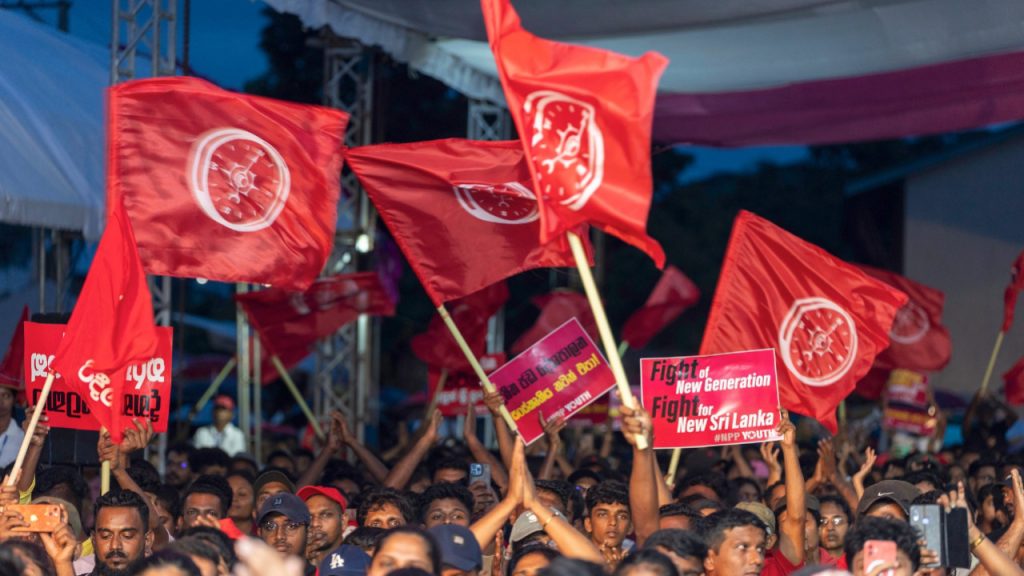
When the National People’s Power (NPP) which had promised the Sri Lankan people in national elections last year that it would bring in a new constitution, announced after coming to power that the process would be carried out only after three years in office, constitutional experts and political analysts pointed out the problems the government may face in doing so later in its term.
It is common for governments to change the constitution in the early stages of their term of office. Both republican constitutions in independent Sri Lanka were introduced early in the tenures of respective governments.
The United Front government led by Prime Minister Sirimavo Bandaranaike, which came to power in May 1970, introduced the first republican constitution in May 1972. The government could have brought in the Constitution earlier, had it not been disturbed by the first armed insurrection of the Janatha Vimukthi Peramuna (JVP) in 1971.
The United National Party (UNP) government led by J. R. Jayewardene which came to power in July 1977, passed the second republican constitution within 15 months. Therefore, doubts were raised about the political wisdom of the present government’s announcement to initiate the new constitution drafting process after three years.
But last week (July 25), Prime Minister Harini Amarasuriya told parliament that initial steps were being taken to introduce a new constitution. Responding to a question raised by Samagi Jana Balawegaya (SJB) MP Ajith Perera, the Prime Minister said a new constitution would be brought before the end of the current government’s term.
Earlier in early April also, the Prime Minister gave a timeline in Parliament for the constitution drafting process. “There are two things that the government needs to urgently prioritise before bringing in a new constitution. When it came to power last year, the government had to focus entirely on stabilizing the economy and ensuring democracy by holding provincial council elections, which have been delayed for years. The government will start the process of drafting a new constitution after holding the provincial council elections,” she said.
At the same time, she acknowledged that no allocation has been made in the budget to carry out this process this year and said that the government intended to continue the constitution drafting process already initiated by the previous government through public consultations.
In fact, the Prime Minister reiterated the promise made by President Anura Kumara Dissanayake in his election manifesto to continue the constitution drafting process of the government (2015 – 2019) led by President Maithripala Sirisena – Prime Minister Ranil Wickremesinghe.
Last week, Minister and Leader of the House Bimal Ratnayake announced that the government would hold provincial council elections early next year, amid widespread opinion that the government would not rush to hold provincial council elections for the time being, following a significant drop in the votes of the ruling party in the last local elections. If the provincial council elections are held as announced by the minister, it can be expected that the constitution drafting process will be accelerated from early next year.
After the previous constitution drafting process, then Prime Minister Wickremesinghe submitted an interim report to Parliament in September 2017. Based on what the new government has announced, the process should start again from that interim report. The government’s approach in this regard will be known only when the process begins.
At this point, important questions need to be asked. What should be the main purpose of the new constitution? What are the main aspects to be taken into account by the NPP government which promised to bring about a system change and a new political culture?
Sri Lanka is at a critical juncture now. If President Dissanayake and his government are really interested in leading the country on a new path, free from the wrong path of the past after decades of political instability, economic crisis and the decay of institutions, they should first abolish the executive presidential system. Next, the constitution should include a meaningful devolutionary arrangement for finding a political solution to the national ethnic problem, which has been the root cause of the country’s unrest for decades. Apart from these two measures, there can be no other priority for the new constitution drafting process.
The executive presidency is not simply a flawed institution, it is the embodiment of a political culture that has crippled Sri Lanka’s potential. Every major calamity the country has endured – ethnic conflict, economic disaster, human rights abuses – has been exacerbated by the unchecked powers of this office.
One of the more tragic ironies in Sri Lanka’s political history is that nearly every major political party has called for the abolition of the executive presidency at some point -including SLFP, UNP, JVP and now NPP. Yet, every time a party comes to power, constitutional reform is conveniently postponed.
People have not forgotten the statement made by the leaders of the NPP during the 2024 presidential election campaign, that Anura Kumara Dissanayake is the last executive president of the country. Last week, Prime Minister Amarasuriya also told parliament that a new constitution was essential and that the executive presidency would be abolished before the end of the government’s term.
The current moment offers a rare chance to break the circle of reneging the promise of the abolition of the presidency. If the NPP squanders this opportunity, it risks becoming yet another party that talked about reform, but failed to deliver.
In the past, governments that wanted to abolish the executive presidency did not have the two third majority in parliament, while governments with the same majority did not have the political will to abolish the office.
The people of Sri Lanka do not yet have leaders who are determined to abolish the presidency without acting with their own political interests in mind. But let us hope that President Dissanayake will never want to join the ranks of such leaders.
Fate of the 13th Amendment
Another important question is what kind of devolutionary arrangement the government will bring in the new constitution, to find a political solution to the ethnic problem.
The JVP, the main constituent of the NPP, has a bitter history of vehemently opposing all attempts to find a political solution to the ethnic problem. The question, therefore, naturally arises as to how much interest the Government will have in incorporating devolution provisions in the new Constitution.
Although not yet properly implemented, the 13th Amendment to the Constitution is the only legal provision in Sri Lanka that deals with the devolution of power. After the Indo-Sri Lanka Peace Accord, all the governments in power for the last 38 years have gradually usurped the powers conferred on the Provincial Council by that amendment.
Will the government be willing to include at least the powers left in the 13th Amendment in the new Constitution? It can never be expected that the government will come forward to infuse more powers than the amendment has.
There is no doubt that the nationalist forces in southern Sri Lanka who are crying out about the danger of separation of the country if the 13th Amendment is fully implemented, will exert pressure on the government to do away with the amendment when the process of drafting a new Constitution is set in motion. Other political parties such as the UNP, the SJB and the SLPP are unlikely to be interested in devolution of power in the current situation.
The main objective of the new constitutional effort should be to advance efforts to find a political solution to the national question, similar to the abolition of the executive presidential system. Otherwise, it is certain that the new constitution is not going to bring any desired change
It is pertinent to recall some of the important remarks made by Lionel Bopage, former general secretary of the JVP, who is currently living in Australia, in an article titled ‘The Importance of a New Constitution for Sri Lanka’ last week.
“Although the current constitution guarantees certain fundamental rights, Sinhala is seen as superior to Tamil, and Buddhism as superior to other religions. This constitution, which did not meet the aspirations of the minority communities, led to divisions among the people and ethnic conflict.
The process of drafting a new constitution should begin with a broad public consultation. The Constitution must reflect the aspirations of all people.
“The 13th Amendment should not only be fully implemented, it should go beyond that. Devolution of power is a means of ensuring participation of all communities in governance and not a threat to national sovereignty. Many in the Sinhala areas view the devolution as having separatist motives. But, in fact, it is an arrangement that enables people to take decisions on their own in areas such as education, health, land and administration.
“The government conveyed that it would initiate the constitutional reforms later in its tenure. But history has taught us that a delayed start can lead to failure. As the elections approach, the political will erodes. That’s happened before and the same should not happen again.
“We have the opportunity to lead Sri Lanka towards a better future. We have the opportunity to build a new democratic society that embraces all communities. The government should act in such a way that every citizen feels involved in it. And it’s not an easy process.
For Sri Lanka to have peace and an environment where communities live with mutual respect, a new constitution must be drafted that reflects the country’s diversity. It’s time for a start. Don’t waste it.”