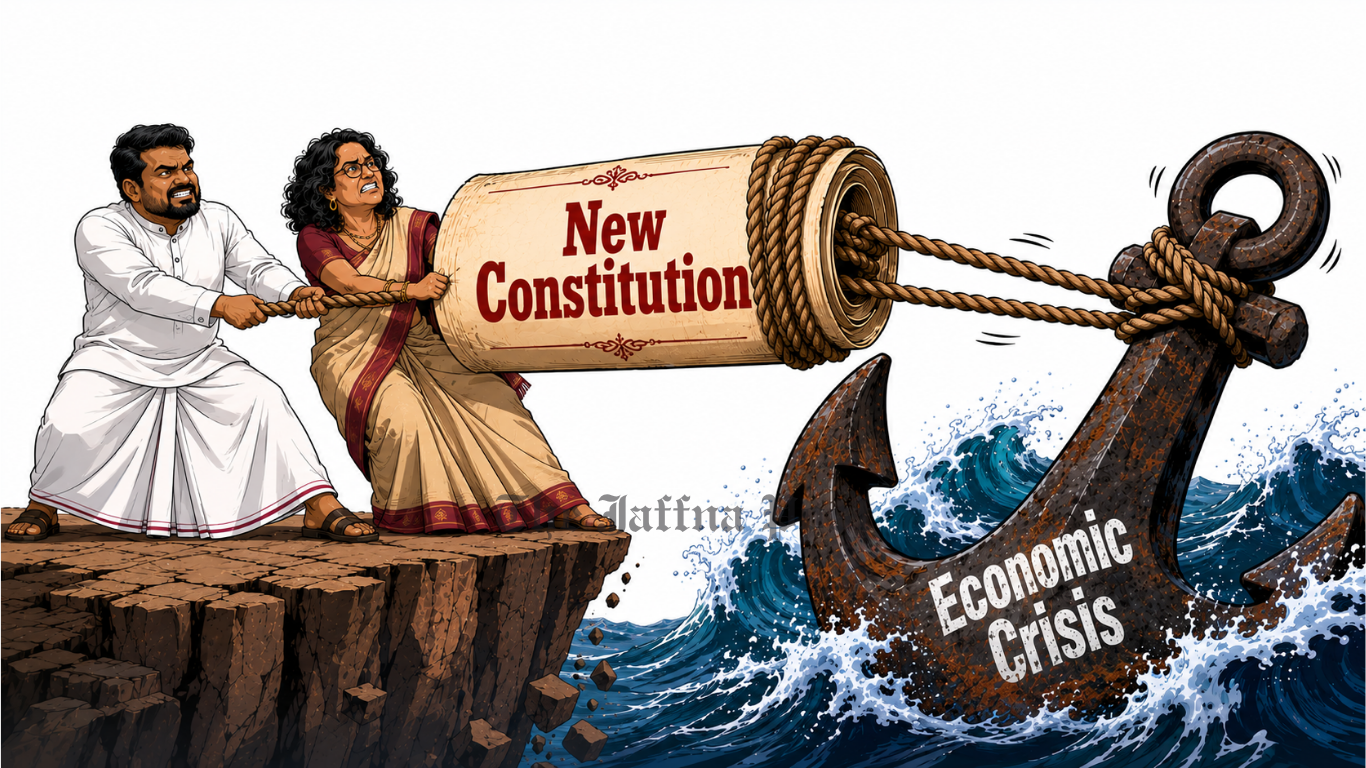

Amidst Sri Lanka’s current political climate and economic crisis, the question of whether the National People’s Power (NPP) government will bring a new constitution — in line with the promise made to the people during the national elections two years ago — has gained significant prominence in political debates.
It is customary for governments to initiate new constitutional drafting processes during the early part of their terms.
The United Front government, led by Prime Minister Sirimavo Bandaranaike, introduced Sri Lanka’s first republican constitution on May 22, 1972, in its second year in power. Had the first armed insurrection of the Janatha Vimukthi Peramuna (JVP) not taken place in April 1971, that government might have brought the new constitution even earlier.
Sri Lanka’s second republican constitution, which has now been in force for 48 years, was introduced by the United National Party (UNP) government led by President J.R. Jayewardene in September 1978—within 14 months of coming to power in July 1977. The first republican constitution lasted for only six years.
It was that second constitution that introduced the Executive Presidential system of governance. However, even before it came into effect, Jayewardene, while still serving as Prime Minister in late 1977, brought an amendment to the 1972 constitution and assumed office as the (first) Executive President on Independence Day, February 4, 1978.
The current constitution has been in place for the longest period in Sri Lanka’s history. As it approaches the half-century mark, serious doubts are being raised about the likelihood of the NPP government bringing a new constitution before that milestone is reached.
Against this backdrop, the remarks made by Prime Minister Harini Amarasuriya in an interview with a Colombo-based media outlet last week warrant attention. It appears the Prime Minister made these comments keeping in mind the widely held perception that the government has not yet paid serious attention to a new constitution.
While admitting that the government has not prioritized the constitutional drafting process under the current circumstances, the Prime Minister maintained that the government remains committed to bringing a new constitution.
“We openly admit that priority has not been given to the constitutional drafting process at this time. Preliminary discussions and foundational steps regarding this matter are underway. In the challenging situation the country currently faces, the government is giving greater importance to essential needs such as the economy, infrastructure development, and poverty alleviation,” Amarasuriya said.
Among the government leaders, it is mostly the Prime Minister who has occasionally expressed views on the new constitution issue both inside and outside Parliament over the past one and a half years. Notably, JVP leaders rarely speak about it.
Based on the Prime Minister’s remarks, if the government is unable to focus on changing the constitution because it is prioritizing economic recovery and poverty alleviation, the question arises: when will a conducive environment emerge to focus on such a process? Complete economic recovery and poverty alleviation are not tasks that can be accomplished within a specific timeline.
While asserting that the remaining three years of their government’s term are sufficient to bring a new constitution, the Prime Minister also expressed confidence that, seeing the public welfare services they implement, the people would grant another powerful mandate to the NPP after the current term. This raises a different doubt: will the NPP ask the public for another term in office just to bring a new constitution?
It is pertinent to recall at this juncture that during the 2024 parliamentary election campaigns, leaders of the NPP, particularly JVP General Secretary Tilvin Silva, asked the public only for a sufficient parliamentary majority to run the government smoothly.
They never asked for a two-thirds majority. They were well aware beforehand of the heavy burden such a parliamentary majority could impose on them. However, the people gave the NPP a massive majority of more than two-thirds (159 seats). It is clear that the resulting public expectation—that the government should use this power to perform extraordinary tasks that previous governments failed to do—is causing significant embarrassment to the administration.
In the nearly half-century since the introduction of the proportional representation electoral system, no other previous government has received such a colossal parliamentary majority as the NPP did in the 2024 general election. The people have given the NPP the full parliamentary majority required to change the supreme law of the country.
The Sri Lanka Podujana Peramuna (SLPP) government, which came to power in late 2020, had initiated steps to bring a new constitution. However, the public uprising following the economic collapse within two years ousted that government, led by then-President Gotabaya Rajapaksa.
Prior to that, the constitutional drafting process undertaken by the ‘Good Governance’ (Yahapalana) government (2015–2019), led by President Maithripala Sirisena and Prime Minister Ranil Wickremesinghe, progressed as far as an interim report in 2017. However, that effort to change the constitution also suffered a setback due to the crisis triggered in October 2018 when President Sirisena dismissed Prime Minister Wickremesinghe and appointed former President Mahinda Rajapaksa in his place.
Yet, during the September 2024 presidential election, Anura Kumara Dissanayake, contesting as the NPP candidate, promised in his election manifesto to continue the very same constitutional drafting process initiated by the Sirisena-Wickremesinghe government.
Unlike the ‘Good Governance’ government, which failed to function effectively due to conflicts between the President and the Prime Minister, the current President and government face no such political issues. The NPP holds absolute control over both the Executive and the Parliament. There is no specific obstacle in Parliament for them to pass a new constitutional draft.
However, reforming a constitution is at least a two to three-year project. It must also receive the approval of the people in a referendum. Given that the NPP suffered a significant decline in votes during the 2025 local government elections—which heavily influences the government’s approach toward future elections, especially the long-delayed Provincial Council elections—will the government have the courage to go for a referendum? Consequently, a massive question mark hangs over the feasibility of the government bringing a new constitution.