
The transatlantic trafficking of enslaved Africans is now recognized as the ‘Gravest Crime Against Humanity’.
The struggle between power and memory was evident as Member States commemorated the International Day to Remember Victims of Slavery on March 25. This legacy was visible in the UN General Assembly Hall in Geneva.
“Today, we unite in solemn solidarity to affirm truth and pursue healing and reparative justice,” said Ghana’s President John Dramani Mahama, representing the 54-member African Group, the UN’s largest regional bloc.
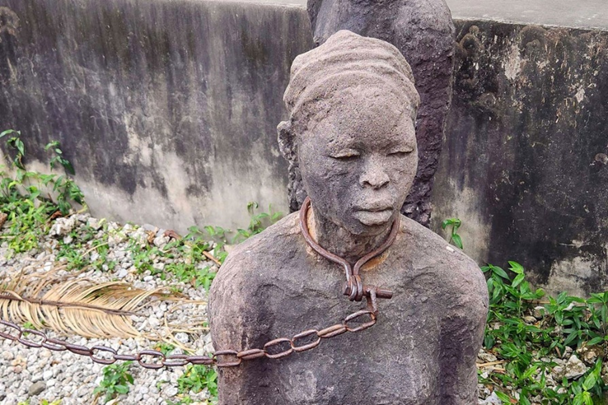
UN Secretary General António Guterres called for action to address the legacies of slavery, including inequality and racism. Assembly President Annalena Baerbock stated, “The slave trade and slavery are among the gravest human rights violations in history”. They affront the principles in the UN Charter and the Universal Declaration of Human Rights; documents shaped in part by these past injustices.” (Perry, 2007)
Acknowledging 400 Years of Slavery
For more than 400 years, millions of Africans were subjected to forced transportation and slavery in the Americas, working on plantations under harsh conditions. (Transatlantic Slave Trade | Key Facts, 2025) This led to a loss of cultural identity and persistent social and economic disadvantages, including ongoing anti-Black racism and discrimination.
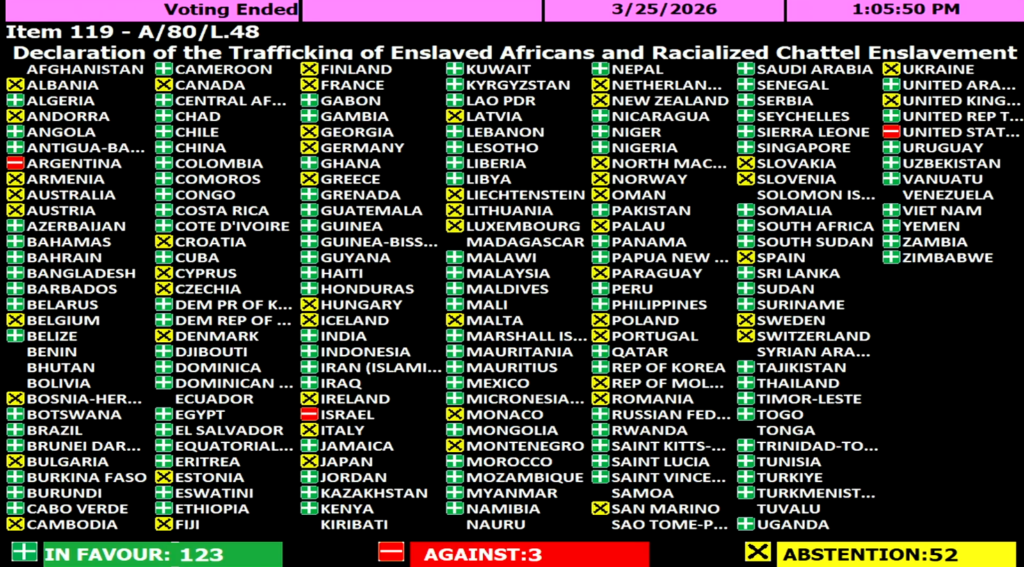
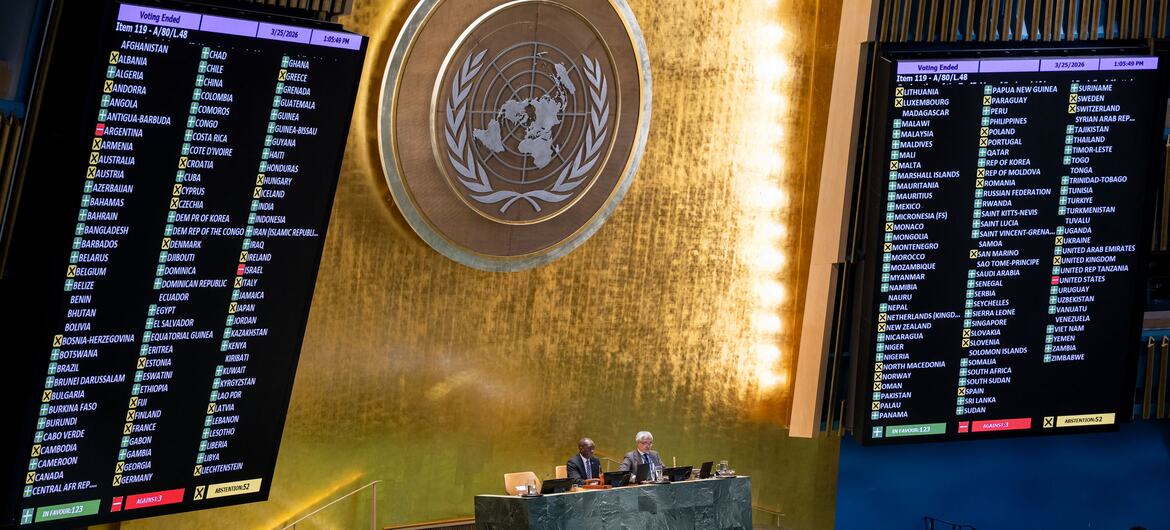
Passed on March 25, 2026, during the International Day of Remembrance of the Victims of Slavery, the United Nations General Assembly (UNGA) adopted a resolution officially recognizing the transatlantic trafficking of enslaved Africans as the gravest crime against humanity.
This resolution marks a shift from symbolic acknowledgment to a direct call for reparatory justice and healing. (UN resolution urges reparations for slavery’s ‘historical wrongs’, 2026). Specifically, it urges member states to engage in ‘inclusive, good faith dialogue,’ to offer formal apologies, to provide financial compensation, to provide health and rehabilitation, and to implement institutional reforms to address systemic racism. (UN resolution urges reparations for slavery’s ‘historical wrongs’, 2026). Furthermore, the resolution demands prompt and unhindered restitution of cultural items, including artworks and national archives, to their countries of origin without charge (Press, 2026).
By labeling the slave trade as the gravest crime against humanity, the resolution seeks to establish a moral and historical ‘jus cogens’. (Declaration of the Trafficking of Enslaved Africans and Racialized Chattel Enslavement of Africans as the Gravest Crime against Humanity, 2026).
UN Resolution Urges Reparations for Slavery’s ‘historical wrongs’
Highlighting these ongoing impacts by reason of the definitive break in world history, scale, duration, systemic nature, severity, and enduring consequences that continue to structure the lives of people through racialized regimes of labor, property, and capital.
The UN resolution’s use of ‘gravest’ distinguishes the centuries-long, industrial chattel slavery system from other atrocities. This distinction was central in the 2026 UN debates, when the Brattle Report estimated reparations owed by 31 former slave-owning nations could top $100 trillion (Brattle Consultants Quantify Reparations for Transatlantic Chattel Slavery in Pro Bono Paper, 2023).
The resolution’s passage highlighted a global divide: 123 nations—including the African Union, Caribbean countries, China, Russia, and much of Latin America and Asia—voted in favor, while opposition came from the United States, Israel, and Argentina.
Meanwhile, the UK, Canada, and all EU members abstained (UN resolution urges reparations for slavery’s ‘historical wrongs’, 2026). These voting patterns reflected differing views: supporters emphasized institutional accountability and the need to heal centuries of exploitation, whereas opponents and abstainers cited legal and historical concerns about reparations (Lederer, 2026).
The Economic Impact
The transatlantic slave trade not only slowed Africa’s growth but reversed it by removing millions of its most capable people and disrupting essential societal structures. Over 12.5 million Africans, many young and productive, were forcibly taken in what is known as Human Capital Flight, which weakened economies and communities (Britannica, 2025).
The widening Wealth Gap was another consequence; profits from slavery and plantation economies funded industrial growth in Britain and the United States, supporting new factories, infrastructure, and technologies (Heblich et al., 2022).
Meanwhile, an Infrastructure of Extraction took shape. Colonized regions were developed mainly for resource extraction, with wealth flowing to ports for export rather than supporting local industries. This extraction model created developmental imbalances that persist to this day (Mpembwa, 2024).
Remembrance is more than reflecting on the past, and it advances development and human rights. Furthermore, restorative justice begins by acknowledging history, which guides debates on reparations and debt relief.
In addition, sites of memory, like the ‘Door of No Return’ in Senegal and the US National Museum of African American History and Culture, educate and honor survivors. Finally, studying slavery’s history helps us identify the underlying factors and recurring patterns that contribute to modern slavery and human trafficking, thus equipping us to confront these injustices that still affect millions.
Social and Political Consequences
The impact extends beyond economics, unfolding in a sequence. First, the trade fueled internal warfare and the rise of ‘predatory states’, eroding trust and institutional stability, thereby leading to political instability.
Subsequently, pseudo-scientific theories of racial hierarchy were developed to justify enslavement—the invention of race—leaving biases that persist in modern healthcare, education, and legal systems. Finally, significant population loss in West and Central Africa caused demographic shifts and prolonged economic stagnation into the 20th century (Campi & Dueñas, 2017).
The UNGA resolution is not legally binding, but it holds significant political influence as a formal statement. It acknowledges that the modern global economic system was built on racialized chattel slavery (‘historical wrongs’, 2026).
For Western nations, the resolution raises concerns about potential legal liabilities and calls for a moral reassessment of global history, identifying chattel slavery as the gravest crime against humanity. By using the term ‘gravest’, the resolution distinguishes the centuries-long, industrialized system of chattel slavery from other historical atrocities.
Why Some Nations Resisted
Countries like the US and the UK, which sometimes abstain, hesitate because they worry about legal liability. If these acts are called a ‘crime’, it could be viewed as an admission of criminal responsibility or succession. This might lead to major lawsuits in international courts and demands for reparations in the trillions. In this complicated legal situation, the call for justice feels very human.
Achieving global peace requires making reparatory justice a reality, turning promises into concrete action. Taking the next steps is essential for real progress.