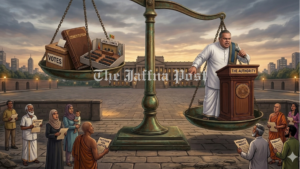
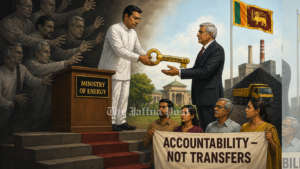
Independent Sri Lanka has seen three constitutions: the Soulbury Constitution (1948–1972), the First Republican Constitution (1972–1978), and the Second Republican Constitution (1978 onwards).
Among these, the Second Republican Constitution, introduced by the United National Party (UNP) government led by President J.R. Jayewardene, has been in effect for the longest period (48 years). Before it crosses the half-century mark (within the next two years), will the National People’s Power (NPP) government be able to bring in a new constitution?
Two years ago, during the national elections, the NPP promised the people that they would introduce a new constitution. In his presidential election manifesto, President Anura Kumara Dissanayake announced that they would continue the constitutional drafting process initiated by the government of President Maithripala Sirisena and Prime Minister Ranil Wickremesinghe (2015–2019).
However, with just three months remaining until he completes two years in office, there are no signs of the new constitutional drafting process moving forward. This is despite his NPP government holding a massive majority of over two-thirds in Parliament.
The leaders of the NPP government are well aware that the people who granted them a resounding parliamentary majority, hold immense expectations. Yet, they are faltering in fulfilling many of the sweeping promises made during the elections.
Primary Concerns
Regarding the drafting process of a new constitution, beyond all other matters, the abolition of the executive presidency and a political solution based on an appropriate power-sharing arrangement for the national ethnic issue remain the primary concerns.
Ever since the executive presidential system was introduced, demands for its abolition have been continuously made. No president or government that came to power promising the public to abolish it has ever fulfilled that promise. One does not have to wait for a long time—just a year or two—to see whether the current President Dissanayake will also join the list of presidents who failed to fulfill that promise.
Regarding the devolution of power, the government’s stance is that the current provincial council system will be maintained until a new constitution is brought in. Rather than President Dissanayake or the ministers, this has been frequently and firmly asserted by Tilvin Silva, the General Secretary of the Janatha Vimukthi Peramuna (JVP), who is considered politically powerful.
If the provincial councils are to continue until a new constitution arrives, they have not specified what kind of power-sharing arrangement will be introduced thereafter, or whether at least the powers currently vested in the provincial councils will be incorporated into the new framework. It is also unknown what the unit for the new devolution of power will be.
It cannot be said that the significant drop in the ruling party’s votes during the 2025 local government elections is the only reason why the government is currently using stalling tactics, reluctant to hold the provincial council elections. The leaders of the JVP, who have ideologically opposed the devolution of power, might also intend to disrupt the provincial councils as much as possible to satisfy Sinhalese nationalist political sentiments.
Tamil Polity Strategies
In a context where the future of the Provincial Councils remains questioned, the political strategies that the Tamil polity could adopt gain immense significance. Although it has always been the expectation of the Tamil people that the Tamil parties should unitedly put forward political solution proposals, unfortunately, it is difficult to maintain faith that such an opportunity will ever arise.
Currently, in the Northern and Eastern Tamil political landscape, two separate initiatives are being carried out to draft constitutional proposals for a solution to the ethnic problem. One is the effort undertaken since last February by the Tamil Lawyers’ Forum to coordinate all Tamil parties and prepare a draft; the other is the initiative of the Eelam Tamil Constituent Assembly.
The Tamil Lawyers’ Forum, which has held three meetings with the Tamil parties so far, appointed a committee at its final meeting specifically to draft the constitutional proposals. Separately from this, some parties and groups that had signed the joint statement released at the end of the first meeting—which declared that no Tamil party would engage individually or jointly in any other drafting process—have now aligned themselves with the activities of the Eelam Tamil Constituent Assembly.
The General Council of the Constituent Assembly, which met last Sunday at Nallur in Jaffna, appointed a 33-member ‘Steering Committee’ to prepare the constitutional draft. It was also resolved at the Nallur meeting to write an official letter requesting the Tamil Lawyers’ Forum to also contribute to the activities of the Eelam Tamil Constituent Assembly.
This prevailing conflict regarding the formulation of constitutional drafts highlights the inability of the Tamil parties to act in unity in a manner that aligns with what contemporary circumstances demand. There is no need to take an X-ray to identify the political forces operating behind this conflict.
Rivalry among Tamil Parties
The political rivalry between the Ilankai Tamil Arasu Kachchi (ITAK) / Democratic Tamil National Alliance (DTNA) faction on one side, and the Tamil National People’s Front (TNPF) / Tamil People’s Council (TPC) faction on the other, is the driving dynamic behind these two different drafting initiatives. Both of these factions hold the position that a sustainable, final solution to the ethnic problem must be a federal framework with irreversible devolution of power.
However, there is a severe disagreement between the two factions on how to handle the Provincial Council system and the 13th Amendment to the Constitution. While one faction emphasizes that the Provincial Council system should be used as a stepping stone in the journey toward a final solution and that the 13th Amendment must be fully implemented, the other faction maintains the position that the Provincial Councils cannot be considered even as a starting point.
While one faction puts forward a framework rooted in the core principles of the Thimpu Declaration—namely Nationalism, Homeland, and the Right to Self-Determination—the other faction, while theoretically supporting this framework, is keen on a pragmatic approach. They aim to achieve an arrangement with autonomous characteristics by making concessions in terminology, so as not to provoke the fears of the majority community.
Although both factions reject a unitary state, they are also forced to confront the reality that no government in Sri Lanka is going to abolish the unitary structure.
The initiatives pursued by both factions reflect the precarious state of the Tamil polity, which has broken down in the post-war era. While the Tamil polity is busy debating and conflicting internally over the subtle legal distinctions of terms like internal and external self-determination, or unitary and federal systems, the general consensus among the majority community continues to show resistance even to the full implementation of the 13th Amendment.
In the absence of a minimum consensus or coalition between the two Tamil political factions, there is no doubt that the government will exploit the separate constitutional proposals to create further divisions among the Tamils. This will also lead to portraying the political aspirations of the Tamil people in the international arena as fragmented and impractical demands.
It is still not too late. Both factions can still attempt to prepare a unified draft. Otherwise, they will merely have to prepare separate drafts for their own satisfaction and keep them to themselves.
Source: Illustration generated using DALL·E