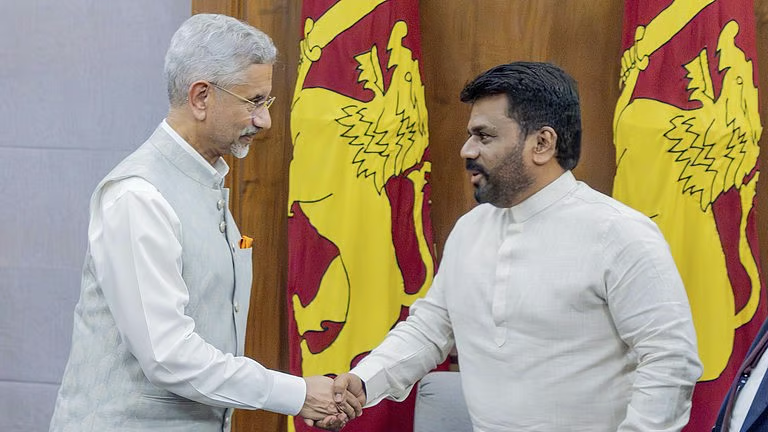
President Anura Kumara Dissanayake’s recent visits to India and Japan have received considerable attention both at home and abroad. They mark a new phase in Sri Lanka’s foreign policy positioning, coming at a time when the country continues to grapple with economic recovery, governance reforms, and the long-standing grievances of minority communities. While his administration has been keen to project an image of reform and renewal, doubts remain as to whether these promises can translate into genuine structural change, particularly in relation to the Tamil question and the functioning of democratic institutions.
Recasting Sri Lanka’s International Relations
Anura’s engagements with New Delhi and Tokyo were not merely diplomatic courtesies. Both India and Japan are key strategic partners with deep political, economic, and security interests in Sri Lanka. For India, Sri Lanka’s stability is directly linked to regional security and the sentiments of its own Tamil Nadu population, which has historically exerted pressure on New Delhi to advocate for Tamil rights in Sri Lanka. For Japan, Sri Lanka represents an important partner in the Indo-Pacific framework and a nation where Tokyo has invested heavily in development assistance and infrastructure.
The optics of these visits, therefore, were significant. They signalled a willingness to engage constructively with powerful international actors, rebuild trust after years of political instability, and reassure creditors that Sri Lanka is serious about governance and reform. Yet, international partners will not evaluate the administration merely on diplomatic niceties; they will look closely at whether Anura’s domestic policies, particularly constitutional reforms and minority rights, are consistent with his outward commitments.
The Promise of Constitutional Reform
One of the President’s most striking pledges has been to abolish or significantly reduce executive powers and to bring in a new constitution. This, he argues, would strengthen parliamentary democracy, decentralise power, and prevent the overreach that has historically undermined Sri Lanka’s governance.
For the Tamil community, these promises are particularly resonant. Since independence, a series of constitutional manoeuvres—including the 1972 and 1978 constitutions—have entrenched centralisation, weakened regional autonomy, and limited minority representation. The abolition of executive powers, in principle, could create an opportunity to redesign the political framework in a way that acknowledges pluralism and devolution.
However, the Tamil population has witnessed multiple pledges of reform over decades, most of which have either been abandoned or diluted under political pressure. The Bandaranaike–Chelvanayakam Pacts of the 1950s collapsed in the face of Sinhala nationalist opposition. The Indo-Lanka Accord of 1987 produced the 13th Amendment and Provincial Councils, but successive governments failed to fully implement the devolution it envisaged. Chandrika Bandaranaike Kumaratunga’s ambitious constitutional reform package of 1995–2000 faltered in parliament amid partisan politics. President Mahinda Rajapaksa openly resisted meaningful devolution after the war, while Maithripala Sirisena’s promised new constitution stalled due to internal divisions and political manoeuvring. Against this backdrop, scepticism is not only understandable but almost inevitable.
Provincial Councils and the Question of Autonomy
The issue of Provincial Councils (PCs) illustrates the gap between rhetoric and reality. The PCs, established under the 13th Amendment, were intended to provide limited regional autonomy. While their powers have been contested and unevenly applied, they nonetheless remain a crucial symbol for Tamil aspirations of self-governance.
Recent statements from government figures, including those by Tilvin Silva—often described as a “shadow president”—have raised concerns by suggesting delays in Provincial Council elections. The postponement of these elections not only raises constitutional questions but also undermines confidence in the government’s reformist agenda. For Tamil communities in the North and East, such delays are not merely technical matters but signals of whether Colombo intends to respect or dilute their avenues of political representation.
From a governance perspective, the contradictory messaging between the President and his senior ministers is problematic. On one hand, the administration speaks of new constitutional reforms and democratic renewal. On the other, it appears to be dragging its feet on even basic electoral processes guaranteed by the existing constitution. This inconsistency risks eroding credibility both domestically and internationally.
Balancing Domestic Politics and International Expectations
The credibility of Sri Lanka’s reform agenda will be judged not only by its citizens but also by its closest international partners. India, in particular, has consistently emphasised the importance of full implementation of the 13th Amendment as a starting point for Tamil autonomy. Japan, while less vocal on internal ethnic issues, will nonetheless evaluate Sri Lanka’s governance reforms as part of its broader assessment of stability and accountability in the Indo-Pacific.
Failure to demonstrate progress on constitutional governance and minority rights could complicate Sri Lanka’s diplomatic balancing act. International partners may continue to extend economic support, but their willingness to invest politically in Sri Lanka’s stability will diminish if reform promises are repeatedly delayed or contradicted.
The Challenge of Consistency and Trust
The Dissanayake administration faces a dual challenge: first, to demonstrate that it has a coherent roadmap for constitutional reform, and second, to show that it can bring along diverse political constituencies in the process. The contradictions within the government’s own ranks—between reformist pledges and hesitant action—risk sending a message of uncertainty.
For the Tamil community, the issue is one of trust. Decades of broken promises, from failed pacts to stalled constitutions, have left many sceptical that any government in Colombo can deliver genuine devolution or political equality. Without meaningful engagement, transparent timelines, and concrete action, the promise of a new constitution risks being seen as another episode in Sri Lanka’s long history of rhetorical reform.
Looking Ahead
If President Anura is serious about creating a more democratic and inclusive Sri Lanka, several steps are crucial. First, his administration must commit publicly to holding Provincial Council elections within a clear timeframe, thereby reaffirming constitutional governance. Second, the process of drafting a new constitution must be inclusive, transparent, and genuinely consultative, engaging not only parliamentarians but also civil society, Tamil representatives, and minority communities. Third, the government must align its internal messaging to avoid the contradictions that currently weaken its credibility.
In the international arena, both India and Japan will continue to monitor developments closely. For them, Sri Lanka’s internal reforms are not only a domestic matter but also part of the region’s broader stability equation. For the Dissanayake government, therefore, the stakes are high.
Conclusion
President Anura’s visits to India and Japan marked a positive start in re-establishing Sri Lanka’s diplomatic engagement. However, foreign policy optics will not suffice to rebuild confidence at home or abroad. The test lies in domestic reform: whether his administration can abolish executive powers, deliver a genuinely inclusive constitution, and restore faith in democratic institutions such as Provincial Councils.
For the Tamil community, these promises are being measured against a long history of disappointment—from Bandaranaike’s failed pacts to Rajapaksa’s centralisation and Sirisena’s aborted reforms. For the international community, they are a question of Sri Lanka’s credibility. For the President himself, they represent the defining challenge of his leadership.
Unless rhetoric is matched by consistent action, transparency, and inclusion, Sri Lanka risks once again falling into the familiar cycle of lofty promises and deferred realities.