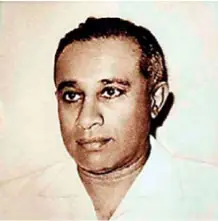

Each year on 13 February, Sri Lanka remembers one of its greatest medical visionaries, Professor Senaka Bibile. For the magnitude of his contribution to public health, to ethical governance, and to the enduring principle that medicines are a social good rather than a commercial luxury, Professor Senaka Bibile, deserves to be honoured profoundly and remembered as one of the principal architects of Sri Lanka’s most humane and farsighted public health policies.
He dedicated his life to ensuring that quality healthcare and essential medicines were accessible to all, irrespective of economic status. His visionary reforms not only transformed Sri Lanka’s pharmaceutical system but also left a lasting imprint on global health policy, shaping international approaches to equitable and rational access to medicines worldwide.
Educated at Trinity College, Kandy, Bibile distinguished himself academically and in extracurricular life, earning prizes in science and biology, rugby colours, and accolades in drama. Early encounters with rural poverty and community service shaped his lifelong commitment to social justice and equitable healthcare.
He graduated in 1945 from the Medical College of the University of Colombo with first-class honours in MBBS, winning the Djunjishaw Dadabhoy Gold Medal in Medicine and the Rockwood Gold Medal in Surgery. In 1949, he pursued postgraduate studies at the University of Edinburgh, earning a PhD in pharmacology in 1952 for his research on biological assays of cortical hormones.
Influenced by Marxist and socialist thought, Bibile believed firmly that healthcare was a fundamental right, not a privilege reserved for the wealthy. He inspired contemporaries such as Carlo Fonseka and worked tirelessly to reduce drug prices in government hospitals while establishing transparent procurement systems. His commitment to ethical medical practice and social justice earned admiration, and resistance, but he remained unwavering.
A principled critic of multinational pharmaceutical corporations, Bibile argued that profit-driven promotion of branded drugs inflated costs and distorted prescribing practices. At a time when pharmaceutical companies in Sri Lanka were widely believed to profit from trade-name sales and biased information against generics, he championed rational prescribing and public accountability.
Although a distinguished academic, his influence extended far beyond the lecture hall. He is best known for developing Sri Lanka’s National Pharmaceuticals Policy in the early 1970s, based on the Bibile–Wickremasinghe Report, co-authored with S. A. Wickremasinghe, founder of the Communist Party of Sri Lanka. The report was presented to Prime Minister Sirimavo Bandaranaike in 1971.
The policy sought to guarantee affordable access to essential medicines through rational drug selection, generic procurement, and centralized purchasing. As early as 1959, Bibile compiled the Ceylon Hospital Formulary, listing approximately 630 medicines by generic name. By 1972, the number of imported drugs had been reduced from over 4,000 to just 171 — a landmark achievement in rationalization and cost control.
The policy rested on three pillars:
- Essential Drugs List (EDL): Medicines selected on the basis of efficacy, safety, public need, and cost-effectiveness. This concept later influenced the global Model List of Essential Medicines adopted by the World Health Organization, becoming a template for many developing countries.
- Generic Name Procurement: Purchasing medicines by generic name to eliminate brand bias and reduce costs.
- Centralized Procurement: Establishment of the State Pharmaceuticals Corporation (SPC) in 1971 to import medicines through international bulk tenders.
As chairman of the SPC, Bibile streamlined drug imports, enforced competitive pricing, and ensured affordability across both public and private sectors. In its first year alone, the SPC saved Rs. 60 million in foreign exchange. As chair of the National Formulary Committee, he also initiated Formulary Notes (later The Prescriber) to promote rational prescribing practices.
His social engagement extended beyond healthcare. In the 1950s, he co-founded Sri Lanka’s first co-operative housing scheme, the Gothatuwa Building Society, alongside progressive intellectuals such as Herbert Keuneman and Anil Moonesinghe — an initiative that led to the Welikadawatte housing estate, known for its vibrant intellectual community.
Today, Prof. Bibile’s legacy continues to inspire policymakers, healthcare professionals, and students. Yet it is often observed with some regret, that those who once benefited from state-supported education, including studies abroad in former socialist countries, and even some self-described leftist policymakers, have drifted from the ethical foundations he championed.
In a world increasingly shaped by market logic, the values of equity, integrity, and public service he embodied are too often overshadowed by financial interests and policy conditionalities imposed by institutions such as the International Monetary Fund and similar bodies.
Professor Senaka Bibile died at the age of 57, reportedly of a heart attack, on September 29, 1977 in Guyana while serving on a United Nations assignment to advance pharmaceutical reforms.
Over the years, questions and suspicions have persisted regarding his untimely death, particularly in light of the powerful commercial interests he had challenged through his unwavering advocacy of generic medicines and the strict regulation of multinational pharmaceutical corporations.
Remembering him on his birthday is not merely an act of tribute. It is a call to renew our commitment to ethics over profit, service over self-interest, and healthcare as a right of the people. His vision challenges every generation to place humanity above money — and conscience above convenience.
Healthcare is not charity, nor a commodity to be traded. It is a human right rooted in dignity. Those who shape and deliver it carry a profound responsibility: to protect lives, not profits.




















Very shortly this site will be famous among all blogging and site-building users,
due to it’s fastidious articles