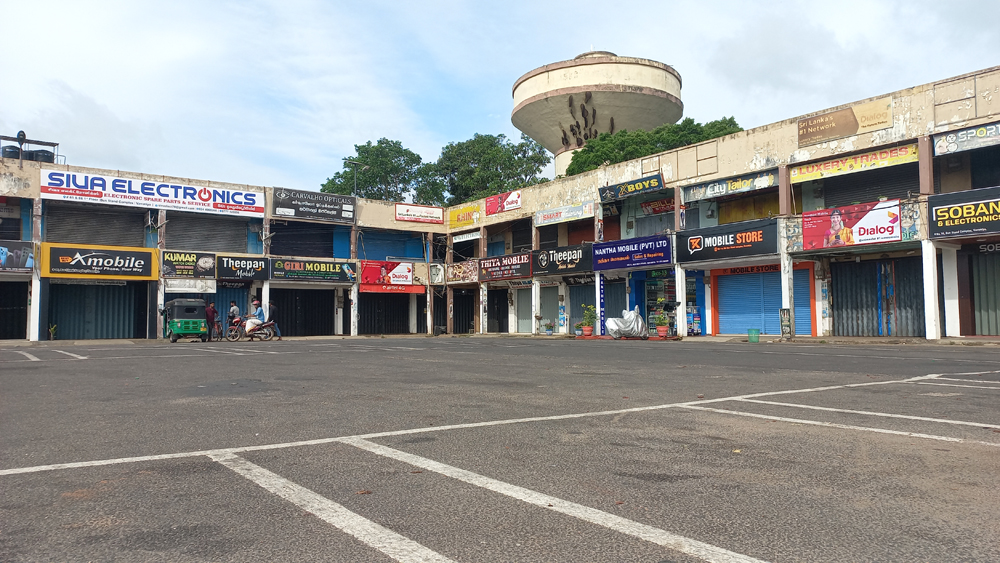
It was 72 years ago in August 1953, that a hartal (general strike ) caused the biggest shock in Independent Sri Lanka’s politics. It was called ‘the August Hartal.’
The August 12, 1953 hartal, called by left-wing political parties and their trade unions in protest against a reduction in the rice subsidy by the United National Party (UNP) government led by Prime Minister Dudley Senanayake, paralysed the entire country.
The government, fearing popular anger, was forced to hold its cabinet meeting aboard a British ship moored in Colombo harbour.
The hartal shook the foundation of the UNP government. In less than two months, Dudley Senanayake not only resigned as Prime Minister, but also temporarily withdrew from politics. That eventually led to the change of government under the leadership of S.W.R.D. Bandaranaike in 1956.
Although no such protest movement took place in southern Sri Lanka after that historic August hartal, several hartals were held in the northern and eastern provinces in the seventies at the call of the Tamil United Liberation Front (TULF ), against the backdrop of the intensifying ethnic problem.
The trigger was the promulgation of the first republican constitution in 1972 under the United Front (UF) government of Prime Minister Sirimavo Bandaranaike. Those hartals, fully supported by the Tamil people, gave impetus to Tamil nationalist politics. In the period that followed the emergence of the armed struggle, there was no room for such peaceful protest in the north and east.
In the last 16 years since the end of the civil war, the Tamil nationalist parties, unable to devise policies and tactics to take the political struggle of the Tamil people to the next stage, in the face of new domestic and international political climate, have not shown interest in methods of struggle such as hartals.
Against this backdrop, we witnessed an ‘August Hartal’ in the North and East last week, in an unexpected turn of events.
Negative impact
If the August 12, 1953 hartal had a positive effect on Sri Lankan politics, the August 18, 2025 hartal had a negative one. While no one can dispute the purpose for which the hartal was called, it is unfortunate that it has become an example of how a hartal should not be conducted.
The Ilankai Thamizharasu Katchi (ITAK), the main Tamil nationalist party, called the hartal to demand justice in the case of the death of Ethirmanasingham Kapilraj, 32, who was killed in an alleged attack by soldiers on August 9 in the Muthaiyankattu area of Mullaitivu district. It was protesting against the continued militarisation of the north and east.
Soon after the incident, ITAK president C. V. K. Sivagnanam and General Secretary M. A. Sumanthiran wrote to President Anura Kumara Dissanayake, on August 10, demanding an
“unhindered, thorough investigation” and pointed out that the military presence and repressive measures in the North and East, even after the end of the war, were responsible for such incidents.
The government assured that a thorough investigation will be conducted and those responsible for the death will be brought to justice. A few soldiers were arrested and remanded.
Initially, a day-long hartal was called on Friday, August 15. However, in view of the Nallur festival and Madu Catholic Shrine festival, the hartal was shifted to Monday, August 18. A half-day hartal was to be held.
It is a well-known secret that while there is no difference between the ITAK and other Tamil nationalist parties in terms of their stance against militarisation in the North and East, the latter did not support the hartal because former MP Sumanthiran was in the forefront of the protest. And it must be pointed out that ITAK did not consult with other Tamil parties before calling for the hartal.
Even the leader of the ITAK’s parliamentary group Sivagnanam Sritharan did not come out openly in support of the hartal, despite the fact that the leadership had officially instructed the party’s MPs and local body members to contribute fully to the success of the hartal.
However, the Hill Country parties such as the Ceylon Workers Congress, Tamil Progressive Alliance, National Union of Workers and Muslim parties such as Sri Lanka Muslim Congress (SLMC) expressed their full support and solidarity with the ITAK.
But business establishments remained closed for few hours in the morning in many parts of the two provinces. It is no secret that other Tamil parties expected the hartal to end in failure.
The President and General Secretary of the ITAK, at a media conference, expressed their indignation at the lack of support for the hartal in Jaffna, which is considered the cultural capital of the Sri Lankan Tamils.
On the one hand, sources from the other Tamil parties said that the Tamil people have taught a befitting lesson to those who called for the hartal, while on the other hand, some observers said that the August 18 has demonstrated that the Tamil people are not interested in the past methods of struggle like the hartal in today’s context, after the end of the war. If so, it seems unlikely that hartals or other forms of peaceful protest will ever again be effective in the North and East.
The question that remains unanswered is whether the developments that were visible in the North and East on August 18 reflected the Tamils’ concern over the continued excessive militarisation of the former war zones or the unhealthy divisions within the Sri Lankan Tamil polity.
It is clear that it no longer makes sense to expect a united approach from the Tamil nationalist parties on the political solution to the national question and on the ways to find solutions to the humanitarian problems faced by the people in the North and East.
Meanwhile, the ITAK refused to sign the letter sent to the United Nations High Commissioner for Human Rights and the member states of the Geneva Human Rights Council by the Tamil National Council led by Member of Parliament Gajendra Kumar Ponnambalam, and some civil society organisations.
Sumanthiran said that the reason for their refusal to sign was that the letter was prepared without prior consultation with them. It is also important to note that the manner in which the letter was drafted and subsequent comments made by those involved in the exercise cast doubts on whether there was a genuine interest in roping the ITAK in the process.
But at the same time Sumanthiran also did not pay attention to the need to consult other Tamil parties before calling for a hartal.
All these developments are manifestations of a serious political malaise plaguing the Sri Lankan Tamil polity. Tamil politicians waste their time in inter and intra party rivalry and ego-centric personality clashes, disregarding the interests of the Tamil people.
It is not surprising if one suspects that from now on, those who write and speak in the interest of uniting the Tamil parties seem to be suffering from some sort of mental disorder.
Photo credit: Chatgpt