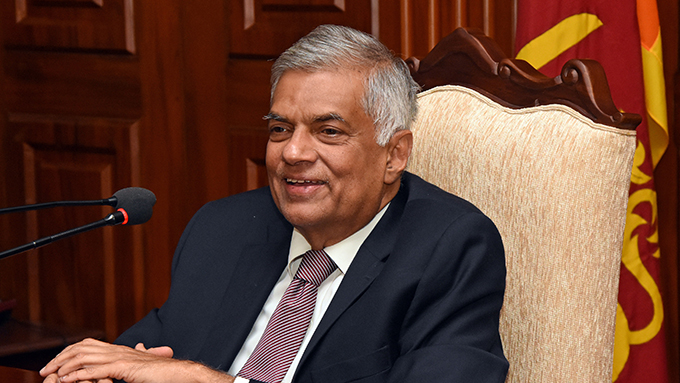

Former President Ranil Wickremesinghe has many firsts in Sri Lanka’s political history. No other political leader has served as president of the country’s oldest political party, the United National Party (UNP), for as long as Wickremesinghe. He has been the leader of his party for more than three decades and was the longest-serving leader of the opposition in parliament.
Wickremesinghe is the first political leader in Sri Lanka to be elected as an executive president through an election in parliament, and he recently became the first former president to be arrested and remanded on charges of abuse of power after a political career of almost half a century.
He was accused of misusing state funds to pay for his personal and entourage’s expenses during his two-day stay in London on his way back home from official visits to Cuba to attend the G-77 summit and to the United States to attend the 78th annual session of the United Nations General Assembly in September 2023.
The former president was in London to attend a ceremony where his wife Maithri Wickremasinghe was awarded an honorary professorship by a UK university. It is reported that Maithri went to the UK with her own money. Wickremesinghe is accused of spending Rs. 16.6 million in state funds on his staff and security personnel during his stay in London.
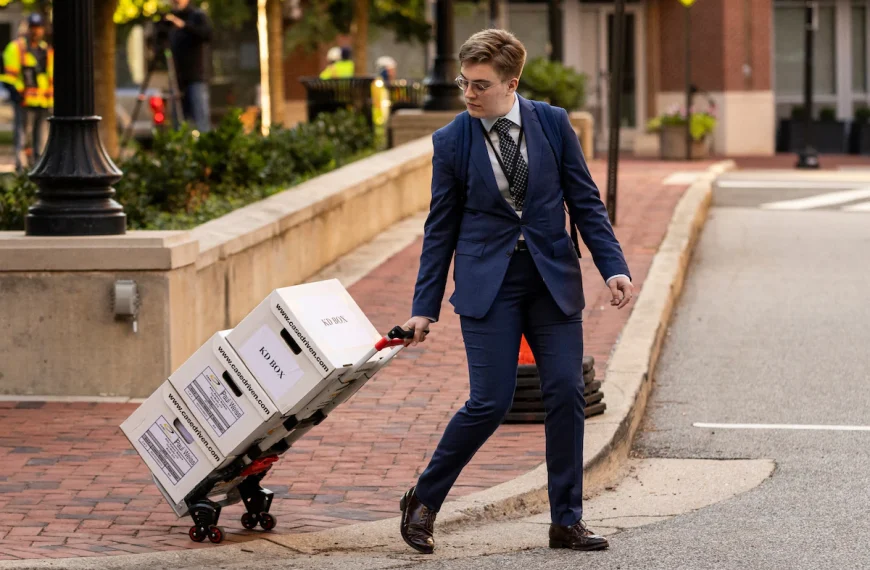
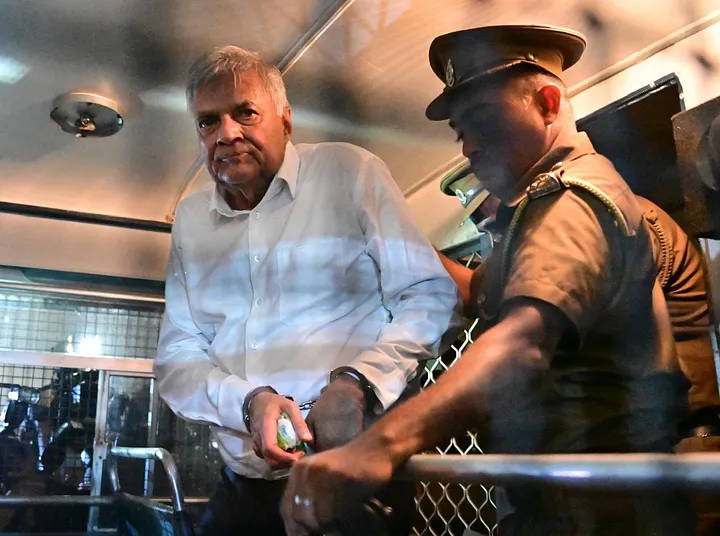
Summoned to the headquarters of the Criminal Investigation Department (CID) of the Sri Lanka Police to give his statement on August 22, he was arrested after a long interrogation and produced before the Colombo Fort Magistrate’s Court. After the ‘dramatic ‘ events, the magistrate remanded him till August 26.
Wickremesinghe was first taken to the Welikada Prison Hospital and later to the Colombo National Hospital. He was admitted to the ICU and was unable to attend court on August 26. Considering the health condition of the former president, who confirmed his presence in the court online, the Fort Magistrate granted bail with three sureties of Rs.5 million each.
The former president returned home on Friday, August 29, after a week in the ICU of the National Hospital, where he was treated for several serious diseases, including heart disease and diabetes, under the supervision of specialist doctors. It is not known whether the government will allow Wickremesinghe to seek treatment abroad.
It is noteworthy that the Attorney General did not request the court to impound former president’s passport to ensure that he does not go abroad.
Wickremesinghe’s case will be heard again on October 29, 2025. Since his fate will be decided by the court, it will be a contempt of the judiciary if we say anything more about it. Although the affair has become a purely legal issue since his arrest on charges of using state funds for personal benefit, it has created a great deal of furore in the political arena.
Politicians who have been very critical of Wickremesinghe in the past have also rallied to show their support and solidarity with him. Leaders of almost all opposition parties held media conferences justifying his actions and saying that one should not differentiate between the Head of State’s personal and official life.
Moreover, they describe the legal action against Wickremesinghe as political victimization by the National People’s Power (NPP) government.
While former president Chandrika Bandaranaike Kumaratunga condemned the move against Wickremesinghe as a calculated assault on the country’s democratic values, another former president Mahinda Rajapaksa described the arrest as political revenge.
Former president Maithripala Sirisena has called on the opposition parties to unite, forgetting party differences, to defeat the constitutional dictatorship being established by the NPP regime. Among the former presidents, Gotabaya Rajapaksa is the only one who has not publicly commented on the issue.
The Wickremesinghe affair has also sparked a debate about whether there can be a distinction between personal visits and official visits presidents. Deputy Solicitor General Dileepa Peiris had told the Colombo Fort Magistrate’s Court that Wickremesinghe had said there could be no such distinction.
Opposition parties have questioned whether President Anura Kumara Dissanayake uses his own vehicle without security personnel when he travels to the Janatha Vimukthi Peramuna (JVP) / NPP events and to visit his family members in Anuradhapura.
In response, Foreign Minister Vijitha Herath stated that the president’s travels within the country for personal needs, especially to visit his ailing mother, could never be compared to the former president taking flights abroad. JVP General Secretary Tilvin Silva has dared the opposition to take the issue to court said, if it can.
Since Wickremesinghe is considered to be the most influential and respected current Sri Lankan political leader at the international level, there was a widespread expectation that the United States and the Western countries in particular, would condemn the actions against him and pressure the government to release him immediately. Nothing of that sort seems to have happened, but there is no doubt that those countries were watching carefully the developments in Sri Lanka.
Among those who have publicly spoken on his behalf from abroad are Indian Congress MP Shashi Tharoor and former peace envoy to Sri Lanka Erik Solheim of Norway. They both urged the NPP government to release Wickremesinghe, saying he had not committed any serious crime.
When Foreign Minister Vijitha Herath was asked whether there were pressures from the international community, including foreign embassies, on the arrest of the former president, he replied that no foreign diplomat or diplomatic organizations had made any remarks. He further said that the international community recognizes that the rule of law in Sri Lanka has been applied equitably and honestly, unlike in the past.
Senior UNP leaders briefed various foreign embassies in Colombo on the circumstances that led to the arrest of the former president and some international organisations requested them to provide further details about the arrest, party sources said.
The Wickremesinghe affair is unlikely to unite the now-dissipated opposition parties and pose a major challenge to the government. The outcry among the opposition leaders immediately after the arrest of Wickremasinghe seems to have subsided. They do not have an acceptable leader with the political clout to lead them to form a broad coalition of opposition parties. At the same time, an important question is whether Wickremesinghe has become a strong political factor that can help unite the opposition parties, after his arrest.
Most of today’s opposition politicians can easily be targeted by the government for their past misdeeds. So they are talking about uniting and mobilizing people in order to create an atmosphere where they can ensure that the government is not inclined to take legal action against them. It is certainly not possible for such an approach to win the support of the people.
At the same time, there is criticism that the NPP government, which has failed to deliver on the promises it made to the people during last year’s national elections, is preoccupied with legal actions against the members of former regimes in order to divert attention from important issues. It is also believed that Wickremasinghe was taken into custody to check the pulse of the people before going after more popular and powerful political leaders.
Government leaders make declarations about actions to be taken against corrupt politicians, showing that they do not heed the warnings of opposition politicians who accuse the government of pursuing political vendettas. The Inspector General of Police has said that investigations have begun to identify those who mobilised protesters to the court premises in support of Wickremesinghe.
President Dissanayake reiterated the Government’s commitment to the implementation of the law in an equitable manner for all citizens, stressing that measures already taken would not be reversed. He said at an event in Colombo last week that state money would be recovered from those who mis-used it, and that those responsible for corruption and abuses would be severely punished. The president has also announced that state-owned houses given to former presidents will be taken back after a new law is passed in September.
At the same time, Public Security Minister Ananda Wijepala told the media that investigations would be launched against other former presidents if complaints were received from anyone, saying the law would be applied equally to all.
An important aspect to be noted in the Wickremesinghe affair is that he is a political leader from one of Sri Lanka’s traditional politically powerful families. His arrest and the many hours of discomfort he had to endure in court have caused serious anger among Colombo’s elite. There have also been criticisms of a class animosity in the actions against Wickremesinghe, given the humble family backgrounds of the leaders of the NPP, particularly the JVP, including President Dissanayake.
It is obvious that even many of those who dislike Wickremesinghe’s politics and his traits are deeply offended by the fact that he was handcuffed and bundled into a prison vehicle like an ordinary criminal. There is also a view at many levels in society that the use of a small sum of Rs.16.6 million to attend his wife’s graduation ceremony (a lesser amount compared to the massive financial corruption in Sri Lanka) should not have been blown into a serious issue that warranted his arrest.
Former diplomat and political analyst Dr. Dayan Jayatilleka, who has been a fierce critic of Wickremesinghe, said in an article last week that the true face of President Dissanayake’s administration has been exposed.
On the issue of the Central Bank bond scam, Dayan said he did not consider the former president to be above suspicion and that it would be an insult to one’s own intelligence to believe that Wickremesinghe would have siphoned off Rs. 16.6 million from state funds that he would have received in a minute if he had asked his family or friends.
Dayan further stated that it was impossible for the leaders of the JVP / NPP to differentiate between legality and legitimacy, and that by arresting Wickremesinghe for a relatively weak issue and inflicting discomfort, the government had demonstrated not only its lack of commitment to social justice, but also the low-mindedness and misplaced emotionalism of its leadership.
A substantial section of the population is also concerned that Sri Lanka, facing an unprecedented economic downturn in its history, should not have arrested and humiliated a senior political leader who took on the mantle of power with political courage and guided its recovery.
A prominent political columnist wrote that the man who raised the dollar reserves in Treasury coffers from a low of USD 50 million upon taking presidential office in July 2022, to a high of USD 6 billion upon leaving it in September 2025, was not worth Rs. 16 million or USD 53,000 dollars as a special gratuity present from a grateful nation for wreaking an economic miracle that revived the country back to active life, but worth only a bed in a steamy prison hospital ward, with the uninviting prospective of a long solitary stay in a security-protected state institution at government expense.
Wickremesinghe left the Colombo National Hospital on 29 August. He was carrying a book, the political memoirs of former British Prime Minister, Boris Johnson, titled ‘ Unleashed.’
He may have brought the book from home to read the during his days in the hospital. And also may have intended to convey a political message to the government by displaying a book with such a title.
While searching Google to find details of Johnson’s book, this writer chanced upon a review of the same by Associate Editor of The Guardian, Martin Kettle under the headline ‘Unleashed by Boris Johnson review – memoirs of a clown’. The blurb says ‘All the fancy verbiage in the world cannot disguise the emptiness at the heart of this self-serving, solipsistic book.’