
Not many would have forgotten that US President Donald Trump proudly claimed that he did not send a single American soldier to fight overseas during his first term (2016 – 2020). After entering the White House for the second time in January 2025, he asked to be awarded the Nobel Peace Prize for stopping eight wars in the world within a period of ten months.
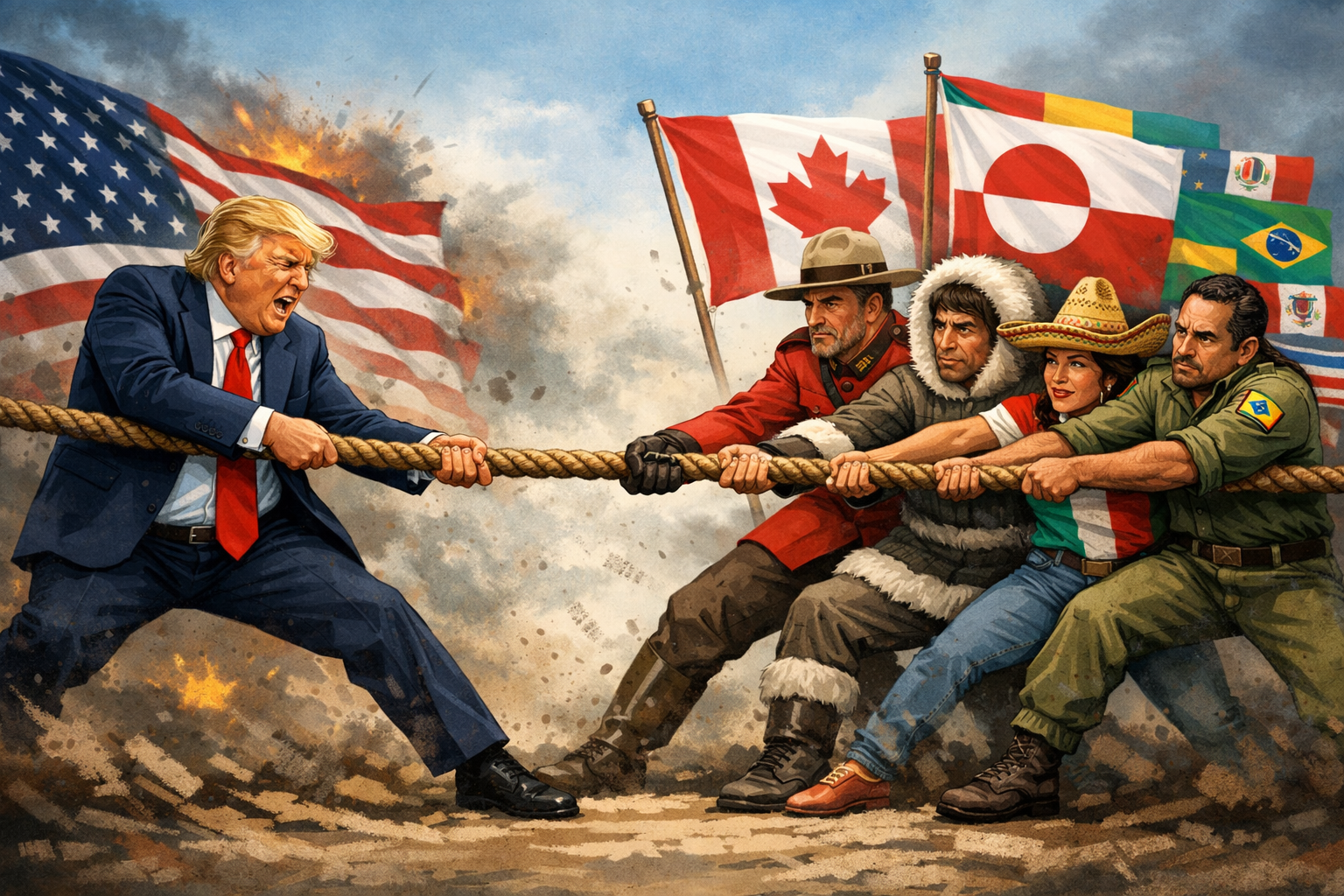
Since the beginning of his second term, Trump has been talking about capturing and occupying countries and territories. He talked about making Canada, a neighbouring country that does not cause any problems, the 51st state of the US and annexing the island of Greenland, an autonomous territory of the Kingdom of Denmark and owning Panama Canal.
Trump, who has supported Israel’s genocide of Palestinians, has also expressed his desire to evacuate people from Gaza and turn the valley into a riviera.
Although New Delhi has categorically denied that Trump had anything to do with the cessation of hostilities between India and Pakistan, international media reported that he has so far said more than seventy times that he was responsible for stopping the war between the two nuclear-armed South Asian countries. While presenting himself as a peacemaker, Trump has bombed Nigeria, Somalia, Iraq, Syria, Yemen and Iran.
On January 3, a day after Venezuelan President Nicolas Maduro offered ‘serious talks’ with Washington, the US carried out a large-scale air strike, kidnaped him and his wife, Cilia Flores, and detained them in New York. Maduro will be standing trial in the US on charges of leading a ‘narco-terrorist movement.’
Trump has said the US Constitution allows him to intervene in Venezuela, arguing that as commander-in-chief of US forces, it is his duty to protect American people and personnel. No sane person would say that Venezuela posed a security threat to the US. The Trump administration has offered no credible evidence that Maduro ran a drug cartel.
Trump had set his sights on Venezuela during his first term. His administration formally charged Maduro and his top aides with alleged involvement in drug trafficking. The US and its Western allies recognized opposition politician Juan Guaido as Venezuela’s acting president.
Venezuela has been a top priority of Trump’s foreign policy since he returned to office in January 2025.The US had declared a ‘war on drugs’ accusing Maduro of being one of the largest narco-traffickers in the world. America announced a $50 million reward for information leading to Maduro’s arrest.
The Trump administration, which has sent thousands of troops and warships to the Caribbean, said that several boats allegedly trafficking drugs were destroyed in the air strikes, but in fact, killed several hundreds of people in the attacks.
Trump authorized the US Central Intelligence Agency (CIA) to carry out clandestine operations inside Venezuela and imposed a naval quarantine on oil tankers to and from the country. The US forces are reported to have seized five oil tankers carrying the ‘banned oil’ as of January 9, 2025.
Even after Maduro’ s arrest, neither Venezuela’s military structures nor the state apparatus collapsed, as was widely expected. The right-wing opposition leader Maria Corina Machado, who won last year’s Nobel Peace Prize, fully supports the US president’s policies, but Trump dismissed her as lacking the popular support and respect needed to govern the south American country.
Vice President Delcy Rodríguez took over the government as acting president the following day by order of the Supreme Court of Venezuela. Trump immediately warned that Delcy would have to pay a huge price if the interim government refused to cooperate with the US.
It is true that the vast majority of Venezuelans were disgusted with Maduro’s government because of the economic crisis and his autocratic ways. However, the US has no locus standi or authority to kidnap the leader of a sovereign nation. If Trump’s job is to kidnap and imprison foreign leaders for misrule and repression, he will have to make choices from a long list of such rulers, including some in power with US economic and military support.
Trump has openly declared that the US will run Venezuela as long as he wants and use its vast oil resources. In a wide-ranging interview to New York Times on January 9, Trump said that the US would profitably rebuild Venezuela’s oil industry and give the country the money it desperately needs.
The US has a long history of interventions in South America and the Caribbean, spanning more than two centuries. Since the middle of the 19th century, the US has intervened in its continental neighbours not only through economic pressure, but also militarily, with invasion and occupation.
Last week’s US military operation in Venezuela closely resembles the arrest of Panamanian dictator Manuel Noriega 35 years ago. President George H. W. Bush ordered Panama’s invasion by about 27,000 troops to capture Noriega, a former CIA ally who had been indicted on drug trafficking charges.
The US has helped military strongmen to topple democratically elected governments and seize power in countries such as Brazil, Chile, and Argentina, but overt military activities in South America and the Caribbean have historically been limited to its closest neighbors. Now a direct military strike on a South American country marks a significant shift in US foreign and security policies.
Why does Trump want regime change in Venezuela, which poses no serious security threat to the United States? It is also not even a major drug producing country. International political observers and strategists identify three main reasons for the US aggression.
First, Trump wants to re-impose America’s primacy in the Western Hemisphere of the world. James Monroe, the fifth president of the US, made a declaration in 1823 promising that the US would not interfere in European affairs in order to ensure that European powers would not interfere or exercise colonial domination over the countries of the American continent in the future. This is known as the Monroe Doctrine.
In line with that doctrine, Trump now wants to keep the western Hemisphere in the US sphere of influence. The ‘National Security Doctrine’ issued by his administration recently, identifies Latin America and the Caribbean region as strategic priorities. American media and experts dubbed it as the ‘Donroe Doctrine.’
The National Security Doctrine document insists that the US must deny influence or control by outside powers in Latin America and ensure that the Western Hemisphere remains under American political, economic, and military influence.
Second, while reinforcing American primacy, the US would also want to keep the Chinese and Russian influence in the region under check. China has already made huge investments in Latin America through its Belt and Road Initiative. It is also the largest or second-largest trading partner of most countries in the region.
Third, the US wants to replace left-wing leaders with far-right ones in most Latin American countries.
Speaking to reporters after Maduro’s arrest, Trump said that, ‘America’s hegemony in the Western Hemisphere will never again be called into question.’
The United States has undermined the sovereignty and security of other countries by attacking Venezuela. The United Nations High Commissioner for Human Rights Volker Turk has expressed dismay that the US attack has undermined the basic principle of international law, adopted after the horrors of two world wars last century. The law dictates that states should not use force for their territorial claims or political demands, and added that the US action has seriously weakened the United Nations, the only mechanism for preventing conflicts. He called on the international community to stand up for the rule of law.
After Venezuela, Trump has threatened Colombia, Greenland, Mexico, Cuba and Iran. European powers have not shown the same impulse to denounce US interference in Venezuela as they did in condemning Maduro’s authoritarianism.
Trump’s New York Times interview reveals his determination to continue to use America’s military might for profit and political supremacy. He said that he did not feel constrained by any international laws, norms, checks and balances.
When asked if there would be any limits to his ability to use US military power, he replied, ‘Yeah, there is one thing. My own morality. My own mind. It’s the only thing that can stop me.’
‘I don’t need international law. The norms of the post-World War 2 order, which the US helped establish, is an unnecessary burden. It is national strength alone that should be the deciding factor when nations’ interests collide. Past US Presidents have been too cautious when it comes to exercising American Power. The US would remain in charge of Venezuela as long as I want – may be for years. I will not be happy with anything short of ownership of Greenland. Europe has to shape up. NATO is useless without the US’, Trump further said.
Asked whether his action might provide a precedent in Ukraine and Taiwan, the US President shrugged off the idea and said President Xi Jinping of China wouldn’t dare attack Taiwan on his watch. He may do it after we have different Presidents, but I don’ t think he is going to do it with me as president.’
His recklessly audacious declarations underline the grave danger that the world will have to face in the coming days. In retrospect, Trump’s transformation of the US Department of Defense into the Department of War makes it clearly he has plans in mind for aggressions.