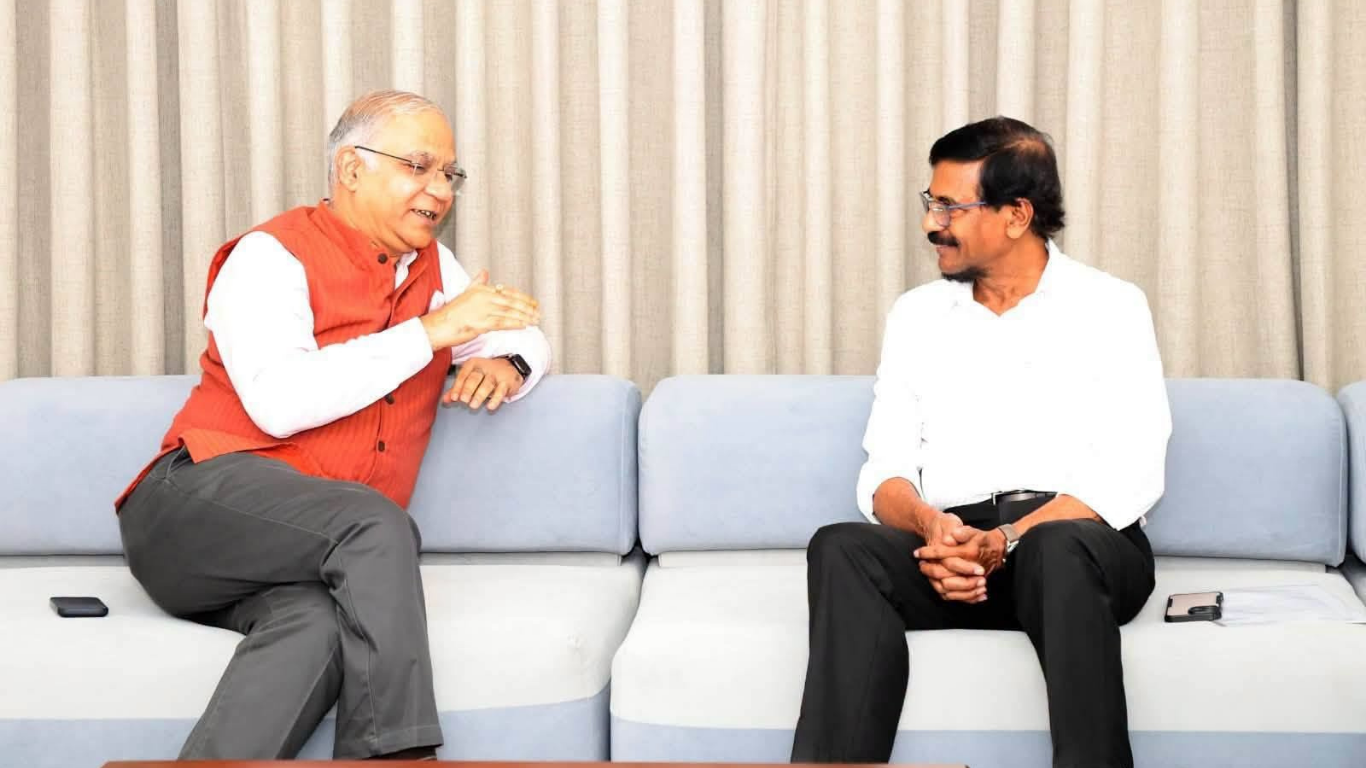

We are not aware of any previous Indian High Commissioners who has frequently met with Janatha Vimukthi Peramuna (JVP) General Secretary Tilvin Silva, in the way Santhosh Jha does.
Former Chinese Ambassador Qi Zhenhong and American Ambassador Julie Chung, who recently completed their tenures in Sri Lanka and returned to their home countries, can be cited as foreign diplomats who visited the JVP party headquarters in Pelawatte, outside Colombo, to meet JVP leaders on several occasions.
During previous governments, Indian High Commissioners at the time did not maintain such extensive interactions with the general secretaries of the ruling party. The secretaries of those parties were not as politically powerful as the JVP secretary, nor did the presidents in power at the time permit it.
Does India believe that by handling Tilvin Silva, it can keep the present government aligned with its interests? The frequent meetings between Santhosh Jha and Tilvin Silva have become a key focal point closely observed in the country’s political and diplomatic circles. The meeting, which took place just days after Indian Foreign Secretary Vikram Misri concluded his high-level visit to Colombo last week, cannot be viewed merely as a routine courtesy call.
During previous regimes, neither Indian diplomatic officials in Colombo nor diplomats from other nations engaged in such intense, consistent dialogues with ruling party general secretaries. Official talks were strictly confined to the President, Prime Minister, or Foreign Minister. In the present context, however, the intense focus directed toward the JVP headquarters by the Indian High Commission has raised various questions and debates.
Against this backdrop, it is natural for the question to arise: Does India believe that only by managing Tilvin Silva can it maneuver the current government according to its wishes?
It appears that New Delhi has clearly calculated that although the National People’s Power (NPP) is in power, its underlying power and policy-making authority fundamentally depend on the JVP’s Central Committee and organizational structure.
Even though President Anura Kumara Dissanayake, who holds wide popular support, serves as the executive head of the government, Tilvin Silva’s influence over the JVP’s grassroots cadres, trade unions, and ideological decisions remains decisive.
India is mindful that the anti-India stance historically held by the JVP should not become an obstacle to current diplomatic and economic cooperation. Specifically, Delhi seems keen to ensure that no internal opposition arises within the party regarding decisions taken by the government on Indian investments, defense agreements, and regional maritime affairs.
Indian diplomacy appears to believe that directly engaging with the party’s organizational leader, who shapes policy decisions, will prove more effective for long-term, unhindered relations than merely dealing with official government representatives.
Beyond being a simple “handling” tactic, this represents a pragmatic diplomatic move by India, recognizing Sri Lanka’s new political reality.
This series of meetings underscore that, beyond the government’s official face, New Delhi is attempting to identify the true center of power and establish its influence and direct dialogue there.
Image Source: HCI, Colombo