

There has been considerable debate and controversy surrounding the government’s proposal to increase the retirement age of Supreme Court judges and judges of the Court of Appeal.
Critics argue that such a move could undermine the independence of the judiciary. Their reasoning is that the judges who directly benefit from the extension, namely, the sitting judges, may feel indebted to the government and therefore become more favorable toward it in their decisions.
While this concern deserves serious consideration, it also raises a broader question. If extending the retirement age is viewed as a favor that compromises judicial independence, why is the initial appointment to the judiciary not regarded with the same level of concern?
Appointment to the Supreme Court or Court of Appeal is arguably a much greater benefit than an extension of service. If judges are expected to remain independent after receiving an appointment from a government, why should they suddenly become incapable of impartiality when their retirement age is extended? The logic appears inconsistent.
Could a higher retirement age actually strengthen independence?
Paradoxically, increasing the retirement age of Supreme Court judges could in some respects strengthen judicial independence rather than weaken it.
A useful comparison can be made with the United States, where Supreme Court justices effectively enjoy life tenure and may remain in office until they voluntarily retire. This arrangement is designed to insulate judges from political pressure by removing concerns about future employment or reappointment.
A similar principle applies to longer judicial tenure generally. The nearer a judge is to retirement, the greater the possibility that future appointments, commissions, advisory roles, or remunerated positions may influence decision-making, consciously or unconsciously. By extending the period during which a judge serves in an independent judicial role, the opportunities for post-retirement inducements may actually be reduced.
From this perspective, a longer judicial tenure could enhance judicial objectivity by reducing judges’ dependence on future government appointments after retirement.
Vacancies remain unfilled in Sri Lanka
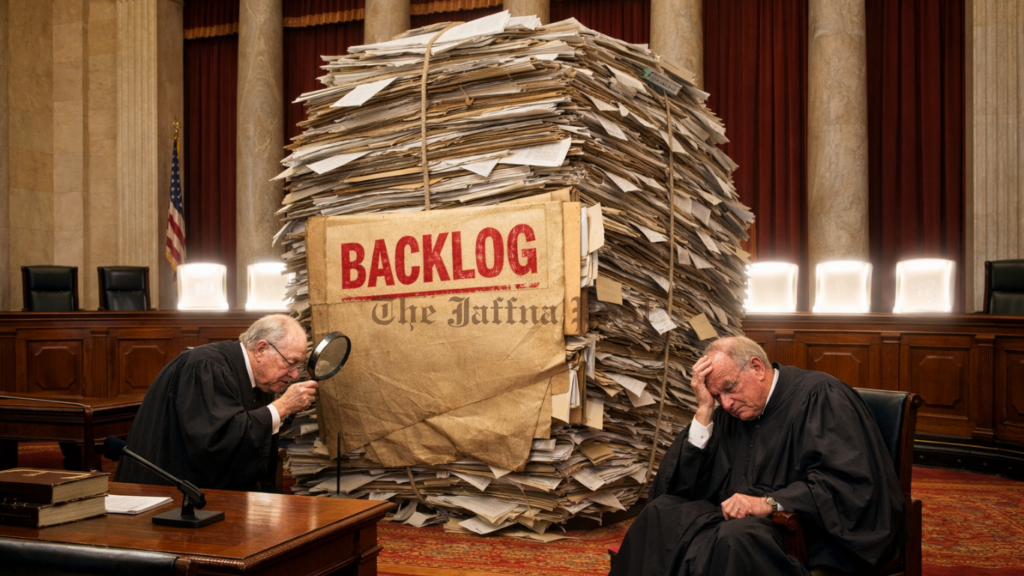
This is not to say that increasing the retirement age is beyond criticism. There are legitimate questions about the government’s justification for the proposal. The primary argument advanced by the government is that the judiciary faces a massive backlog of cases and that retaining experienced judges for a longer period will help improve case disposal rates. However, this explanation lacks credibility when viewed against the current realities of judicial administration.
The first and most obvious issue is that the government has not fully utilized the positions that already exist within the higher courts.
The Supreme Court is permitted to have up to 16 judges, yet for extended periods it has operated with significantly fewer. If five positions remain vacant, it is difficult to understand how extending the tenure of existing judges is the preferred solution to the backlog problem. The immediate and logical step would be to fill those vacancies without delay.
Similarly, vacancies exist within the Court of Appeal. If the government’s true objective is to increase judicial capacity and improve the throughput of cases, these positions should be filled as a matter of urgency. Every vacant judicial office represents a lost opportunity to hear and dispose of cases.
This naturally leads to another question: Is there a shortage of suitably qualified candidates? Sri Lanka has experienced legal professionals within the judiciary and the private Bar who could potentially be appointed to higher judicial office. If qualified individuals are available, why are appointments being delayed?
Concerns about judicial appointments
Some observers speculate that the reluctance to make appointments may be influenced by concerns about judicial independence itself. There is a perception that certain judges in the Court of Appeal may not deliver outcomes that align with the preferences of those in power. Whether this perception is accurate or not, the existence of such doubts highlights the importance of transparency in the appointments process.
Judicial promotion should never be based on whether a judge is expected to favor the government. Appointments and promotions must be determined by competence, integrity, experience, and commitment to the rule of law. Any perception that political considerations influence judicial advancement can be damaging to public confidence in the legal system.
The retirement age debate is not the whole story
If the government’s primary objective is to increase the speed with which cases are concluded, then focusing only on Supreme Court and Court of Appeal judges overlooks a much larger problem.
The backlog of cases is not confined to the superior courts. Delays are equally, if not more, severe in the lower courts, where the majority of litigation begins and where ordinary citizens experience the justice system firsthand.
If extending judicial tenure is genuinely intended to increase judicial capacity, why is the proposal limited to higher court judges? Why are similar measures not being considered for lower court judges who also contribute to case disposal?
This inconsistency weakens the argument that the proposal is purely about addressing delays.
The real test of judicial independence
The debate over retirement age should not distract from the more fundamental question: What is the purpose of judicial independence?
Judicial independence is not an end in itself. Its ultimate purpose is to protect ordinary citizens by ensuring the rule of law. An independent judiciary is valuable only if it provides timely, fair, and accessible justice.
Today, one of the greatest failures of the justice system is delay. Cases often take years, sometimes decades, to reach final resolution. For litigants, justice delayed is often justice denied.
Responsibility for this problem cannot be attributed solely to governments. The judiciary, legal practitioners, procedural rules, and institutional practices all contribute to delays. There is a widespread perception that cases are frequently prolonged through repeated postponements, for the benefit of the legal professionals.
In countries such as Singapore, judicial officers operate within a system that emphasizes efficiency and timely case completion. Strict case management practices ensure that litigation progresses at a reasonable pace. Sri Lanka could benefit from adopting similar reforms.
Should not the Bar Association members focus on this aspect?
The forgotten lessons of the 1972 reforms
The current debate on judicial retirement age also overlooks a more important historical lesson. Sri Lanka has previously attempted comprehensive reforms to improve the efficiency of the administration of justice.
Following the 1972 constitutional changes, significant efforts were made to modernize court procedures and reduce delays in litigation. One of the most notable initiatives was the Administration of Justice Law of 1973, spearheaded by Dr. Nihal Jayawickrama.
The objective was to simplify procedures, reduce technical obstacles, and ensure that litigants could obtain decisions without spending years in the courts.
The reforms recognized that justice delayed is justice denied. Instead of focusing solely on the number of judges, they attempted to address the underlying procedural inefficiencies that created delays. However, many members of the legal profession opposed aspects of these reforms.
Critics of that opposition have long argued that lengthy litigation benefited certain professional interests because prolonged cases generated additional legal fees. When the political climate changed, many of the reforms were reversed or diluted.
Whether one agrees or disagrees with every aspect of the 1972–73 reforms, they addressed the real problem facing litigants: the excessive time required to obtain justice. Today, more than fifty years later, Sri Lanka continues to struggle with the same challenge.
Therefore, before engaging in a battle over whether Supreme Court judges should retire at one age or another, policymakers, judicial officers, and the Bar Association should revisit the broader lessons of the 1972 constitutional and 1973 justice reforms.
The central question should not be how long judges remain in office, but how the justice system can deliver fair, efficient, and timely outcomes for ordinary citizens.
The need for structural reform
Meaningful improvements would include:
- Reducing opportunities for unnecessary adjournments
- Filling all existing judicial vacancies without delay
- Improving civil and criminal procedure to reduce unnecessary delays
- Introducing stronger case management systems
- Considering retirement age reforms across all levels of the judiciary rather than only the superior courts
Historical efforts to reform judicial procedures have often faced resistance from stakeholders who benefit from the status quo. Any serious discussion about judicial independence should therefore also address institutional inefficiencies that prevent citizens from obtaining timely justice.
Conclusion
The controversy over increasing the retirement age of Supreme Court and Court of Appeal judges raises important questions about judicial independence. However, the debate should not be reduced to a simplistic argument that longer tenure automatically makes judges more favorable to the government.
The more pressing issue is whether the government is genuinely committed to strengthening the justice system. If reducing case backlogs is the objective, filling existing judicial vacancies and reforming court procedures would likely have a far greater impact than merely extending the retirement age of senior judges.
Ultimately the Bar Association and Jurists should recognize the true measure of judicial independence is not whether judges retire at 65, 67, or 70. It is whether ordinary citizens can rely on a justice system that is impartial, efficient, and capable of delivering timely decisions.
Until those broader structural issues are addressed, the debate over retirement age risks becoming a distraction from the deeper challenges facing the administration of justice in Sri Lanka.





















An excellent and balanced analysis. The debate over the retirement age of judges risks distracting us from the much deeper structural weaknesses of Sri Lanka’s justice system.
Judicial independence is certainly important, but independence alone is insufficient if justice remains inaccessible due to years or even decades of delay. The real measure of an effective judiciary is whether it delivers fair, timely, and affordable justice to ordinary citizens.
If the government’s stated objective is to reduce case backlogs, the logical starting point should be to fill all existing judicial vacancies, modernize court procedures, strengthen case management, and introduce measurable performance standards across every level of the judiciary, not merely the superior courts. Extending the retirement age may provide some short-term benefit by retaining experienced judges, but it cannot substitute for comprehensive institutional reform.
More fundamentally, appointments, promotions, tenure, and retirement should all be governed by an independent, transparent, and merit-based constitutional framework that minimizes political influence at every stage. Public confidence in the judiciary depends not only on judges being independent but also on citizens believing they are selected, promoted, and retained solely based on competence, integrity, and commitment to the constitution and rule of law.
Ultimately, the objective should not be to debate whether judges retire at 65, 67, or 70, but to build a justice system that consistently serves the people efficiently, impartially, and without political interference. Strong institutions—not individual officeholders—are the true foundation of judicial independence and public trust.