
In 2024, I wrote an essay, titled ‘Israelis in Sri Lanka and the Advent of a ‘Neo’ Colonialism.’ My concern then was the disruption long-term Israeli tourists, often over-staying tourist visas, were causing, particularly in the Eastern Province. Government intervention was mostly visible through relative inaction.
Over the past year, Sri Lanka’s pristine coastal enclaves, from Hikkaduwa and Weligama in the west to Arugam Bay in the East, have found themselves at the centre of a complex and needless geopolitically-inflected controversy. As I explained in my earlier essay, the rapid growth of Israeli tourism has brought to light serious concerns regarding regulatory oversight, economic fairness, and national sovereignty.
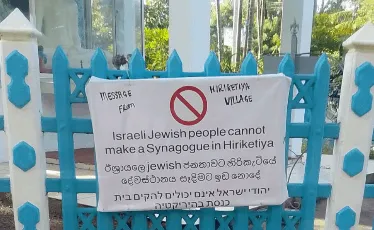
The latest controversy erupted in August 2026, in Hiriketiya, near Dickwella, in the country’s south. Unlike in the east, where the protesters were mostly from Muslim communities, in Hiriketiya, the protests were led by Buddhists, including monks.
At the centre of latest public debate is the establishment of a ‘Chabad House’, essentially a Jewish community and religious centre, catering to Israeli travelers. One of the primary demands the protesters made, was to investigate if this religious entity was established legally and if the activities of Israeli residents, including running businesses, were legal.
In the context of the earlier controversy, Prime Minister Harini Amarasuriya is on record for clarifying in Parliament on 8 January, 2025, that neither the Ministry of Buddhasasana, Religious and Cultural Affairs nor any other government institution had granted official permission for the establishment of Israeli religious sites. In other words, what existed was illegal.
Chabad Houses as private business entities of the local Chabad Houses, of which there are about six at present, claim they operate as registered private business entities. However, operating public religious and communal hubs on standard tourist or corporate permits violates local town planning and immigration guidelines. Besides, despite the claim, it is very unclear even if standard business licenses were issued in the first place.
If religious entities were run under temporary business licenses, that itself is a clear violation of Sri Lankan law showing scant disregard to both the legal system in the country and its socio-political sensitivities.
This setup stands in stark contrast to how Sri Lanka’s own religious presence is managed in Israel. In Tel Aviv, a Sri Lankan Buddhist temple was established in 2013 to serve thousands of Sri Lankan migrant workers. The effort was facilitated by the Sri Lankan Embassy in the Israeli capital.
To respect local Israeli laws and urban regulations, that temple operates discreetly inside a private apartment complex rather than as a prominent, independent public centre with an overt public religious personality as is usually the case with Buddhist temples globally.
The Chief Incumbent of the temple, at the time it opened in 2013, Ven. Karavilakotuwe Dhammathilaka, is on record for stating very clearly that in keeping with the religious sensitivities in Israel, the inaugural ceremony itself was also held on a low scale without much publicity. This makes sense given the fact that Israel is one of the most religiously intolerant societies in the world as its track record amply demonstrates. This is more so in the last few years.
What is important in the context of the opening of the Buddhist temple in Tel Aviv is, no laws were violated, the temple was meant for long term-residents, and respected local laws and sensitivities. It was also an effort formally facilitated by the Sri Lankan Embassy.
The comparison raises a fundamental question of parity: why should foreign nationals in Sri Lanka, including Israelis, establish public religious and cultural centres without municipal or government authorisation, while Sri Lankans abroad strictly abide by local constraints, as the nondescript Sri Lankan Buddhist temple in Tel Aviv clearly demonstrates?
The debate and anxieties around the Israeli presence in Sri Lanka occurs alongside another pressing concern. That is, the relatively precarious position of thousands of Sri Lankan workers in Israel who are mostly in the construction, agriculture and caregiving sectors.
Recently, thousands of Sri Lankan migrant workers faced deportation from Israel due to job category violations, after switching from agriculture or caregiving to unauthorised sectors. The Sri Lankan Foreign Ministry reportedly actively intervened with Israeli authorities to negotiate regularisations and protect these workers.
In my view, illegality is illegality everywhere. If Sri Lankans violated Israeli law, that country had every right to deport them, and we should not have intervened. But I do understand the government’s position, too, as it relates to employment of citizens. In that case, there should be a system where such regularisations are managed via the facilitation of the Sri Lankan Embassy, and if citizens do not make use of such a facility, they should clearly face the consequences of Israeli law.
Troubling double standard
Whichever way one looks at it, this highlights a very troubling double standard. That is, while Sri Lankan workers and the government have to cautiously navigate strict Israeli labour and visa laws, Israeli visitors in Sri Lanka frequently evade local visa laws without consequence.
This mostly occurs as a result of the institutionalised spinelessness of our law enforcement when it comes to foreigners, and particularly seemingly ‘white’ foreigners. But surely, over 78 years after Independence, spineless meekness on our part must have clear limits.
There needs to be clear reciprocity. Besides, Israelis are not here to work as the Sri Lankans in Israel are. They are supposed to be tourists. They should neither work nor establish religious edifices as they feel fit violating our laws and sensitivities as a matter of routine. This is why the ongoing Israeli activities reek of settler-colonialism.
Also, it is not only a matter of Israeli intransigence and official and public Sri Lankan apathy. The latter becomes possible when locals, who rent buildings to visa facilitate in running illegal Israeli businesses depriving their own citizens of legitimate incomes, are not even prosecuted by local law enforcement and judicial systems.
As often is the case, foreign arrogance is built upon local meekness and lack of even the most basic sense of national pride. Of course, this does not apply to anyone, including Israelis who are operating a business in Sri Lanka legally, based on legitimate licenses issued by the government.
The proliferation of unlicensed, foreign-run businesses poses severe economic challenges to Sri Lanka’s local tourism industry. Many Israeli visitors enter this country on standard tourist visas but illegally set up guesthouses, surf camps, and cafes. Often operating exclusively in Hebrew, these businesses transact via informal channels or foreign accounts.
When foreign visitors, including Israelis, run unregistered businesses, there are numerous local fallouts. For one thing, Sri Lanka loses substantial corporate, local government, and value-added tax revenues. Secondly, these activities severely undercut local livelihoods. Local vendors, tour guides, and small hoteliers are excluded by closed-loop and illegal Israeli operators.
One of the common complaints where illegal Chabad Houses have been established is that they provide accommodation and meals to Israeli tourists, seriously disadvantaging local tourism-related businesses.
Adverse economic impact
Much of the income earned from these closed illegal operations, hardly comes to Sri Lanka in any way except for payment for supplies and rentals. Finally, since properties lease informally at inflated long-term rates to these operators, it drives up costs for Sri Lankan entrepreneurs and small business owners.
But all this has become possible and so entrenched because of the established track record of relative inactivity of the Sri Lankan government in general, as well as local governments and law enforcement in particular.
This brings to mind the Israeli feature film, Arugam Bay. Directed by Marco Carmel and shot on location in Sri Lanka, including Ella and Arugam Bay. The film follows former Israeli soldiers using Sri Lanka’s coastal towns to process military combat trauma. The production received formal clearances for filming from the Sri Lanka Tourism Promotion Bureau in so far as publicly available information indicates.
However, its narrative, framing Sri Lankan beach towns as retreats for Israeli military veterans, with blood on their hands and massive human rights violations to their credit, reaffirms local concerns about the island being used as a backdrop for Israeli human rights violations against Palestinians without sufficient regard for local perspectives.
It is precisely this kind of narrative, through word of mouth as well as social media, that creates an image of Sri Lanka as meek and trouble-free destination for Israelis intent on illegal activities.
Does the Sri Lankan government and its citizens want such a label attached to the country? I certainly don’t. It is quite shocking that the Sri Lanka Tourism Promotion Bureau gave permission for a such film to be shot locally. It shows both the Authority’s sorry view of what tourism is and scant disregard for ethical tourism.
Pushback mis-characterised as anti-Jewish sentiment
Public pushback against these illegal activities has sometimes been described by local as well as Israel supporters as anti-Jewish sentiment. But this completely mischaracterises the issue.
Global condemnation of Israel’s military actions in Gaza and beyond and massive rights violations of entire Palestinian communities is rooted in international humanitarian law, not antisemitism.
Differentiating between opposition towards violating state policies and hostility toward Jewish people is critical. Sri Lankans standing against Israeli military aggression or localised law-breaking are asserting human rights and national law as well as decent and legal behaviour by foreigners in our own country. This is not engaging in discrimination. That is, Israelis must be treated here as our people are treated in Israel. By law and by the book.
Sri Lanka must remain a welcoming host to international tourists. However, hospitality must not replace accountability. The government must strictly enforce visa restrictions, shut down unauthorised commercial and communal spaces, and protect local businesses.
By upholding the rule of law uniformly, Sri Lanka can safeguard its economy, preserve its national sovereignty, and maintain harmony along its shores.
Image Source: www.themorning.lk/