Sri Lanka enters 2027 at a pivotal moment. After four years of painful adjustment, the country has restored macroeconomic stability. Inflation has fallen to single digits, foreign reserves have recovered to workable levels, and the Government has achieved a primary fiscal surplus. These are significant accomplishments. They prevented institutional collapse and stabilised a nation facing its worst economic crisis since independence.
However, stabilisation is not prosperity. It is merely the end of one journey, and the beginning of another.
Sri Lanka now has a historic opportunity to move from crisis management to genuine economic transformation. Budget 2027 should become the country’s first Economic Transformation Budget, designed not simply around revenue and expenditure but around three national missions:
- Raising productivity
- Mobilising investment
- Improving living standards
Only such a mission-oriented approach can generate the sustained economic growth above 7% annually, required to meet future debt obligations while significantly improving household incomes.
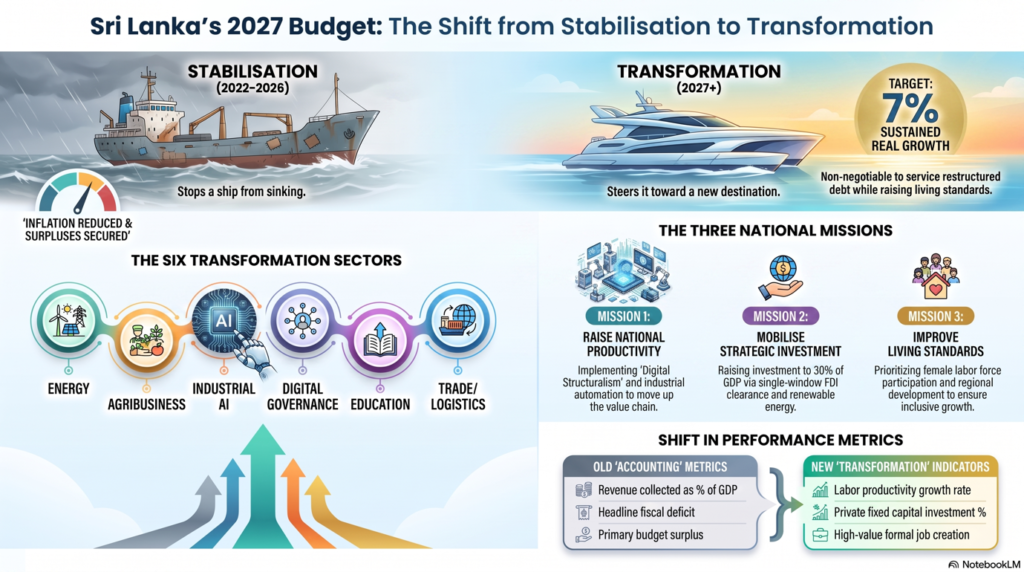
“Recent achievements mark the end of economic stabilisation—not the beginning of national prosperity. Stabilisation stops a ship from taking on water, but it does not steer it towards a new destination.”
Why Stabilisation Alone Is Not Enough
Conventional economic thinking assumes that once fiscal discipline is restored and a primary surplus achieved, market confidence will naturally stimulate private-sector growth. However, confidence alone does not build logistics corridors, automate factories, modernise agriculture, or develop a highly skilled workforce.
Productivity, exports, innovation, and investment do not automatically emerge simply because inflation is low. They require deliberate, targeted, and sustained structural reforms.
If Budget 2027 remains a conventional accounting exercise, adjusting taxes at the margins and distributing funds among ministries, Sri Lanka risks falling into a prolonged low-growth trap.
To service its restructured external debt while improving living standards, the economy must sustain annual growth of at least 7%. This cannot be achieved through austerity alone. It requires transformation across six critical sectors.
Energy: Transition from expensive fossil fuels to utility-scale renewable energy while modernising the national grid to reduce industrial electricity costs.
Agriculture: Replace input subsidies with investment in agricultural technology, including drip irrigation, precision farming, cold-chain logistics, and high-value export crops.
Industry: Move apparel, tea, and manufacturing up the value chain through automation, artificial intelligence, robotics, and environmentally sustainable production.
Digital Governance: Implement comprehensive digital transformation across land registries, customs, taxation, and business licensing while establishing a genuine single-window authority for foreign direct investment.
Human Capital: Align tertiary and vocational education with STEM and digital skills while reforming labour regulations to increase female labour-force participation.
Trade and Logistics: Upgrade ports, transport corridors, and customs systems to position Sri Lanka as South Asia’s premier maritime and logistics hub.
Economic transformation is not optional. It is the only sustainable path to long-term prosperity.
A New Budget Framework: Mission-Oriented Governance
Sri Lanka’s traditional budgeting system, organised around ministries, encourages silo-based planning and competition for resources. Budget 2027 should break away from this model by organising public expenditure around three national missions:
- Raising National Productivity
- Mobilising Strategic Investment
- Improving Household Living Standards
Under this framework, expenditure on agriculture, education, or infrastructure should no longer be viewed merely as a cost but as an investment in productivity and national wealth. Every public expenditure should be evaluated according to its contribution to long-term economic transformation.
“Budget 2027 should introduce a National Transformation Scorecard that measures success using two complementary dimensions: traditional fiscal indicators and long-term structural transformation indicators.”
Mission One: Raise National Productivity
Productivity is the engine of higher wages and international competitiveness. Sri Lanka should prioritise investment in:
- Digital Structuralism: Digitise land registries, customs, taxation, and business licensing to reduce transaction costs and minimise corruption.
- Agricultural Modernisation: Transform subsistence farming into commercial agribusiness through precision agriculture, drip irrigation, and modern cold-chain infrastructure.
- Industrial Automation: Introduce tax credits and accelerated depreciation for companies investing in artificial intelligence, robotics, and advanced manufacturing.
- Logistics Infrastructure: Expand deep-water terminals, improve port efficiency, and better integrate domestic supply chains with global markets.
- Workforce Development: Establish technical institutes, industry-led apprenticeships, and lifelong learning programmes aligned with labour market needs.
Increasing productivity is the only sustainable way to achieve higher real wages—a pressing national priority.
Mission Two: Mobilise Investment
Sri Lanka must increase gross capital formation from its current level of approximately 24.6% of GDP to over 30% if it is to sustain annual growth above 7%.
This requires:
- A genuine single-window authority for foreign direct investment, supported by statutory approval deadlines.
- Expanded financing for small and medium-sized enterprises through credit guarantees and public-private co-investment funds.
- Deeper capital markets by promoting corporate bonds, REITs, venture capital, and green bonds.
- Performance-based incentives for foreign investors linked to exports, technology transfer, productivity, and local value addition.
- Greater private investment in renewable energy—including solar, wind, biomass, and electricity grid modernisation—to lower production costs.
A modern investment ecosystem is essential for transforming economic stability into sustained economic expansion.
Mission Three: Improve Household Living Standards
Economic growth must be inclusive. Budget 2027 should therefore prioritise:
- Creating high-value, skilled employment.
- Increasing female labour-force participation through childcare, eldercare, safe transport, and flexible working arrangements.
- Supporting youth entrepreneurship through innovation grants, start-up incubators, and university-linked seed funding to reduce brain drain.
- Promoting balanced regional development by investing in Trincomalee, Hambantota, and regional agro-processing and industrial zones.
- Strengthening social protection by improving the targeting and transparency of the Aswesuma programme through digital systems.
Ultimately, economic transformation must be reflected in rising real incomes and an improved quality of life for all citizens.
Measuring Success: A National Transformation
As the well-known management principle states: “What gets measured gets managed.”
Budget 2027 should therefore introduce a National Transformation Scorecard that tracks both fiscal stability and structural transformation through indicators such as:
- Labour productivity growth
- Private investment as a percentage of GDP
- Export diversification
- Global Innovation Index ranking
- High-value job creation
- Real median household income
- Household savings rate
- Reduction in multidimensional poverty
Every ministry should submit quarterly performance reports outlining key performance indicators (KPIs), targets, achievements, challenges, and corrective actions, enabling the President and Cabinet to monitor progress towards the country’s national missions.
Conclusion: A Budget for the Nation’s Future
Sri Lanka has travelled a difficult path from economic collapse to macroeconomic stability. Yet stability is not prosperity, and recovery is not transformation.
Budget 2027 can either become another routine fiscal exercise or serve as the blueprint for building a productive, competitive, investment-driven, and inclusive economy.
History will judge this Budget not by the taxes it raises or the money it spends, but by whether it creates the conditions for higher productivity, increased investment, stronger exports, better employment opportunities, and rising living standards.
If Budget 2027 embraces these three national missions, it will become far more than an annual fiscal statement. It will lay the foundation for a resilient, innovative, and prosperous Sri Lanka—one capable of sustaining economic growth of over 7% while honouring its obligations to future generations.
Honourable Minister of Finance, the choice is yours.
This article, on behalf of the LEADS Forum, is based on discussions with Professor Asoka Seneviratne, an economist with extensive international experience.