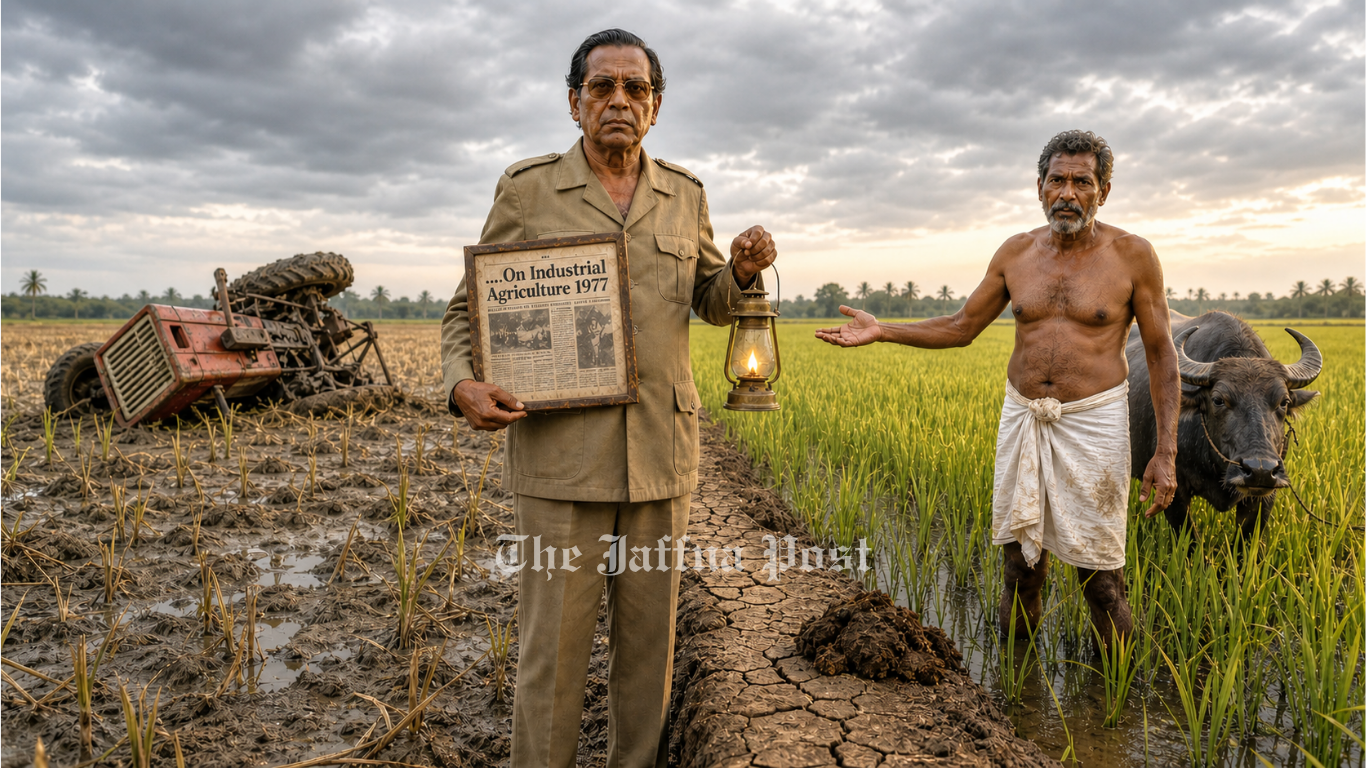

There is a looming crisis before us. As an agricultural nation, we should fear the disruption of fossil oil and fertilizer as our crops cannot produce without them and our fleet of tractors cannot function without them.
Sadly, this dependency was anticipated. In 1977, national newspapers, including an article in The Observer, warned of agriculture’s heavy reliance on energy. That warning is worth repeating today, as the stakes are now far higher.
“On Industrial Agriculture” (1977)
A case-in-point is the ‘miracle rice’ that gives an immediate manifold increase in crop over traditional varieties. This would seem indeed a welcome gift, if not a virtual godsend in troubled, food-scarce times like these. The reckoning is simple. If we have an acre of paddy with a yield of 30 bushels, then all we need to do is switch to the new intensive varieties that give twice the original yield, and we have 60 bushels with the same acreage. Presto! The problem is solved.
But not quite: there is an important feature called energy that we often fail to take into our accounting. Energy is one of the most important features of an ecosystem. At the human level, the food we eat represents the source from which we derive energy for all our bodily functions. This food too, whether animal or vegetable in origin, requires energy for its organization.
Animals, like us, derive their energy from plants and other animals (heterotrophs), and most plants derive their energy form the sun (autotrophs). Therefore, as we are so dependent on energy, it would bode well for us to examine the sources and cost of the energy available to us.
One of our primary sources of food is rice. The agricultural system that yields this grain requires some extra input of energy in addition to the sun to make it yield utilizable crops.
The traditional varieties of rice used with traditional agricultural methods utilize composted fertilizer and animal power as the source of extra energy for subsidy. This type of system uses 0.062 to 0.065 calories of energy subsidy for one calorie of food output. As this energy input is basically biological, i.e. man and animal power, it does not represent an economic loss to the nation.
On the other hand, the use of ‘miracle rice’ intensive agricultural systems, which often use around 0.3 to 0.5 calories of energy input for 1 calorie of food output, and which entail heavy doses of fertilizers and agro-chemicals, does indeed represent tangible financial or economic pressure on the nation.
It can be argued that although such a system may entail a financial cost to the country, the increase of crop by the application of these techniques would justify such an expense, especially as in the present situation we are still not self-sufficient in our rice production.
This argument is a valid one, if we are concerned only with a short- term result. Unfortunately, in the long-term it would seem we stand to lose tremendously in adopting such a strategy. The new breeds of ‘miracle rice’ are merely genetically selected dwarf plants with small roots systems and the minimum amount of leaves needed to capture a maximum amount of usable solar radiation.
Such a plant has a low potential for protection and maintenance, these functions being taken over by management, fuels and chemicals. It is selected to produce edible grain at the expense of non-edible tissue and responds excellently to high inputs of fertilizers. Such plants, coupled with the use of tractors, pesticides, weedicides etc., produce seemingly wondrous crops.
All the components that go to form this high-yield agriculture are also dependent on energy for their organization. In this case the source of energy is from fossil fuels, i.e. oil and coal.
We in this country, having no fossil fuels, would then become increasingly dependent on imported energy if such methods of agriculture were to be actively utilized. Achieving a high agricultural productivity at the expense of being enslaved by the price of fossil fuel would seem a hollow victory. It would be illuminating to ask the question: can we use these methods as long as they are economically profitable, and then revert back to traditional systems? The answer is already obvious to the farmers who use high-energy agro-chemicals. They observe that their field gets ‘burned’ with the use of fertilizer and agro-chemicals.
The meaning of this simple but very important observation is that soil organisms that make up the micro fauna and flora of the soil ecosystem are disrupted, and the natural fertility of the field falls. To again build up soil organisms to pre-agrochemical complexity could take from one to four years. So, once we become dependent on the high-energy input rice agricultural system, it is very much a case of taking hold of the proverbial tiger’s tail – there is no letting go.”
It was not that this movement to fossil fuel went unquestioned, when a display of the new ‘agricultural tractor’ was done in Sri Lanka around 1933. A race was set up between the traditional buffalo drawn plough and the tractor. Of course, the tractor won. When asked what the prime minister, the hon. D. S. Senanayake, thought about this machine, he walked around it with great interest and asked the director of the company, “This is truly a wondrous machine sir, but tell me, where is the dung?” He saw, at that time, the Achilles heel of modern agriculture. Its dependency on fossil energy to maintain productivity.
It was not that the farmers themselves did not complain. They did. Their voices were encapsulated by a series of countrywide farmer meetings culminating in a statement made at a national meeting of Sri Lankan farmers, supported by the CGIAR and presented for the Mid Term Meeting of the CGIAR to be held in Brasilia in May 1998.
Over 300 farmer delegates issued the following statement:
“We, the farmers of Sri Lanka would like to further thank the CGIAR, for taking an interest in us. We believe that we speak for all of our brothers and sisters the world over when we identify ourselves as a community who are integrally tied to the success of ensuring global food security.
In fact, it is our community who have contributed to the possibility of food security in every country since mankind evolved from a hunter-gather existence. We have watched for many years, as the progression of experts, scientists and development agents passed through our communities with some or another facet of the modern scientific world.
We confess that at the start we were unsophisticated in matters of the outside world and welcomed this input. We followed advice and we planted as we were instructed. The result was a loss of the varieties of seeds that we carried with us through history, often spanning three or more millennia. The result was the complete dependence of high input crops that robbed us of crop independence.
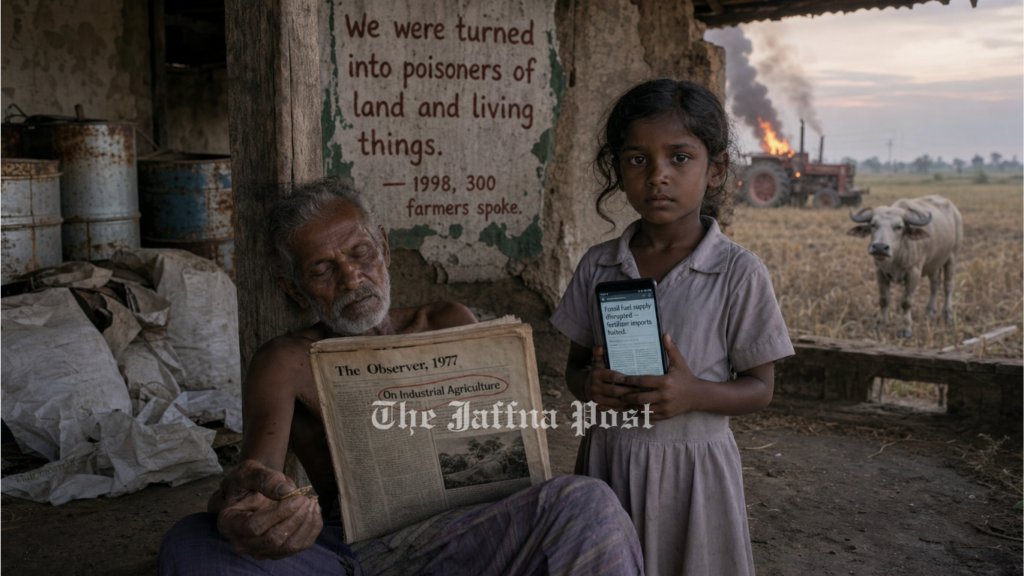
In addition, we farmers, producers of food, respected for our ability to feed populations, were turned into the poisoners of land and living things, including fellow human beings. The result in Sri Lanka is that we suffer from social and cultural dislocation and suffer the highest pesticide related death toll on the planet.
Was this the legacy that you the agricultural scientists wanted to bring to us? We think not. We think that you had good motives and intentions, but left things in the hands of narrowly educated, insensitive people.”
Although, this was the first farmer led statement to the international community. There was no attention paid to it by the administration, a good illustration of the disjoint. In this context, it is sobering to reflect on a favorite quote of the Hon D.S. Senanayake:
“Agriculture is not merely a way of making money by raising crops; it is not merely an industry or a business; it is essentially a public function or service performed by private individuals for the care and use of the land in the national interest: and the farmers in the course of securing a living and a private profit are custodians of the basis of national life. Agriculture is therefore affected with a clear and unquestionable public interest ….”
However, the goals of modern agriculture discount this public function, based on the premise that the main goal of agriculture is productivity increase. This has created a plethora of problems that bedevil all of humanity. The most significant of which are, a loss of sustainability, a loss of biodiversity, a loss of independence, a loss of traditional knowledge and a loss in nutrient breadth.
Now we are faced with the reality that we gave all that up to be totally dependent on fossil energy to maintain our food production. We have followed the high energy input agriculture when fossil energy was cheap and available, but with global wars about disrupt energy supplies, is it not time to realise our vulnerability in food production following this path ?
We need a new paradigm in agriculture.
Source: https://www.linkedin.com/pulse/agricultural-crisis-coming-sri-lanka-ranil-senanayake-zt1jc/