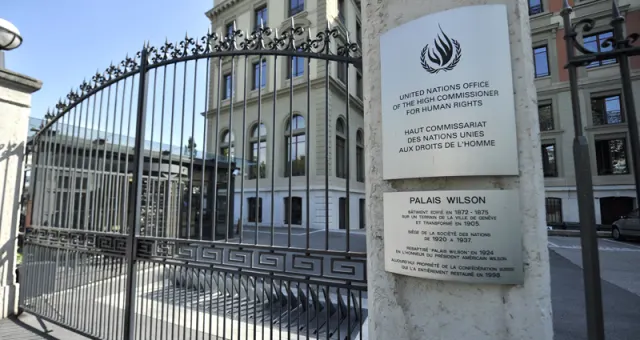

The 63rd session of the United Nations Human Rights Council, which commenced on September 7 in Geneva, is scheduled to continue until October 7.
This time, a high-level delegation from Sri Lanka led by Foreign Minister Vijitha Herath did not travel to Geneva. Sri Lanka’s Permanent Representative, Sumith Dassanayake stationed there is handling matters related to Sri Lanka at the session.
On Tuesday September 8, the second day of the Human Rights Council session, High Commissioner Volker Türk formally submitted the report on the Sri Lankan situation and initiated discussions with member states and Sri Lankan representatives. However, prior to this, the report was released in advance by his office on Thursday, September 3.
The report, titled ‘Promoting Reconciliation, Accountability and Human Rights in Sri Lanka’, welcomed certain positive measures taken by the Sri Lankan government, such as anti-corruption initiatives, progress in high-level investigations regarding the 2019 Easter Sunday bomb attacks, and the partial release of military-held lands.
Nevertheless, it highlighted that the overall pace of legal and institutional reforms has stalled. The report expressed regret over arbitrary arrests resulting from the continued use of the Prevention of Terrorism Act (PTA) and highlighted severe provisions in the newly proposed draft legislation intended to replace it.
In 2025, 602 instances of torture and cruel treatment, along with 18 deaths in custody, were documented in the report. Additionally, it pointed out ongoing state surveillance, inquiries, and intimidation targeting civil society activists, journalists, and human rights defenders.
Noting that investigations into major historic events such as the 2006 massacre of 17 French NGO workers in Muttur, remain stalled, the report urged a moratorium on the use of the PTA and called for independent criminal investigations alongside security sector reforms.
While local authority elections were held in 2025, the report notes that provincial council elections have not been held since 2014. However, it does not specifically urge that these elections be held quickly or that the 13th Amendment be fully implemented.
The UN High Commissioner for Human Rights’ report recommends signing the Rome Statute, which established the International Criminal Court (ICC). In this context, it is worth noting the explanation provided by British High Commissioner to Sri Lanka, Andrew Patrick, regarding the practical difficulties of referring the Sri Lankan issue to the ICC, during a recent meeting in Jaffna with families of the disappeared and Tamil civil society representatives.
Since Sri Lanka is not a signatory or state party to the Rome Statute, the ICC lacks automatic jurisdiction to initiate investigations or prosecute alleged war crimes or enforced disappearances during the Sri Lankan war.
To move forward, despite Sri Lanka not signing the Rome Statute, the Sri Lanka situation can only be referred to the ICC Prosecutor through a UN Security Council resolution. However, the British High Commissioner stated that obtaining a referral from the Security Council is practically impossible due to the geopolitical environment within the council, specifically because permanent members like China or Russia are likely to exercise their veto power.
With the Human Rights Council session underway, discussions surrounding human rights and accountability in Sri Lanka have once again returned to the forefront of the political arena and media landscape.
Despite several changes of government in Sri Lanka over the seventeen-plus years since the end of the civil war, the stalemate in delivering justice to war-affected people remains unchanged.
Since the war ended, more than ten major resolutions have been passed at the Geneva Human Rights Council. Despite these resolutions taking various forms – ranging from international inquiries and internal mechanisms to the High Commissioner’s evidence-gathering mechanism (Sri Lanka Accountability Project) – the tangible benefits for victims on the ground remain zero.
Responding to the High Commissioner’s report last week, Sri Lanka’s representative categorically stated that the country would never accept any external mechanism regarding accountability.
This has strengthened concerns among affected communities over whether Geneva sessions have merely devolved into a routine annual diplomatic exercise. International reports and resolutions create temporary pressure or discomfort for those in power in Colombo, but they have failed to address the fundamental grievances of the victims.
The demands of the people affected by human rights violations in the North and East have remained on the streets for decades. Relatives of the forcibly disappeared have been conducting continuous protests for years, demanding to know the truth about what happened to their loved ones. During these protests, hundreds of parents have passed away without receiving justice.
The struggles of the Tamil people demanding the return of their own lands, which were seized by the military during the war, continue to this day. While previous governments simply ignored these protests, the current NPP government is also adopting a dilatory approach without acting swiftly on these matters.
It is deeply disappointing that the new government, which came to power with slogans of system change and a new political culture, is showing reluctance to take legal action regarding the severe past human rights violations and war crimes. Human Rights Watch highlighted this in its report last week.
The bitter practical reality today is that no powerful nation or international organization is prepared to take bold steps to haul Sri Lanka before any international court or international tribunal.
It has been proven time and again that the international community speaks about human rights mostly based on its own geopolitical and regional interests, rather than genuine justice for the affected people. A cycle of condemning Sri Lanka and subsequently granting extensions for political reasons continues in Geneva.
The Sri Lankan Tamil polity has simultaneously demanded accountability for human rights violations and war crimes, alongside a lasting political solution to the national ethnic issue, from Colombo governments. However, failing to achieve even the slightest progress on either of these demands, reflects a major political stalemate for the Tamil community.
With no promising sign in sight that justice will be delivered in the future, the affected people are plunged into severe despair and anxiety. As Geneva’s resolutions remain merely on paper and Colombo’s promises exist only in words, a generation denied justice still fighting for its rights is a tragedy that ought to shake the conscience of the international community.
In such a situation, unless the NPP government avoids the failed path of previous regimes, breaks the deadlock in the Geneva process, and takes decisive action to provide real justice and relief to the affected people, there is no meaning in talking about ‘change’.
All previous governments formed ‘inquiry commissions’ under the guise of an ‘internal mechanism’ merely to escape international pressure, only to shelve them later. If the current government rejects international mechanisms, it must immediately establish a credible, independent domestic investigative structure subject to international oversight as an alternative.
Legal proceedings must be initiated without delay in symbolically significant cases. Numerous cases concerning the murder of journalists, enforced disappearances of individuals, and severe wartime rights violations remain stalled despite the existence of evidence.
As Human Rights Watch pointed out, the government must demonstrate the courage to reopen these cases and independently prosecute those accused, regardless of who they are, even if they possess political or military influence. This alone will serve as true testimony to the government’s policy against corruption and crime.
If the NPP, which assumed power with a mandate as a ‘government for change’, continues the previous rulers’ tactic of buying time regarding human rights and national reconciliation, it will only deepen the dissatisfaction among the affected populace.
Rather than stopping at addressing Geneva, taking bold actions for justice on the ground will be the true solution to the domestic and international crises Sri Lanka faces.
As nearly two years approach since the people of Sri Lanka elected a government that promised to eradicate the culture of impunity, it is critical to note the Office of the United Nations High Commissioner for Human Rights (OHCHR) stating in its report that the opportunities for change are closing.