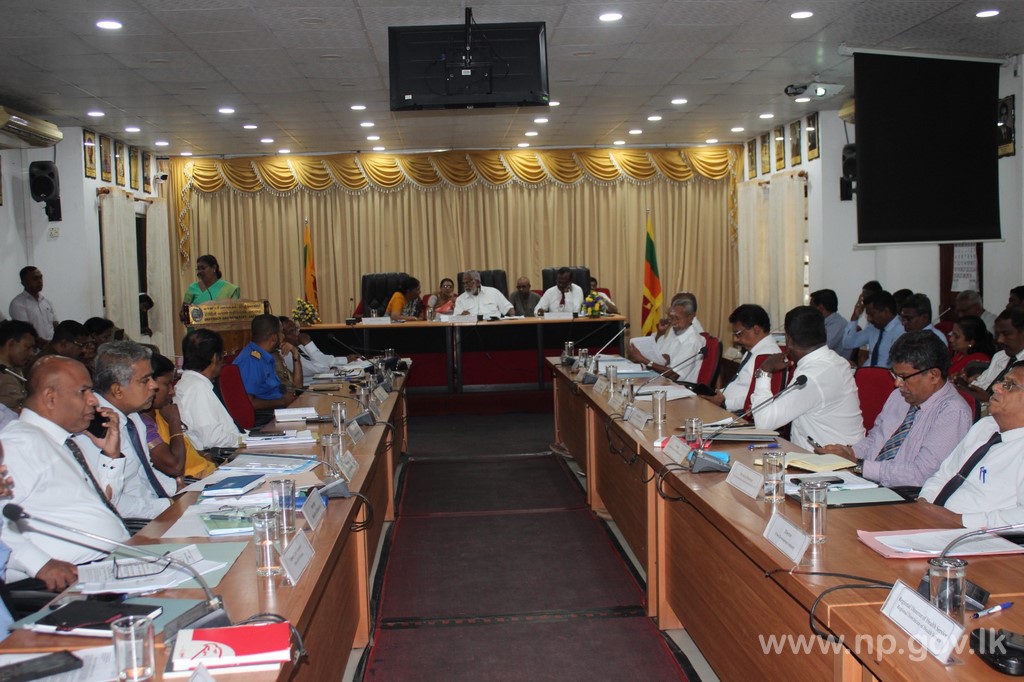

Every district in Sri Lanka has a District Coordinating Committee(DCC). This article is triggered by the conduct seen in Jaffna and at times followed in one or two more areas in the Northern Province.
The optics are at minimum distasteful, disgraceful and horrific with shouting being the primary theme. In September 2025 guidelines had been issued by the Home Ministry which could potentially undermine mandates of several agencies whose responsibility is planning, allocation of finances and development. Such ad hoc measures undermine the entire administrative system.
The purpose of the DCCs should be to learn of progress of use of funds allocated to central agencies. Provincial funds are distinct as another channel under the Governor, Chief Minister, Provincial Ministers, Chief Secretary and Provincial Ministry Secretaries.
At present there is insufficient coordination between funds given to central agencies and provincial agencies. Outlined below is a core function of the Finance Commission.
Responsibilities of the Finance Commission
It shall be the duty of the Commission to make recommendations to the President as to:
- a) The principles on which such funds as are granted annually by the Government for the use of provinces should be apportioned between the various provinces; and
- b) Any other matter referred to the Commission by the President relating to provincial finance. c) The Commission shall formulate such principles with the objective of achieving balanced regional development in the country, and shall accordingly take into account the population, per capita income, the need progressively to reduce social and economic disparities and the need progressively to reduce the differences between the per capita income of each Province and the highest per capita income among the Provinces.
Accordingly, the Finance Commission is to apportion such funds between the provinces.
Core Functions of the Commission
- Assessment of provincial needs.
- Apportionment of annually granted funds between provinces.
- Division of total amount allocated to each province between recurrent and capital needs.
- Separation of capital funds between Province Specific Development Grant (PSDG) and Criteria Based Grant (CBG).
- Breakdown of PSDG between identified development sectors/agencies.
- Formulation of principles and guidelines with the objective of achieving balanced regional development through proper utilization of provincial finance.
The overachieving purpose should be to ensure ‘development ‘.
A Vision for Development by Provinces
Fuel and infuse a surge of development through revenue generation -The objective is to generate sustainable revenue streams that can fuel and support the developmental activities in the Province. This may involve exploring various sectors, attracting investments, promoting entrepreneurship, and leveraging the available resources to stimulate economic growth.
Achieve selected objectives within five (5) years – The overall objective is to accomplish the set goals and targets within a specific time frame of five years, indicating a sense of urgency and commitment towards achieving tangible results in a relatively short period.
These selected objectives outline a comprehensive vision for Provincial Development Authorities, encompassing economic growth, environmental sustainability, improved governance, and enhanced well-being for the residents of the Province.
Foster inclusive and equitable development – Ensure that the benefits of development reach all segments of society, including marginalized communities, women, and youth. Implement targeted programs and initiatives to address social disparities and promote equal opportunities for economic growth and social well-being.
Promote innovation and entrepreneurship – Encourage innovation, creativity, and entrepreneurship in the Province. Support the establishment of start-up incubators, provide access to financing and mentorship programs, and create an ecosystem that nurtures and supports local talent and innovative ideas.
Develop robust infrastructure – Invest in the development of high-quality infrastructure, including roads, ports, airports, energy systems, and digital connectivity. Enhance transportation networks, ensure reliable power supply, and improve internet connectivity to attract investments, facilitate trade, and create an enabling environment for businesses to thrive.
The reason this article urges balanced development is to close the gap between urban and rural Sri Lanka, ensure the right to development of all of Sri Lankans to give meaning and effect to the directive principles of state policy in our constitution.
Directive Principles of State Policy
Directive principles are principles intended to guide the State when making policy. Here are some examples:
‘[Article] 27(2): The State is pledged to establish in Sri Lanka a democratic socialist society, the objectives of which include:
The full realization of the fundamental rights and freedoms of all persons;
The promotion of the welfare of the People by securing and protecting as effectively as it may, a social order in which justice (social, economic and political) shall guide all the institutions of the national life;
The realization by all citizens of adequate standard of living for themselves and their families, including adequate food, clothing and housing, the continuous improvement of living conditions and the full enjoyment of leisure and social and cultural opportunities, etc.
27(7): The State shall eliminate economic and social privilege and disparity, and the exploitation of man by man or by the State.
27(8): The State shall ensure that the operation of the economic system does not result in a concentration of wealth and the means of production to the common detriment.
27(9): The State shall ensure social security and welfare.’
These are overarching policy directions to practice in all government programs. When ministries seek financial votes they need to bear it in mind. Likewise, when parliament approves the budget, in implementation the department of policy planning, budget, finance commission should monitor and follow through.
What then is the role of District Coordinating Committees? They are convened by the District Secretary (Government Agent). It shows it is about central functions in the districts. What is absent is the presence and presentation of divisional secretaries and their work, a tier below the district secretary.
Similarly, decentralized funds are given to Members of Parliament. There is no word on plans or progress or synergy. At these meetings the finance commission should be online. They are entirely absent.
A few months back the President was heard to comment about poor use of central allocations in two provinces. Conversely similar questions could be posed on use of central funds. The finance commission should take responsibility for these inadequacies.
By default, we now see a hotchpotch. It is co-chaired by an appointed Minister with the Governor. A practice started by previous administrations, followed unquestioningly. The fiasco witnessed in Jaffna and at times other places is a result.
In the past we had something called a GA’s meeting, chaired by the secretary to the Prime Minister. It is time we see a reset. As priority:
- – Policy, voted funds, quarterly progress
- – Performance by central agencies
- – Performance by provincial agencies
- – Synergy and coordination
- – Measurement of outcomes
- – Satisfaction surveys of beneficiaries
- – Continuous improvement
Critiques should be heard in parliament in committees which oversee voted funds. Policy changes should be debated and followed through in Parliament. When elected provincial councils are in office, similar sets of priorities could be followed.
A vital aspect is feedback of citizens. Some time back the office of the Parliament Speaker organised regional, electorate-based sittings in structured town hall meetings. Clearly, members of Parliament could join, hear feedback and even seek course corrections through Parliament.
Equally a standing committee in parliament could continuously hear citizens grievances on delivery or non-delivery of policy measures.
As Governor I had proposed listening teams drawn from relevant provincial agencies to listen in structured sittings to views of citizens. Performances of local authorities would also be captured in such sittings. The optics we see now, carried through social media and TV channels are unflattering. We need to take note.
Image source: www.np.gov.lk