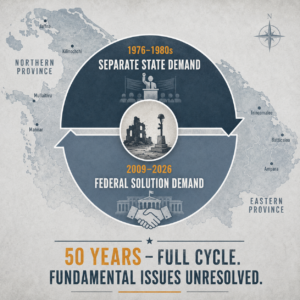
For more than three decades, the political discourse concerning Sri Lanka’s Tamil population has remained largely confined to constitutional reform, devolution, and the implementation of the 13th Amendment. From parliamentary debates to academic discussions, the issue has consistently been framed as one of power-sharing within a unitary state.
Yet, despite repeated negotiations, commissions, and political assurances, the lived reality in the Northern and Eastern Provinces remains largely unchanged. These regions continue to face economic stagnation, persistent youth migration, weak private sector activity, and underutilised strategic assets.
This raises a fundamental and often overlooked question: can political dignity be sustained without economic power?
The 13th Amendment: Promise Without Delivery
The 13th Amendment, introduced following the Indo-Lanka Accord of 1987, remains the only constitutional framework available for devolution in Sri Lanka. It established Provincial Councils with the intention of decentralising power and addressing minority grievances. However, more than three decades later, the Amendment remains only partially realised.
Provincial Councils operate with limited fiscal authority, while key powers continue to be retained at the centre. Decision-making remains heavily concentrated in Colombo, and institutional weaknesses have reduced effectiveness.
As a result, the 13th Amendment today represents a framework that is politically significant, but operationally constrained.
The Missing Dimension: Economic Power and Regional Capacity
The broader debate has overlooked the absence of economic agency in the North and East. Economic activity is largely limited to agriculture, fisheries, and public sector employment, with minimal industry or export-oriented production.
Youth outmigration continues to weaken long-term development, while fragmented donor-driven initiatives have failed to create sustainable economic ecosystems.
To make devolution meaningful, it must extend into economic empowerment through regional investment zones, improved institutional capacity, and investor-friendly systems.
The Tamil diaspora represents a major untapped resource, offering capital, expertise, and global networks. Structured and transparent investment platforms are essential to harness this potential.
From Regional Margins to National Opportunity. The development of the Northern and Eastern Provinces must be recognised as a national economic opportunity. Jaffna, KKS, and Trincomalee offer strong potential in aviation, logistics, energy, and industry. Investing in these regions can increase national GDP, reduce disparities, and strengthen economic resilience.
Sri Lanka’s post-war experience shows that political solutions alone are insufficient. Economic development must be integrated with political inclusion.
The future lies in moving from dependency to productivity and aligning political frameworks with economic empowerment to achieve sus