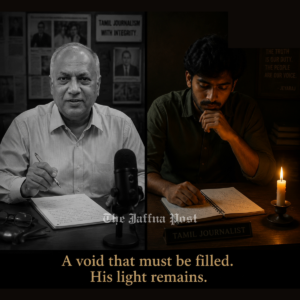
Thileepan (Rasaiah Parthipan), who believed in armed struggle and was ready to lay down his life at any moment, is commemorated specifically because he sacrificed his life through a non-violent hunger strike. That stands as an irony in his political life.
Thileepan, who served as the Jaffna regional political head of the Liberation Tigers of Tamil Eelam (LTTE), began his hunger strike in front of the Nallur Kandaswamy Temple on September 15, 1987, about a month and a half after the signing of the Indo-Lanka Accord, putting forward five demands directly to the Indian government.
Steadfastly pursuing his protest without taking even a drop of water, Thileepan passed away on the eleventh day (September 26) as his demands remained unfulfilled. The moral struggle launched by this armed fighter and his sacrifice have attained a deeply emotional significance among the Tamil people. Annual commemoration events take place at the Thileepan memorial situated in Nallur.
The developments following this year’s commemoration events have created a tense atmosphere in the Tamil regions. Amidst the events held at the memorial site between September 15 and September 26, a bust of Thileepan was brought and placed there.
On the morning after the conclusion of the commemoration, September 27, Jaffna police removed Thileepan’s statue from the site. Protests have been taking place condemning this action and demanding that the statue be brought back and reinstalled at that location.
The removal of Thileepan’s statue has sparked intense debate and controversy across the Tamil political spectrum, particularly between the Ilankai Tamil Arasu Katchi (ITAK) and the Tamil National People’s Front (TNPF). Since the arguments and accusations put forward by both sides to justify their respective stances and actions do not contribute to any healthy discourse among the Tamil people, this column avoids analyzing them. Instead, it seeks to focus on certain key issues that the Tamil people ought to understand from the events following the removal of the statue.
In the modern political history of Sri Lanka, the Tamil people’s struggle for political rights has a long and complex history—transitioning from democratic avenues to armed struggle and culminating in devastating destruction through a civil war. This history, along with the memories intertwined with the Tamil people, must be approached critically and soberly with their future in mind, rather than purely on the basis of emotion.
In post-independence Sri Lanka, peaceful struggles (satyagraha, agreements, and parliamentary democratic methods) spearheaded by moderate Tamil political leaders were repeatedly thwarted. As a consequence of this and the racist violence and discriminatory policies unleashed against the Tamil people, Tamil youth lost faith in democratic means.
In the late 1970s, armed militant movements began to emerge with the mindset that violent struggle was the only way to secure the political rights of the Tamil people. Following Black July in 1983, the number of such movements increased significantly.
Sri Lankan governments and Southern Sri Lankan society categorized this armed struggle as “terrorism” threatening the country’s sovereignty and national security. As a result, the conflict between the state and the armed movements escalated into a three-decade-long war. The armed struggle remains a tragic chapter in the Tamil people’s fight for political rights.
In this war, tens of thousands of young men and women sacrificed their lives. Every single one of them was a child belonging to some family. Therefore, commemorating them is an unavoidable human duty and a source of psychological solace for the Tamil people.

Although there are various critiques regarding the ideologies and actions of the Tamil militant movements, the right to remember lost loved ones who participated in these struggles is globally recognized as a fundamental human right.
However, the contrasting perspectives on commemoration that exist between the communities on both sides of the ethnic divide remain a major challenge in Sri Lankan politics.
While Tamil society views these militants as martyrs who gave their lives for their rights and security, Southern Sri Lankan society views them as terrorists who attempted to disrupt the country’s territorial integrity.
While Tamil society regards commemoration as a way to share losses and express collective grief, Southern Sri Lankan society views it as an effort to revive the armed struggle and glorify those they perceive as terrorists. This divergence in perspective continues to be a formidable obstacle to achieving genuine reconciliation in post-war Sri Lanka.
Allowing the commemoration of the dead without hindrance by the government and law enforcement authorities would demonstrate respect for the sentiments of the war-affected Tamil people.
Although the war has been brought to an end, the government and Southern society must soberly realize that the root political issues and rights-based demands that sparked the conflict remain unresolved. Yet, even after more than 17 years since the end of the war, signs of such a realization.
In short, while the trajectory and violence of the armed struggle can be evaluated from various political and historical perspectives, the right of the Tamil people to commemorate their deceased loved ones is a human need that transcends politics. Real mutual trust and lasting peace in Sri Lanka can only be built by understanding and respecting this right.
However, commemoration alone will never bring political emancipation or a complete political solution to the Tamil people. Commemoration is merely a ‘tool’ to keep a community’s history of struggle and thirst for justice alive; it is neither the ultimate goal nor the political outcome itself.
Just as remembering past losses is important, defining political goals for the future is equally vital. Tamils must show the same importance they give to emotional events toward formulating practical strategies suited to the contemporary domestic and international environment.
Beyond the politics of commemoration, Tamils must focus on moving toward their advancement. A society that remains submerged solely in past memories may cherish history, but it cannot create a new one.
The right of the people to remember the dead is a fundamental human right. However, it is essential that the overall political struggle of the Tamils does not remain confined merely within identity politics centered on commemoration, but is instead linked with practical, policy-driven political maneuvers.
In this post-war era, leaders of Tamil political parties lack the political maturity and wisdom required to advance the Tamil people’s struggle for political rights to the next stage by adapting to new circumstances and drawing lessons from past struggles. Instead, they focus on keeping the Tamil people bound solely to the memories of past sacrifices and destruction, attempting to mask their own incompetence.
The protests taking place in the North and East following the removal of Thileepan’s statue, alongside the mutual accusations among Tamil political parties, reflect the deep structural crises in current Tamil politics.
Tamil political parties, which failed to provide decisive political guidance to the Tamil people after the end of the war, have turned commemoration events into their primary political agenda and a tool to emotionally manipulate voters for electoral gains. These parties do not seem to realize that their actions trivialize the very sacrifice of Thileepan, whom they claim to honor.
Due to the egoistic rivalry among the leaders of Tamil political parties, a leadership vacuum has emerged. As a result, an exceedingly regrettable situation has arisen where persons who returned from abroad with earned money to start profit-making businesses in the North and East, and individuals with an unbalanced mindset, project themselves as the voice of the Tamil people.
The controversy that erupted following the removal of Thileepan’s statue will not make any positive contribution to the political or social advancement of Tamils. The sanctity and purity of the act of remembrance have been reduced to a mere political drama. Such empty controversies and emotional outbursts will bring no benefit whatsoever to the next phase of the Tamils’ political movement or the improvement of their livelihoods.
This remains a futile effort that keeps the Tamil society trapped in past emotions, diverting them from the systematic path of struggle for present-day rights. Such emotional controversies are pushed to the forefront merely to mask the leadership vacuum and the absence of genuine, people-centric policies and action plans. This highlights the present political impoverishment of the Tamils.
If the political resistance of Tamils shrinks to being solely centered around remembrance and symbolic politics, there is a danger that crucial political goals will be pushed to the background, making the retrieval of the right to remember, the only remaining politics.